
 Written By :
 ChatGPT
 Perplexity
 Claude
 Gemini
PropTech, short for property technology, is the use of software, data, automation, connected devices, and digital platforms to improve how real estate is discovered, financed, developed, bought, sold, leased, managed, and operated.
The term covers much more than property listing websites. Modern PropTech includes artificial intelligence, property management software, smart-building systems, digital twins, construction platforms, analytics tools, transaction software, and connected devices. MIT describes property technology as a broad spectrum of digital tools changing how real estate is designed, managed, transacted, and experienced.
For real estate companies, the important question is no longer simply what PropTech means. It is where the technology solves a real business problem and where adding another tool only creates more complexity.
TL;DR: Key Takeaways
- PropTech applies digital technology across nearly the entire real estate lifecycle, from property search and construction to transactions, property management, and smart-building operations.
- Major categories include AI and analytics, property management platforms, marketplaces, transaction technology, ConTech, digital twins, IoT, and real estate automation.
- A strong PropTech strategy starts with a business problem and measurable outcome rather than adopting technology simply because it is new.
What Is PropTech?
PropTech means property technology. It refers to digital products and systems created to improve processes throughout the real estate industry.
A PropTech solution might help a buyer find a home, allow a property manager to automate rent collection, give an investor better market data, help a construction team coordinate a project, or use sensors to monitor how a building is operating.
That makes PropTech an umbrella rather than one specific type of software.
Is PropTech the same as real estate technology?
The terms are often used interchangeably.
Real estate technology is the broader descriptive phrase for technology used within real estate. PropTech has developed into an industry term that can also describe the companies, software platforms, startups, investment activity, and technology ecosystem serving property-related businesses.
- ConTech focuses primarily on construction technology.
- Real estate fintech focuses on payments, lending, financing, and financial transactions.
- Smart-building technology connects physical building systems with software, sensors, and automation.
- AI real estate technology applies artificial intelligence to analytics, search, communication, document processing, and workflow automation.
Where Does PropTech Fit Into the Real Estate Lifecycle?
PropTech can influence almost every stage of real estate, including property discovery, evaluation, financing, construction, transactions, property management, building operations, and portfolio management.
What Are the Main Types of PropTech Software?
1. AI and real estate data analytics
AI and analytics tools can organize and interpret property, transaction, market, customer, maintenance, building, and financial data.
2. Property management platforms
Property management platforms can bring leasing, payments, maintenance, accounting, tenant communication, reporting, and recurring operational tasks into a shared system.
3. Property marketplaces and search platforms
Property marketplaces help consumers discover properties, compare listings, review information, and increasingly move further into the transaction journey.
4. Construction technology and project management
Construction technology can support project planning, budgeting, scheduling, documentation, design coordination, and field communication.
5. Digital twins and 3D property technology
Digital twins create digital representations of physical spaces and can support property marketing, documentation, planning, facilities management, and other workflows.
6. Smart buildings and IoT
Connected devices can support access control, environmental monitoring, energy management, leak detection, equipment monitoring, and other building functions.
7. Real estate transaction technology
Transaction technology can digitize electronic signatures, document management, approvals, workflow tracking, and other transaction processes.
8. Real estate CRM and marketing technology
CRM and marketing technology can support lead capture, follow-up, segmentation, appointment scheduling, communication, attribution, and reporting.
For companies dealing with disconnected systems and repetitive handoffs, properly designed AI automation services can help connect workflows rather than simply adding another standalone application.
Examples of PropTech Companies and Real Estate Technology Platforms
| Company/platform | Main PropTech area | Typical use |
|---|---|---|
| Zillow | Residential property platform | Property search and consumer housing journey |
| Buildium | Property management | Leasing, payments, accounting and operations |
| CoStar | Commercial real estate data | Property information, research and analytics |
| Matterport | Digital twins and 3D technology | Property visualization and documentation |
| Procore | Construction technology | Construction project management |
| DocuSign | Transaction technology | Electronic signatures and agreement workflows |
| SmartRent | Smart-property technology | Connected devices and property automation |
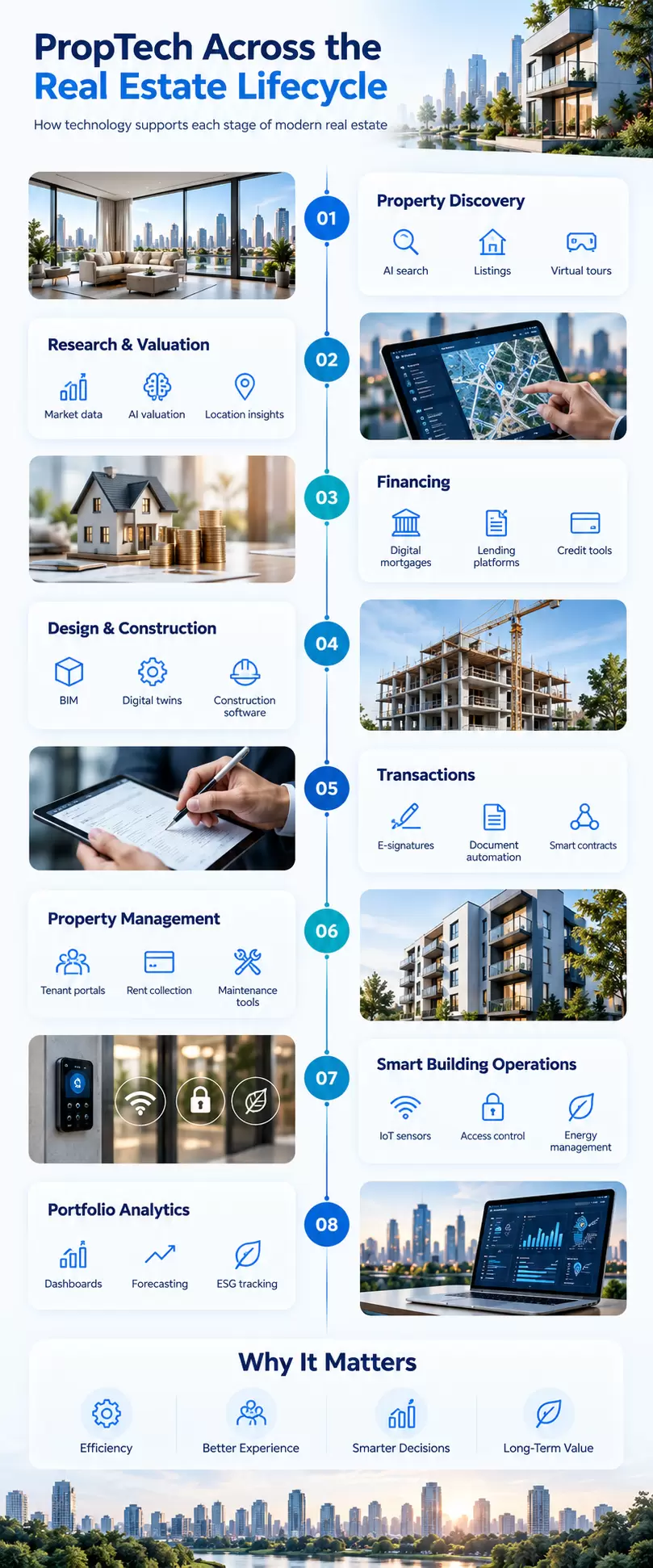
Why Is PropTech Important to the Real Estate Industry?
PropTech can reduce repetitive work, make business information easier to use, improve customer and tenant experiences, and connect physical properties with digital operations.
What Are the Biggest Challenges With PropTech Adoption?
Too many disconnected platforms
Adding software without considering how information moves between systems can create another technology silo.
Poor data can limit good technology
Duplicate, outdated, incomplete, or inconsistent information can reduce the usefulness of analytics and automation.
Feature lists can distract from actual ROI
Businesses should define what measurable operational or customer outcome a new platform is expected to improve.
User adoption matters
Training, documentation, workflow ownership, and employee feedback should form part of implementation.
Privacy, security, and governance need attention
Companies should understand what information platforms collect, where data moves, who can access it, and what happens when systems are integrated.
How Should a Business Choose PropTech Software?
- Identify the business problem.
- Map the existing workflow.
- Define measurable improvements.
- Review integrations.
- Evaluate data and security requirements.
- Test the platform on a real workflow.
- Measure results before expanding.
For businesses building customer-facing digital experiences, JDG's web design and development services can support the website and connected digital foundation.
Which PropTech Trends Are Shaping 2026?
AI is becoming part of the workflow rather than a standalone tool
AI is becoming more deeply integrated into systems that interpret information, summarize records, qualify requests, support users, and trigger actions.
Real estate platforms are becoming broader ecosystems
Property platforms increasingly aim to connect more stages of the customer and operational journey.
Digital twins are extending beyond property marketing
Digital twins can support documentation, planning, facilities management, collaboration, and operational workflows.
Smart properties will generate more operational data
The opportunity is to turn building data into useful maintenance decisions, energy strategies, alerts, and operational insights.
Technology ROI will receive more scrutiny
Real estate companies will increasingly evaluate unused subscriptions, redundant platforms, broken integrations, and technology projects that do not produce measurable value.
Building a Stronger Digital Foundation for PropTech
Real estate businesses do not need every new technology. They need a digital foundation capable of supporting the technology that matters.
JDG's digital marketing services, AI automation services, and web design and development services address different parts of that foundation.
Real estate teams focused on acquisition can also use JDG's website marketing guide to connect website performance with broader marketing activity.
PropTech Is Becoming Part of How Real Estate Operates
PropTech now reaches construction, transactions, property management, building operations, analytics, marketing, financing, and customer experience.
A useful PropTech strategy begins by identifying a real operational or customer problem, selecting technology capable of solving it, integrating that technology with existing systems, and measuring whether it actually improves the business.
For real estate companies dealing with disconnected software, manual lead handling, outdated web experiences, or repetitive processes, JDG's digital services can support a more connected digital foundation.
Frequently Asked Questions
What is PropTech?
PropTech, or property technology, refers to software, digital platforms, connected devices, data systems, and other technologies used to improve how real estate is developed, marketed, bought, sold, leased, financed, managed, and operated.
What does PropTech mean in real estate?
The PropTech meaning is “property technology.” It covers technologies ranging from listing platforms and management software to AI, smart-building systems, digital twins, construction platforms, and transaction technology.
What are some common examples of PropTech?
Examples include property marketplaces, property management software, electronic signature platforms, digital twins, construction software, real estate data platforms, smart-building systems, CRM software, and automation tools.
What is PropTech software?
PropTech software is a digital application or platform designed to improve a property-related process such as management, leasing, transactions, construction, analytics, marketing, or building operations.
Is PropTech only for large real estate companies?
No. The right technology depends more on the business problem and workflow than company size.
What are the major PropTech trends in 2026?
Important trends include deeper AI integration, workflow automation, connected platforms, digital twins, smart buildings, IoT, stronger data integration, and greater focus on measurable technology ROI.
How do you choose the right real estate technology platform?
Start with the business problem, then evaluate integrations, data requirements, security, usability, implementation needs, and measurable business outcomes.

Your comment will appear after approval.