
 Written By :

 ChatGPT
 Perplexity
 Claude
 Gemini
If you want to know how to rank in ChatGPT, start by understanding what visibility means on the platform.
Unlike Google, where a website can hold a numbered organic ranking, ChatGPT can create answers using information from multiple sources. Your website might appear as a clickable citation, while your business could also be mentioned or recommended without a link.
To improve your chances, you need to make your content accessible, publish useful answers, build credible brand information, and track your visibility across relevant questions.
This guide explains the practical steps businesses can take to improve ChatGPT search visibility in 2026.
TL;DR: Key Takeaways
-
Make your website accessible. Allow OAI-SearchBot to crawl public pages you want considered for ChatGPT search, and check for technical restrictions.
-
Create content worth citing. Answer specific customer questions, explain important details clearly, and support claims with reliable evidence.
-
Build and measure your visibility. Earn genuine third-party mentions, track citations and recommendations, and review referral traffic instead of looking for a single ranking position.
What Does It Mean to Rank in ChatGPT?
Ranking in ChatGPT means improving how often and how accurately your website or business appears in relevant AI-generated answers.
There are two important types of visibility.
1. Website citations
When ChatGPT searches the web, it may include clickable links to pages that support its answer.
For example, someone asks:
"What should a small business check before hiring an SEO agency?"
ChatGPT might cite an article explaining SEO audits, pricing, deliverables, and how to evaluate a provider.
If your article becomes one of those sources, your website gains citation visibility.
2. Brand mentions and recommendations
A user might instead ask:
"Which digital marketing agencies offer SEO and website development services?"
ChatGPT may mention businesses that appear relevant to the request. A brand mention does not necessarily include a link to that company's own website.
The distinction matters because a website can receive citations without its brand being recommended, and a business can receive recommendations without earning a direct website citation.
Key Insight: There is no universal first-place position to hold across all ChatGPT conversations. A more useful goal is to appear accurately and consistently across questions that matter to your customers.
How Does ChatGPT Find Websites and Choose Sources?
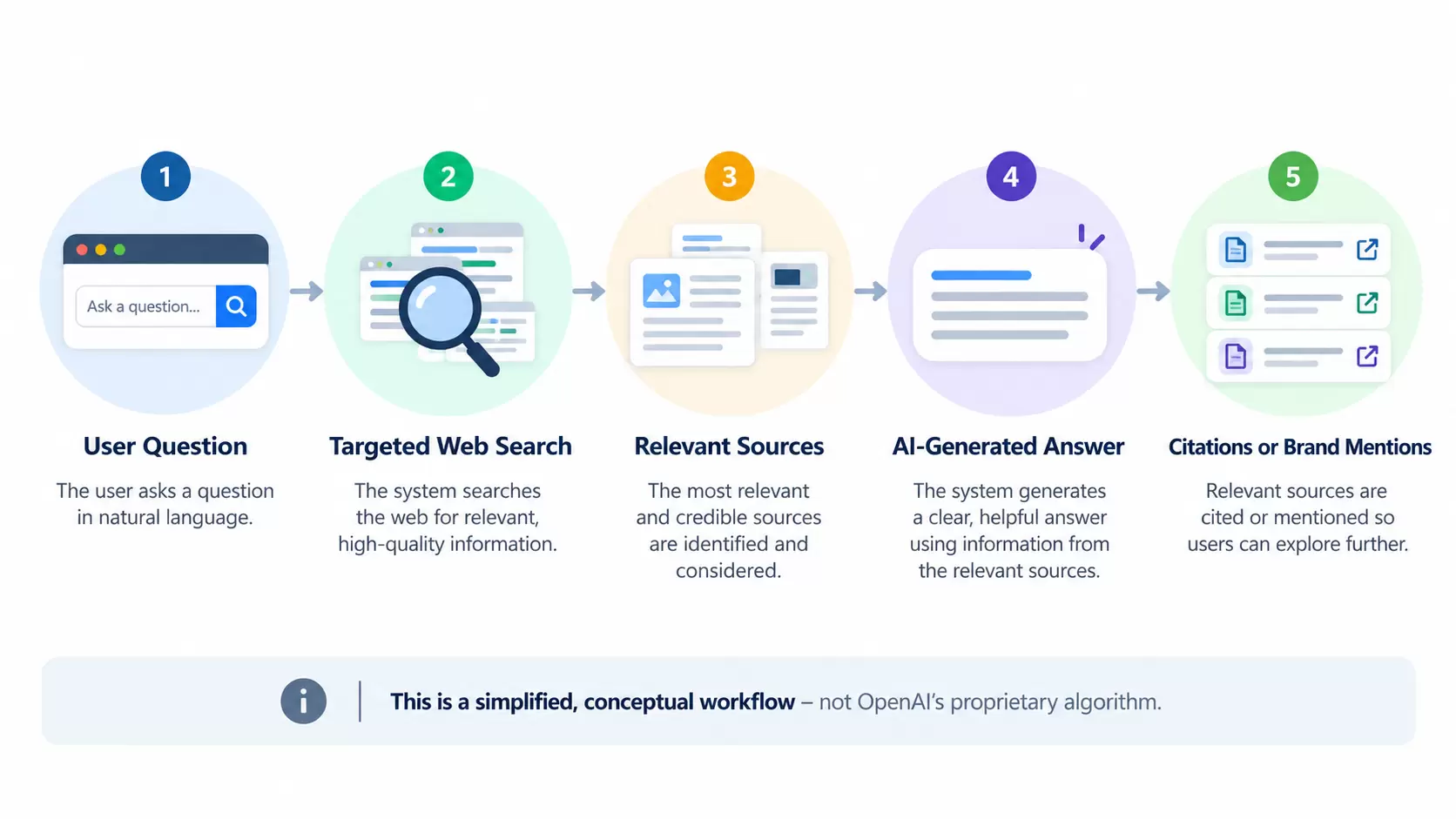
ChatGPT search can access web information to answer questions that benefit from current sources.
According to OpenAI's documentation on ChatGPT search, the system may rewrite a user's question into more targeted searches and use search providers to find relevant information.
For example, a user could ask:
"What is the best accounting software for a small company that sends international invoices?"
A search system might look for information about small-business accounting, international billing, supported currencies, and software comparisons.
It may then assemble an answer using relevant sources.
OpenAI states that search results are ranked using multiple factors intended to identify relevant, reliable information. It does not publish a complete ranking formula, and inclusion is not guaranteed.
This means effective ChatGPT search optimization should focus on three areas:
-
Discovery: Can search systems find and access your pages?
-
Answer usefulness: Does your content clearly address the question?
-
Credibility: Is the information accurate, supported, and consistent with other reliable sources?
How to Rank in ChatGPT: 9 Practical Steps
There is no single optimization trick that guarantees ChatGPT visibility. The best approach combines technical SEO, helpful content, brand credibility, and ongoing measurement.
Here is a practical sequence to follow.
1. Identify the Questions Your Customers Actually Ask
Before optimizing pages, identify the questions you want your website or business to appear for.
Traditional keyword research is a useful starting point, but conversational searches often include more context.
Compare these searches:
| Traditional search | Conversational search |
|---|---|
| SEO agency | Which SEO agency can help a small ecommerce business improve organic traffic? |
| CRM software | Which CRM tools are suitable for a small sales team with a limited budget? |
| Website development | What should a startup look for when hiring a website development company? |
| Local accountant | How do I choose an accountant for a small business in my city? |
The conversational versions reveal the user's needs, constraints, and decision criteria.
Start by collecting questions from:
-
Sales calls and customer emails
-
Google Search Console queries
-
Google search suggestions and related questions
-
Relevant competitor content
-
Customer support conversations
-
Ahrefs keyword research and AI visibility tools
Separate your questions into informational, comparison, and purchase-intent groups.
For example, a business offering SEO services might target questions about SEO audit costs, technical SEO problems, how agencies measure results, and how to choose an SEO provider.
Create a list of 15 to 25 important questions. Keep them as a baseline for future testing.
For businesses that need a wider content plan, a structured SEO content strategy can help connect customer questions with the right pages.
2. Make Sure OAI-SearchBot Can Access Your Website
Even excellent content has limited opportunity to appear in ChatGPT search if the system cannot access it.
OpenAI identifies OAI-SearchBot as the crawler used to surface websites in its search features.
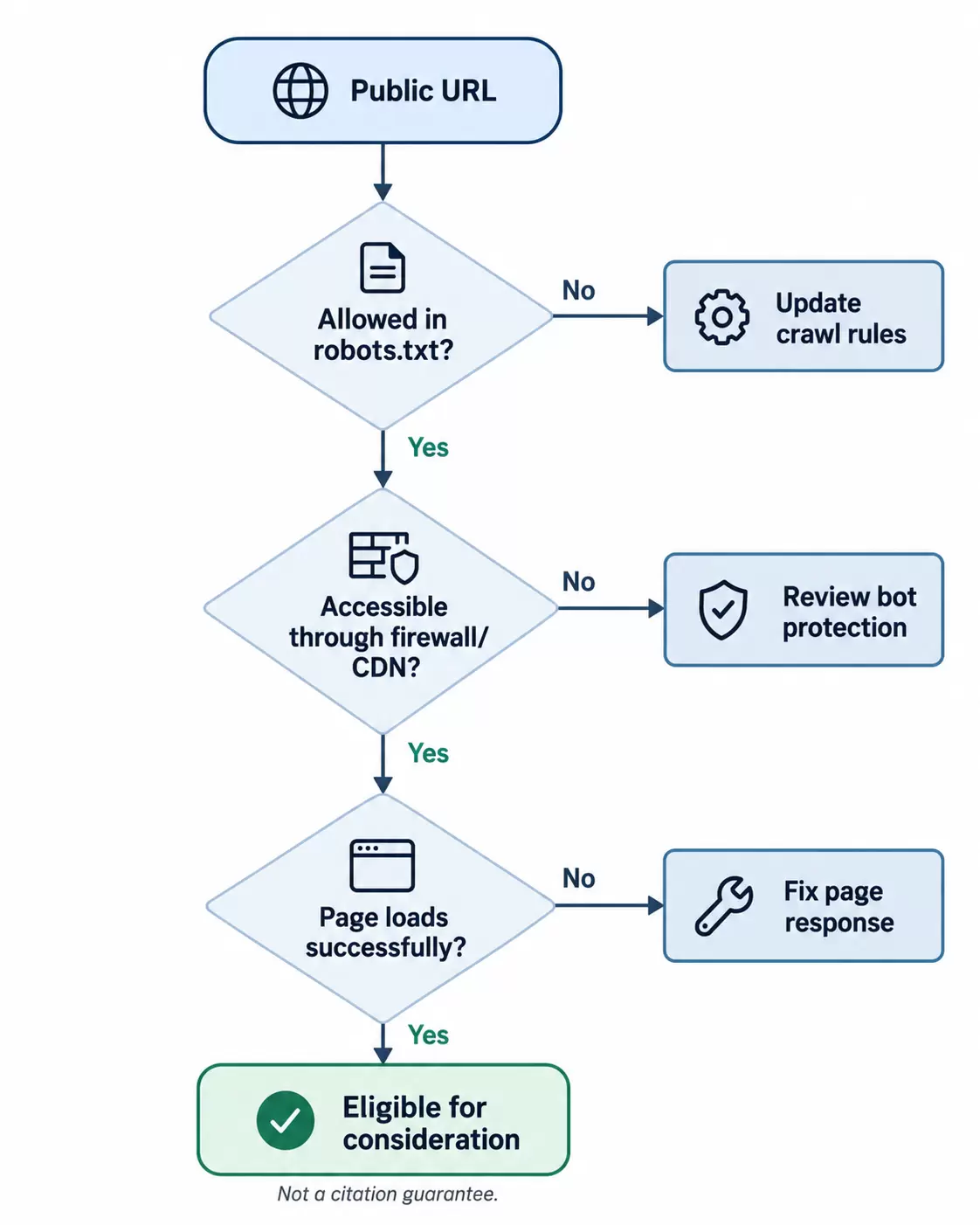
To improve eligibility:
-
Open your website's
robots.txtfile, usually available atyourdomain.com/robots.txt. -
Check that OAI-SearchBot is not blocked from public pages you want to appear in search.
-
Check for accidental
noindexdirectives and other access restrictions. -
Make sure important pages return successful HTTP responses rather than errors such as
403or404. -
Review firewall, CDN, and bot-protection settings. Confirm they permit legitimate requests from OpenAI's published searchbot IP ranges.
-
Check server logs where available to identify blocked or failed crawler requests.
Different OpenAI bots serve different purposes:
| Crawler | Primary purpose | What website owners should know |
|---|---|---|
| OAI-SearchBot | ChatGPT search discovery | Allow access to public content intended for search visibility |
| GPTBot | Potential model-training data collection | Training controls are separate from search eligibility |
| ChatGPT-User | Certain user-initiated page visits | Not the crawler used to determine automatic ChatGPT search inclusion |
You can allow OAI-SearchBot while blocking GPTBot if that matches your website's training-data policy.
OpenAI also notes that changes to its robots.txt handling can take approximately 24 hours to be reflected. That does not mean your website will earn a citation within 24 hours.
Refer to the official OpenAI crawler documentation before changing your robots rules.
3. Strengthen Your Existing Search Engine Visibility
ChatGPT search optimization should not replace traditional SEO.
A technically healthy website is easier for search systems to discover, understand, and evaluate.
Start with basic improvements:
-
Make important pages accessible and indexable.
-
Use descriptive page titles and clear headings.
-
Fix broken internal links and unnecessary redirect chains.
-
Keep XML sitemaps accurate.
-
Use appropriate canonical tags to manage duplicate URLs.
-
Make important content available in crawlable HTML.
-
Improve mobile usability and page performance.
Pay attention to Bing as well as Google.
ChatGPT can use external search providers, and Microsoft's Bing is among the providers documented by OpenAI. However, Bing indexing alone does not guarantee inclusion, and it should not be treated as an absolute prerequisite for every possible citation.
Use Bing Webmaster Tools to inspect important URLs, monitor indexing issues, and submit your sitemap.
Bing also recommends IndexNow to notify participating search engines when URLs are added, updated, or removed.
These steps support discovery. They do not buy or guarantee a place in ChatGPT answers.
If your technical foundation needs improvement, start with established professional SEO practices before investing in more specialized AI search tactics.
4. Write Clear Answers That AI Search Can Understand
This is one of the most practical changes you can make to your existing content.
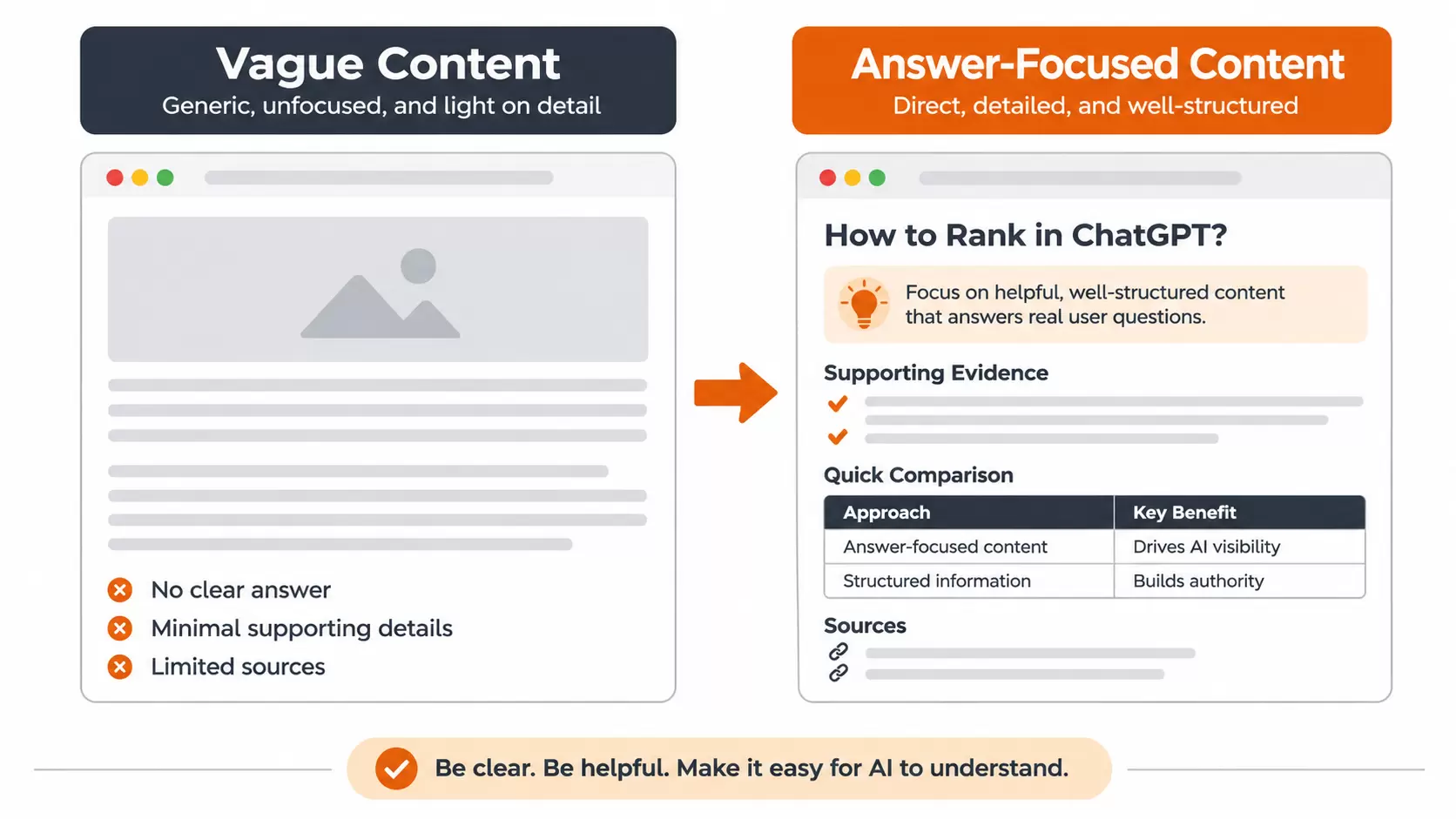
Pages should answer the reader's main question without forcing them to read several paragraphs of marketing copy first.
Consider a blog about ecommerce website costs.
Weak opening:
"Our company provides innovative ecommerce solutions designed to transform businesses and accelerate digital growth."
That statement says very little about the cost question.
Better opening:
"The cost of an ecommerce website depends on its design, platform, product catalog, integrations, and ongoing maintenance. A useful estimate should separate one-time development costs from recurring software, hosting, and support expenses."
The second version directly explains what determines the answer.
To make content easier to understand and reference:
-
Answer the main question near the beginning.
-
Use descriptive headings for important subtopics.
-
Keep explanations focused on one idea at a time.
-
Include accurate examples, comparisons, and limitations.
-
Explain prices, dates, or requirements when they matter.
-
Use tables when users need to compare options.
-
Link to relevant supporting sources.
A concise answer paragraph can help readers and retrieval systems understand a section quickly, but there is no officially required word count for ChatGPT citations.
Example: A software comparison page should not simply say that one tool is better. It should explain the relevant features, suitable users, pricing conditions, limitations, and the date those details were checked. That gives a potential buyer useful information rather than an unsupported recommendation.
5. Support Your Content With Credible Evidence
Publishing a direct answer is useful. Giving readers a reason to trust that answer makes it stronger.
Review your most important pages and ask:
-
Who wrote or reviewed this information?
-
Where do the factual claims come from?
-
Are prices, specifications, and dates current?
-
Does the article distinguish established facts from opinions?
-
Is the information original, or does it repeat what every competitor says?
Add genuinely useful supporting material when available.
This might include product documentation, transparent methodology, original survey findings, photographs, screenshots, documented processes, or properly attributed expert commentary.
For example, a website comparing business software could explain the criteria it used, the date of its review, and which features were independently verified.
Don't invent test results, statistics, client outcomes, or expertise. Unsupported claims weaken the usefulness and reliability of a page.
Existing articles can often be improved through focused SEO content optimization, provided every revision adds accuracy or value rather than simply increasing word count.
6. Make Your Business Information Consistent and Use Accurate Structured Data
ChatGPT may be asked about businesses, products, services, people, and locations. Your public information should make those relationships clear.
Review the basic information across your website and relevant third-party profiles.
Check that your business name, services, locations, contact details, product descriptions, and other important facts are accurate and consistent.
For local businesses, opening hours, service areas, addresses, and contact information are especially important.
Structured data can help describe your content.
Depending on the page, relevant schema.org types may include:
-
Organizationfor business identity -
LocalBusinessfor applicable physical businesses -
Servicefor described services -
ArticleorBlogPostingfor editorial content
Use only markup that accurately represents the visible page and its real-world entities.
Google's structured data documentation explains how explicit markup helps search engines understand page information.
However, OpenAI has not published a rule saying that adding schema markup guarantees a ChatGPT citation or higher placement. Treat it as part of sound website architecture, not a ranking shortcut.
7. Build Topic Clusters Around Your Core Expertise
A single article cannot answer every question a potential customer might ask.
Suppose your company offers ecommerce development.
A useful content cluster could include:
-
How much does an ecommerce website cost?
-
Shopify vs. WooCommerce: Which platform fits your business?
-
What features should an ecommerce website include?
-
How do payment and inventory integrations work?
-
What affects ecommerce website maintenance costs?
Each article answers a distinct question and links to closely related resources.
A clear cluster helps readers move from basic research toward detailed comparisons and informed decisions.
It also creates a better-organized website with stronger internal relationships between topics.
This is why building topical authority through connected content is more useful than publishing a large number of overlapping articles with minor keyword changes.
Focus on coverage, relevance, and original value rather than page count.
8. Earn Genuine Brand Mentions Beyond Your Website
Your website is not the only source of information about your business.
People also discover brands through review platforms, industry publications, independent comparisons, news coverage, and relevant professional communities.
These sources can influence what information is available about your brand when AI systems research a topic.
An Ahrefs analysis examined 75,000 brands and reported correlations between ChatGPT visibility and factors including YouTube mentions and branded web mentions.
These are observed relationships, not proof that creating mentions will directly cause ChatGPT to recommend a business.
Research Snapshot: Ahrefs' research suggests that off-site brand presence deserves attention alongside website optimization. It does not establish a universal ranking formula or guarantee that a specific mention will generate a citation.
Practical ways to strengthen your public brand presence include:
-
Maintain accurate profiles on relevant business and review platforms.
-
Earn editorial coverage through useful industry insights or original research.
-
Participate in professional communities when you can contribute a real answer.
-
Seek honest customer reviews through appropriate channels.
-
Build relationships with publications that genuinely cover your market.
-
Make sure existing third-party descriptions of your business are accurate.
A thoughtful digital PR strategy can support this work by creating opportunities for legitimate mentions and editorial links.
Avoid buying fake reviews, manufacturing recommendations, or placing promotional content in communities without disclosure.
These tactics can damage trust rather than build it.
9. Measure ChatGPT Visibility, Not Just Traditional Rankings
Knowing how to rank in ChatGPT answers is only part of the process. You also need to know whether your visibility is improving.
Start with the prompt list you created in Step 1.
Test those questions at regular intervals and record what happens.
Use the same prompt wording, intended market, and testing method where possible. Record relevant differences in date, location, search mode, or personalization.
Keep in mind that AI-generated answers can vary between runs. A single response is not a reliable measure of a brand's overall visibility.
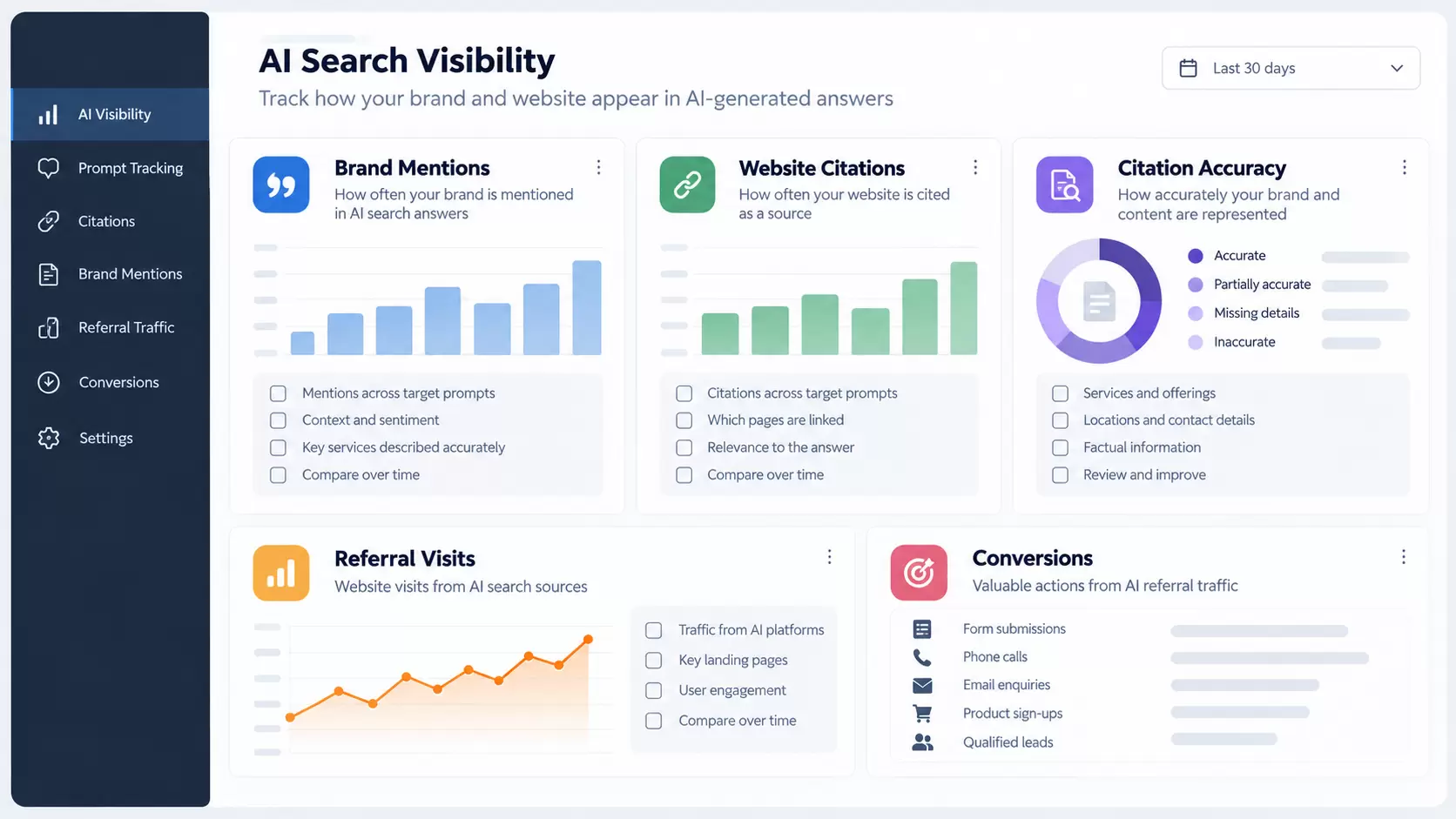
Track these metrics:
| Metric | What to measure |
|---|---|
| Brand mention coverage | Percentage of tested prompts that mention your brand |
| Website citation coverage | Percentage of tested prompts that cite your domain |
| Citation relevance | Whether your cited page actually supports the answer |
| Brand description accuracy | Whether services, locations, capabilities, and other details are correct |
| ChatGPT referral traffic | Website visits attributable to ChatGPT links |
| Leads and conversions | Useful business actions from identifiable referral visits |
You can calculate citation coverage as:
Citation coverage = (Prompts citing your domain ÷ Total prompts tested) × 100
For website traffic, use GA4 to inspect identifiable ChatGPT referrals, including chatgpt.com referral information and campaign parameters where available.
Do not assume every mention or citation generates a website visit. Google Search Console measures Google Search performance, not ChatGPT citation impressions.
Specialized AI visibility platforms can help with repeated prompt testing and citation monitoring, but reported metrics may differ by tool and methodology.
A 30-Day ChatGPT Search Optimization Plan
You do not need to overhaul your entire website at once.
Start with the pages that matter most to your customers, then expand based on what you discover.
| Timeline | Main focus | Actions |
|---|---|---|
| Week 1 | Research and technical review | Identify priority prompts, record baseline visibility, check OAI-SearchBot access, and review indexing. |
| Week 2 | Content improvements | Rewrite weak opening answers, improve headings, verify claims, and update important service pages and articles. |
| Week 3 | Authority and topical coverage | Strengthen internal links, publish one genuinely useful supporting resource, and identify relevant third-party mention opportunities. |
| Week 4 | Measurement and refinement | Repeat prompt testing, review citations and brand descriptions, check referral traffic, and prioritize the next improvements. |
This is an implementation schedule, not a promise that your business will appear in ChatGPT within 30 days.
The speed of discovery and inclusion depends on many factors outside your control.
Common ChatGPT SEO Mistakes to Avoid
Even websites with useful content can waste time on the wrong priorities.
Treating ChatGPT like a fixed Google ranking
There is no universal position that applies across all prompts, users, and conversations. Optimize for relevant visibility rather than chasing a single number.
Blocking the search crawler
Blocking OAI-SearchBot can prevent eligible pages from being surfaced in ChatGPT search answers. Check the crawler settings before investing heavily in content changes.
Producing hundreds of similar AI-written pages
Publishing repetitive content for every slight keyword variation rarely helps readers. Use one strong page for closely related intent and create separate resources when the questions genuinely differ.
Adding schema and expecting immediate citations
Accurate structured data can clarify page information, but no published evidence establishes it as an automatic ChatGPT ranking boost.
Ignoring independent information about your business
If your website says one thing while external profiles say another, customers and AI systems may encounter conflicting information. Correct important inconsistencies at their source.
Confusing paid ChatGPT advertising with organic visibility
Advertising is separate from organic ChatGPT answers. OpenAI states that advertisers cannot pay to influence the answers ChatGPT generates.
If you are exploring the paid channel, our ChatGPT advertising guide covers that topic separately.
Can Small and Local Businesses Appear in ChatGPT Answers?
Yes. A large national brand is not the only type of business that can appear in AI-generated answers.
For local businesses, relevance often depends on specific customer needs, location, services, and other available context.
Consider a question such as:
"Which website development agencies work with small businesses in my city?"
A business can make its public information more useful by clearly explaining where it operates, which services it provides, who those services suit, and how customers can contact it.
Accurate local listings, relevant service pages, genuine reviews, and independent local mentions can also help people discover and evaluate the business.
OpenAI's search documentation confirms that location information can affect relevant local results.
However, there is no guarantee that a particular local company will be mentioned or recommended.
How Long Does It Take to Rank in ChatGPT?
There is no reliable universal timeline for earning ChatGPT citations or recommendations.
Crawler-rule changes, page discovery, indexing, content selection, and generated answers are different stages.
OpenAI indicates that changes to robots.txt crawler preferences may take about 24 hours to be reflected. That is not a timeframe for ranking or citations.
Content improvements and legitimate brand-building work may require ongoing evaluation. In some cases, a page may be accessible but never selected for the prompts you test.
The practical approach is to monitor your results regularly, improve weak pages, and avoid promises of instant placement.
Build a Website Worth Finding and Citing
If you're trying to improve ChatGPT visibility, start with the fundamentals: accessible pages, clear answers, credible information, and a consistent business presence.
Then test the customer questions that matter most.
Just Digital Gurus helps businesses approach this through ChatGPT SEO services that connect content structure, technical readiness, brand authority, and AI visibility strategy. If you want to assess where your website currently stands, contact Just Digital Gurus to discuss an AI search visibility review and the improvements worth prioritizing.
Frequently Asked Questions
1. Can you rank #1 in ChatGPT?
ChatGPT does not provide one fixed organic ranking position across all conversations. Search results and generated answers can vary by question, context, and other factors. Focus on relevant citations, accurate brand mentions, and qualified traffic instead.
2. How do I rank in ChatGPT search results?
Start by allowing OAI-SearchBot to access the public pages you want considered for search. Then improve technical SEO, publish content that answers relevant questions, verify factual claims, and build credible independent brand mentions. None of these steps guarantees inclusion.
3. How can I rank higher in ChatGPT answers?
Improve how well your information matches specific user needs, how clearly it answers questions, and how reliably it is supported. Measure appearance across a consistent group of prompts rather than assuming there is a universal position to move higher in.
4. Do I need to rank on Bing to appear in ChatGPT?
Bing visibility can support discovery because ChatGPT uses external search providers, including Microsoft. However, Bing rankings are not a guaranteed predictor of ChatGPT citations, and OpenAI has not stated that a particular Bing position is required for every answer.
5. Can I block GPTBot and still appear in ChatGPT search?
Yes. OpenAI documents separate crawler controls for search and model training. A website can allow OAI-SearchBot while disallowing GPTBot. Those settings serve different purposes.
6. Does schema markup help websites rank in ChatGPT?
Accurate schema markup helps describe business and page information in a machine-readable format. It is useful for website clarity and traditional search, but OpenAI has not identified a guaranteed citation benefit from adding any specific schema type.
7. How can I check whether ChatGPT mentions my website?
Create a list of relevant prompts and test them consistently over time. Record brand mentions, website citations, which pages are linked, and whether the information is accurate. You can also inspect identifiable ChatGPT referral visits and conversions in your analytics platform.

Your comment will appear after approval.