
 Written By :

 ChatGPT
 Perplexity
 Claude
 Gemini
Shopify vs Etsy is a common decision for anyone planning to sell products online. Both platforms help you reach customers, but they work differently. Etsy is an established marketplace where shoppers discover products from independent sellers. Shopify lets you create a branded online store and develop your own customer acquisition channels.
Etsy can be attractive for handmade and creative products, while Shopify offers more flexibility for businesses planning to build an independent ecommerce brand.
But which platform actually costs less? And which is better for SEO, marketing, and long-term growth?
This comparison covers Shopify vs Etsy fees in 2026, including a $100 sale example, the features that matter most, and how to choose the right option for your business.
TL;DR: Key Takeaways
-
Choose Etsy if you sell eligible handmade, designed, vintage, or creative products and want access to an established marketplace.
-
Choose Shopify if you want an independent branded store, more control over SEO and marketing, and greater flexibility over your customer experience.
-
Consider both if your products qualify for Etsy and you can manage the costs, inventory, and customer service of two sales channels.
Shopify vs Etsy: Quick Comparison
The biggest difference is where your business operates. Etsy hosts your shop within its marketplace, while Shopify provides the tools to operate your own branded storefront.
| Feature | Shopify | Etsy |
|---|---|---|
| Platform type | Hosted ecommerce platform | Online marketplace |
| Starting cost | Paid subscription | No standard monthly seller subscription; listing and other fees apply |
| U.S. starting plan | Basic: $29/month billed yearly, or $39 monthly | $0.20 per listing; possible shop setup fee |
| Selling fees | Payment processing and possible third-party transaction fees | Listing, transaction, payment processing, and possible advertising fees |
| Built-in marketplace audience | No comparable built-in marketplace for your individual store | Yes |
| Website customization | Extensive theme and storefront options | Limited to Etsy shop features |
| Custom domain | Supported | Etsy shop URL within the marketplace |
| SEO control | Greater control over your store's website SEO | Primarily Etsy search and listing optimization |
| Marketing | SEO, email, social, ads, apps, and other channels | Etsy Ads, Offsite Ads, and external promotion |
| Product eligibility | Broad catalog options, subject to Shopify rules and applicable law | Must satisfy Etsy's Creativity Standards |
| Best for | Independent brands and growing ecommerce operations | Eligible creative and marketplace-focused sellers |
Pricing reflects published U.S. rates checked in October 2026. Exact fees and available features depend on location, plan, and payment setup.
Key Insight: Etsy can help you reach shoppers who are already browsing a marketplace. Shopify gives you more control over the shopping experience, but attracting visitors becomes a central part of your business strategy.
What Is Shopify, and Who Should Use It?
Shopify is a hosted ecommerce platform that lets businesses create an online store, list products, process payments, manage inventory, and handle orders from one system.
You can choose a theme, connect a custom domain, create product collections, publish content, and add functionality through apps and integrations. Shopify handles the core hosting and commerce infrastructure, while you manage your store and brand within the platform.
Shopify is especially useful for businesses that want to:
-
Build a recognizable ecommerce brand.
-
Sell products outside a niche creative marketplace.
-
Create customized product and collection pages.
-
Invest in organic search, social media, and advertising.
-
Develop direct customer relationships and repeat purchases.
-
Expand their catalog or sales channels over time.
The trade-off is that opening a Shopify store does not automatically bring shoppers to it.
Store design, traffic acquisition, product positioning, and customer experience all require attention.
If you're planning a new store, JDG's ecommerce website development process explains the stages from platform selection to launch.
What Is Etsy, and Who Is It Best For?
Etsy is an online marketplace where independent sellers list products for people searching for distinctive, creative, and personalized goods.
A shopper might search Etsy for custom wedding invitations, handmade pottery, vintage home decor, personalized jewelry, or downloadable artwork.
Instead of visiting each seller's independent website, shoppers can browse products from multiple sellers within Etsy.
That provides an opportunity for marketplace discovery, but it also means sellers compete with other shops on the same platform.
Etsy's Creativity Standards organize eligible products into four categories:
-
Made by a seller: Products the seller personally creates or produces.
-
Designed by a seller: Original designs, including eligible digital downloads and items produced by disclosed production partners.
-
Handpicked by a seller: Eligible vintage or specially curated products.
-
Sourced by a seller: Qualifying craft, party, or buyer-personalized supplies.
Not everything sold online qualifies for Etsy. Reselling ordinary mass-produced goods is generally prohibited unless the products fall within specific exceptions.
For that reason, product eligibility should be the first question—not the last—when deciding between these platforms.
Shopify vs Etsy Fees in 2026: Which Costs Less?
When comparing Shopify vs Etsy fees, it's easy to focus only on monthly subscriptions or transaction percentages.
But the platforms have different pricing models.
Shopify combines a recurring subscription with payment-related and optional operating costs. Etsy charges primarily through listing, transaction, payment processing, and applicable advertising fees.
Shopify fees explained
According to Shopify's U.S. pricing page, the Basic plan currently costs:
-
$29 per month when billed yearly.
-
$39 per month when billed monthly.
-
Online standard card processing rates starting at 2.9% + $0.30 for Shopify Payments.
-
A 2% third-party transaction fee on Basic when applicable.
Other costs may include paid apps, premium themes, a custom domain, email or advertising expenses, and professional services.
Shopify doesn't use Etsy's standard per-product listing fee model. However, having unlimited product listings doesn't mean running a Shopify store is free.
Etsy fees explained
According to Etsy's official fee documentation, important U.S. seller charges include:
-
Listing fee: $0.20 per listing.
-
Listing renewal: Listings expire after four months, and renewal charges may apply. Additional quantities sold can also create listing fees.
-
Transaction fee: 6.5% of the order amount, including charged shipping and gift wrapping.
-
U.S. payment processing: 3% + $0.25 per transaction.
-
One-time setup fee: May apply when opening a shop; the amount varies.
-
Offsite Ads: Additional fees on qualifying ad-attributed orders.
Etsy sellers may also face currency conversion, regulatory, shipping-label, or other location-specific charges.
How much do Etsy Offsite Ads cost?
Etsy's Offsite Ads program can add a meaningful expense to orders attributed to an external advertisement.
The current rules are:
-
Shops that have never reached $10,000 in Etsy sales in a consecutive 365-day period pay 15% on attributed orders and can opt out.
-
Once a shop reaches $10,000 in any consecutive 365-day period, the applicable rate becomes 12%, and participation is required for the lifetime of the shop.
-
The Offsite Ads fee is capped at $100 per order.
The fee isn't charged on every Etsy order. It applies when the order meets Etsy's advertising attribution rules.
Shopify vs Etsy: A $100 sale example
Consider a U.S. seller receiving a $100 product order.
For a simple comparison, assume one item, no shipping charge, no sales tax, standard online card processing, and no Offsite Ads attribution.
| Cost | Shopify Basic | Etsy |
|---|---|---|
| Listing fee allocated to item | $0.00 | $0.20 |
| Platform transaction fee | $0.00 with Shopify Payments | $6.50 |
| Payment processing | $3.20 | $3.25 |
| Total shown fees | $3.20 | $9.95 |
| Amount remaining before other expenses | $96.80 | $90.05 |
This example uses Shopify's standard 2.9% + $0.30 processing rate and Etsy's U.S. 3% + $0.25 processing rate. It allocates one $0.20 Etsy listing fee to the item.
Shopify's monthly subscription is not included in the per-order calculation.
If the Etsy order is attributed to Offsite Ads, the advertising fee could add another $12 or $15 on this $100 order, depending on the seller's applicable rate.
What happens with 10 sales per month?
Imagine both businesses make 10 sales worth $100 each during one month.
Under the same simplified assumptions:
| Monthly cost | Shopify Basic | Etsy |
|---|---|---|
| 10 orders: variable fees | $32.00 | $99.50 |
| Basic subscription, yearly billing equivalent | $29.00 | $0.00 |
| Total illustrated fees | $61.00 | $99.50 |
This is not a profit comparison. It excludes inventory, shipping, taxes, unsold Etsy listings, advertising, app subscriptions, and customer acquisition costs.
The Shopify figure also uses the effective monthly cost of an annual plan, which requires a yearly billing commitment.
Example: A Shopify store might have lower platform-related charges on repeated $100 orders, yet still cost more to operate if the seller spends heavily on advertising. Etsy's marketplace exposure has value, but it doesn't guarantee sales.
Before deciding based on fees alone, estimate your complete website budget. Our website cost calculator can help you plan development, ecommerce functionality, integrations, and ongoing costs.
Shopify vs Etsy Features: What Actually Matters?
Both platforms provide basic tools for online selling. The bigger differences appear when you want more control, customization, or marketing flexibility.
Store design and branding
Shopify gives you greater freedom to customize your storefront using themes, page layouts, navigation, product collections, and brand assets.
Etsy allows you to customize your shop identity, but product pages and the overall buying environment follow Etsy's marketplace structure.
For businesses developing their own visual identity, JDG's branding and graphic design services are relevant to creating consistent product presentation and marketing assets.
Product management and inventory
Both platforms support product listings, variations, order management, and inventory-related workflows.
Shopify is generally a stronger option for businesses managing larger catalogs, multiple product categories, and complex commerce requirements.
Etsy's product listing experience is more focused on its marketplace and eligible product categories.
SEO and organic search visibility
Shopify gives merchants broader control over product pages, collection pages, website navigation, blog content, metadata, internal links, and parts of technical SEO.
That makes it suitable for businesses planning to attract customers through Google and other search engines.
Shopify SEO work can include:
-
Optimizing product and collection pages.
-
Improving store architecture and internal linking.
-
Creating helpful content for product-related searches.
-
Reviewing indexing, canonical URLs, and duplicate pages.
-
Improving mobile experience and website performance.
For businesses planning this approach, JDG offers Shopify SEO services focused on product visibility, collection pages, and technical optimization.
Etsy SEO works differently.
Etsy sellers optimize individual listings to become more discoverable through marketplace searches. Titles, relevant tags, categories, attributes, photos, descriptions, and customer experience all play a role.
Etsy listings can also appear in Google results, so it's inaccurate to say Etsy has no external SEO opportunities. However, Etsy sellers cannot control the entire marketplace's technical structure.
Etsy's listing optimization guidance explains the distinction between optimizing for Etsy search and external search engines.
Marketing and repeat customers
Shopify allows businesses to build marketing around their own website. This can include organic search, email campaigns, social content, paid ads, remarketing, and direct traffic.
Etsy also supports Etsy Ads, Offsite Ads, and seller-led promotion, but offers less freedom over how customer relationships operate within the marketplace.
A seller collecting customer information through an independent Shopify store can build permission-based email marketing programs. An Etsy seller must follow Etsy's rules and obtain appropriate consent before using customer information outside the marketplace.
For businesses planning several acquisition channels, JDG's digital marketing services can support a connected approach to search, content, advertising, and conversions.
Analytics, payments, and shipping
Shopify provides storefront and sales reporting, with capabilities depending on the subscription plan. Sellers can also connect supported external analytics and marketing tools.
Etsy provides shop and listing performance insights within its seller environment.
Both platforms support payment and shipping workflows, but availability, rates, and supported services vary by region.
If you plan to sell internationally, verify local payment options, taxes, shipping integrations, currencies, and product eligibility before choosing a platform.
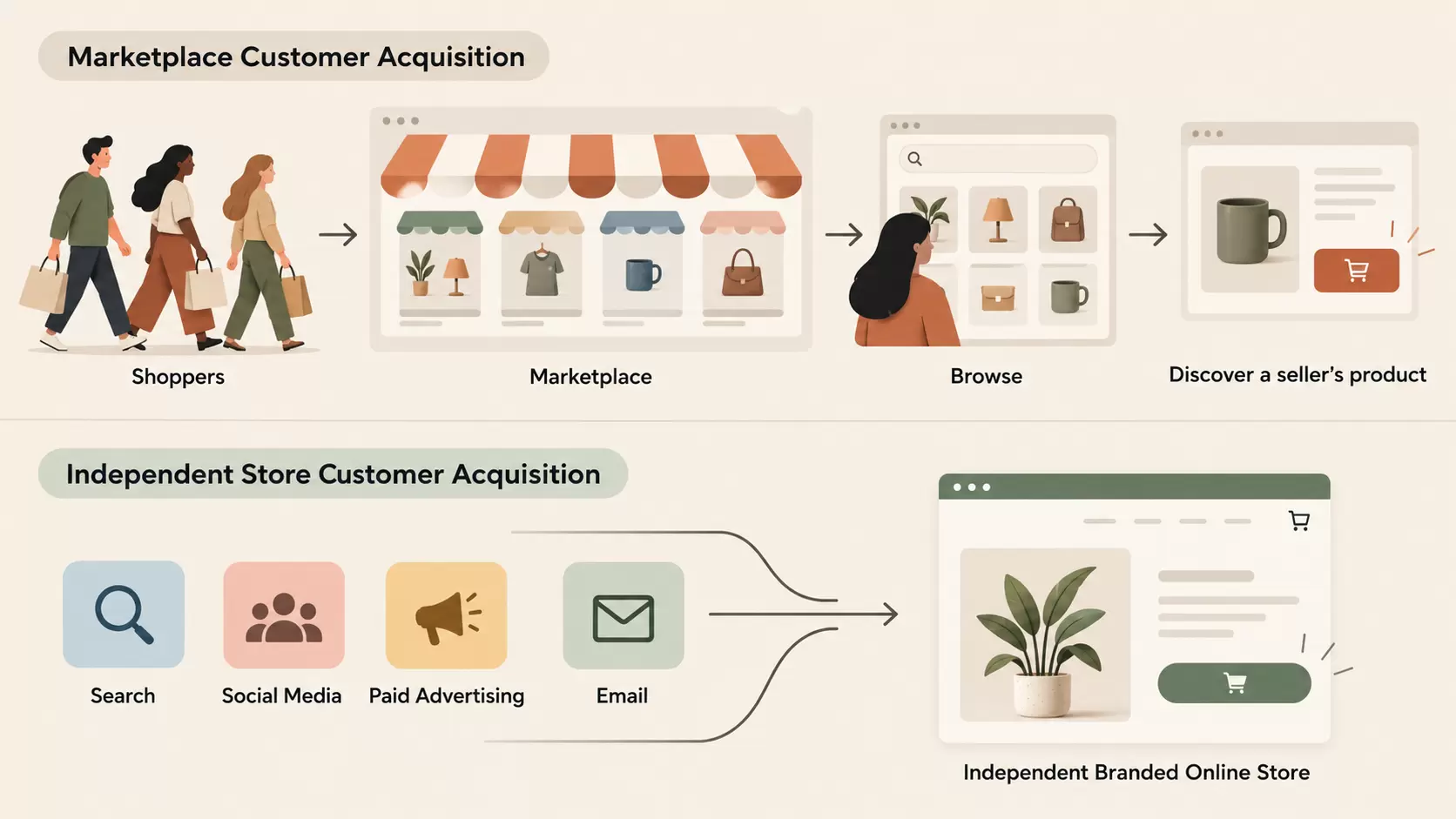
Selling on Shopify vs Etsy: How Do You Get Customers?
The biggest operational difference isn't the checkout. It's how shoppers find your products.
Getting discovered on Etsy
Etsy shoppers already visit the marketplace to search and browse products.
A seller offering personalized wedding invitations, for example, could be discovered when a shopper searches for custom wedding stationery.
However, that seller competes with other Etsy shops offering similar items.
Visibility depends on listing relevance, product presentation, competitiveness, customer service, and other marketplace factors.
Being on Etsy does not mean your products will automatically rank or sell.
Bringing shoppers to Shopify
With Shopify, you have to develop a customer acquisition strategy.
A branded store might attract buyers through:
-
Google organic search.
-
Social media content.
-
Paid search and shopping campaigns.
-
Email marketing.
-
Influencer partnerships.
-
Direct brand searches.
-
Returning customers and referrals.
That may require a larger marketing investment, especially when you're starting without an existing audience.
However, independent businesses can develop content and marketing assets that support repeat visits and long-term search visibility.
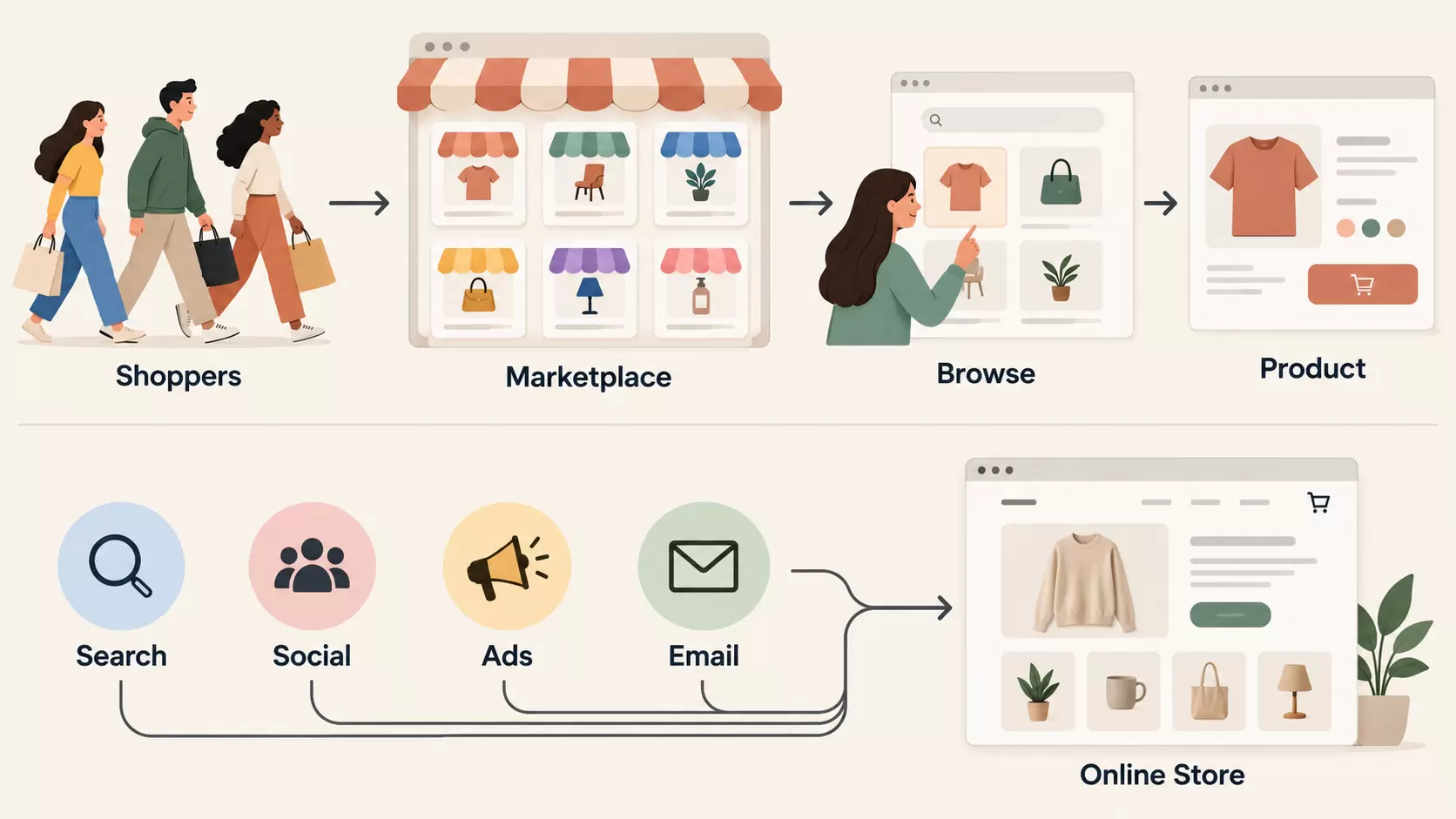
Key Insight: Marketplace traffic and customer ownership are different things. Etsy can connect sellers with shoppers, while Shopify gives merchants more room to build an independent marketing and retention strategy.
Shopify vs Etsy for Selling Different Types of Products
Shopify vs Etsy for selling products isn't just about which platform has more features. The type of product you offer may determine whether Etsy is suitable at all.
| Seller type | Often the better starting point | Why |
|---|---|---|
| Handmade jewelry maker | Etsy | Creative marketplace audience and product fit |
| Custom wedding invitation designer | Etsy or both | Marketplace discovery plus branded selling opportunities |
| Artist selling original digital downloads | Etsy or Shopify | Both can support digital products, with different discovery models |
| Print-on-demand artist | Depends on product eligibility | Etsy requires original seller designs and appropriate production partner disclosures |
| General electronics reseller | Shopify | Ordinary mass-produced resale generally doesn't meet Etsy's standards |
| Growing fashion brand | Shopify | Greater control over catalog, branding, and customer experience |
| Vintage collector | Etsy or both | Eligible vintage products can fit Etsy's marketplace |
| Established ecommerce brand | Shopify, potentially alongside Etsy | More flexibility over SEO, marketing, and operations |
These are general recommendations, not guarantees. Etsy eligibility, customer demand, margins, and competition must be reviewed for the actual products.
Which is better for beginners?
Etsy can be simpler for a beginner with eligible products because the seller doesn't need to build an independent ecommerce website.
Shopify is also beginner-friendly, but launching the store is only part of the work. The seller must plan how to attract customers.
Which is better for handmade products?
Etsy is an obvious platform to evaluate for handmade and personalized items.
Shopify can be attractive if the seller already has social media followers, wants a more distinctive brand, or plans to expand beyond the marketplace.
Which is better for a growing ecommerce business?
Shopify generally provides more room to develop an independent brand, a larger product catalog, and a broader marketing system.
However, growth still depends on product quality, pricing, customer demand, fulfillment, and effective marketing.
Can You Sell on Shopify and Etsy at the Same Time?
Yes. Running an Etsy shop and an independent Shopify store can be a practical strategy for some sellers.
For example, a business might use Etsy to reach shoppers searching for handmade gifts while building a Shopify store for its own brand, educational content, product collections, and repeat customers.
The two channels can play different roles:
-
Etsy: Marketplace discovery.
-
Shopify: Branded ecommerce experience and direct marketing.
But running two channels also means coordinating prices, product information, inventory, shipping, customer service, and returns.
Important Shopify–Etsy integration update for 2026
Shopify's current Marketplace Connect documentation says that new Etsy connections cannot currently be created through Marketplace Connect.
Existing Etsy connections through that app can continue operating.
If you're starting a new multichannel setup, review currently supported third-party integrations or manual workflows before assuming automatic synchronization is available.
This limitation doesn't prevent a business from operating separate Shopify and Etsy stores. It affects how the two systems can be connected.
Shopify vs Etsy: Pros and Cons
Shopify advantages
-
More control over storefront design and branding.
-
Custom domain support.
-
Greater flexibility for website SEO and content.
-
Broad marketing and integration options.
-
Stronger foundation for an independent ecommerce operation.
-
No standard per-product listing fee.
Shopify disadvantages
-
Recurring subscription expense.
-
Requires a strategy for attracting visitors.
-
Additional apps and marketing can increase costs.
-
More responsibility for the overall customer experience.
Etsy advantages
-
Access to an established shopping marketplace.
-
Straightforward listing process for eligible products.
-
Discovery opportunities through Etsy search.
-
No standard monthly seller subscription requirement.
-
Useful channel for handmade, designed, and vintage items.
Etsy disadvantages
-
Listing, transaction, and payment processing fees.
-
Offsite Ads charges on qualifying orders.
-
Competition with other sellers in the same marketplace.
-
Less control over website design and technical SEO.
-
Restrictions on product eligibility and customer data use.
Shopify vs Etsy: Which Should You Choose in 2026?
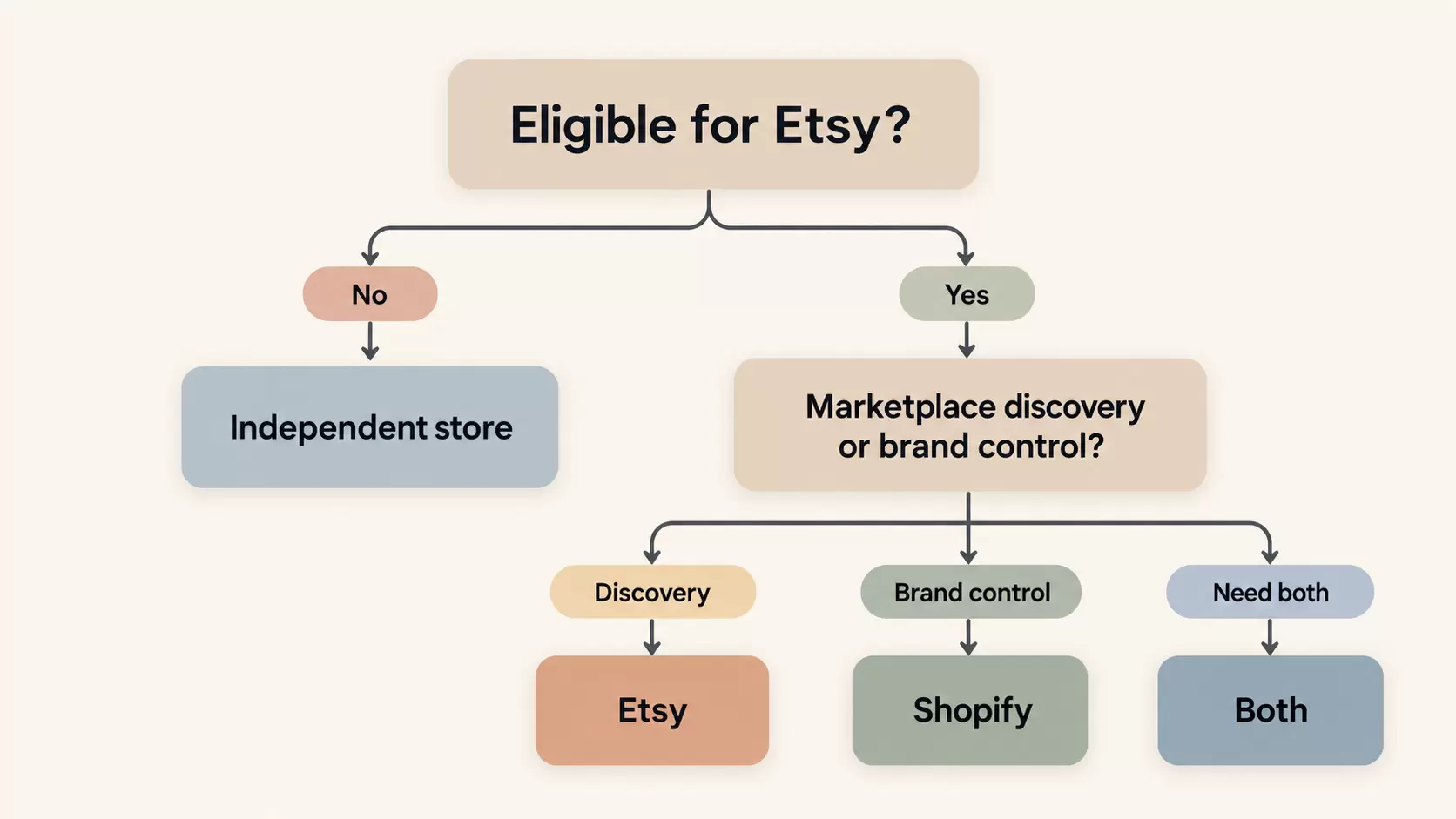
Rather than choosing only by brand recognition, answer these four questions.
1. Does your product qualify for Etsy?
If it doesn't meet Etsy's policies, Shopify is the more relevant choice between these two platforms.
2. Where will your first customers come from?
If you sell eligible creative products and don't yet have an audience, Etsy's marketplace is worth testing.
If you already have a strong audience, organic search strategy, or marketing budget, Shopify may be more attractive.
3. How much control do you need?
If your business depends on custom product pages, branded content, integrated marketing, and long-term customer relationships, Shopify provides more freedom.
4. Can your margins support the full cost?
Calculate platform charges, payment processing, shipping, inventory, advertising, production, and other recurring expenses.
Do not choose Shopify solely because its per-order charges appear lower, or Etsy solely because it doesn't require a standard monthly seller subscription.
Decision Framework: Choose Etsy for eligible products when marketplace discovery is your main priority. Choose Shopify when building an independent branded storefront is the priority. Consider both when you have a clear role for each channel and can manage the added work.
Frequently Asked Questions
Is Shopify cheaper than Etsy?
It depends on order volume, average order value, payment processing, subscriptions, advertising, and other expenses. Shopify may have lower variable charges on some sales, but the monthly plan and traffic acquisition costs must be included.
Is Etsy or Shopify better for beginners?
Etsy may be easier for a beginner selling eligible creative products because it offers an existing marketplace. Shopify suits beginners who want a branded store and are prepared to develop their own traffic.
How much does Etsy charge sellers in 2026?
Etsy currently charges a $0.20 listing fee and a 6.5% transaction fee, plus country-specific payment processing charges. Other costs can include advertising, listing renewals, and setup fees.
Does Shopify charge a listing fee?
Shopify does not generally charge Etsy-style per-product listing fees on its standard online store plans. Sellers pay subscription and applicable payment-related charges, plus optional expenses.
Which is better for SEO, Shopify or Etsy?
Shopify provides more control over a store's website SEO, including content, internal links, metadata, and product or collection pages. Etsy supports search optimization within its marketplace and some external search visibility.
Can you sell print-on-demand products on Etsy and Shopify?
Yes, but Etsy products must meet its Creativity Standards. Seller-original designs produced by disclosed partners may qualify. Shopify generally supports broader print-on-demand selling arrangements, subject to its policies and applicable laws.
Can you move from Etsy to Shopify?
Yes. Sellers can create a Shopify store and migrate eligible product and business information, but the process depends on available export tools, data permissions, app support, and migration requirements. Reviews and customer information should not be assumed to transfer automatically.
Can you connect Shopify and Etsy automatically?
Some third-party integration options may be available, but Shopify currently does not allow new Etsy connections through its Marketplace Connect app. Check current integration support before choosing a synchronization method.
Final Verdict: Shopify or Etsy?
Shopify and Etsy solve different problems.
Etsy is a marketplace where eligible creative sellers can reach people already browsing for products. Shopify is a hosted ecommerce platform that gives businesses more flexibility to build their own branded store, attract customers, and develop long-term marketing channels.
For handmade sellers who are just getting started, Etsy may offer a simpler entry point. For businesses that want more control over their website, customer experience, and organic visibility, Shopify may offer a better long-term fit.
And for sellers who can manage two channels effectively, using both may create complementary opportunities.
If you're building an independent ecommerce brand, JDG's ecommerce SEO services can help you plan how customers discover your products through search.
For a new Shopify store or an existing site that needs stronger SEO and a better shopping experience, contact Just Digital Gurus to discuss your ecommerce goals.
Pricing and platform details reviewed October 8, 2026. Verify rates for your country and plan before publishing or making a financial decision.

Your comment will appear after approval.