
 Written By :
 ChatGPT
 Perplexity
 Claude
 Gemini
ChatGPT Ads are no longer just a future advertising concept or a limited experiment for a handful of large brands. As of September 2026, OpenAI operates a self-service advertising platform with campaign objectives for views, clicks, and conversions, along with CPM and CPC buying, conversion measurement, custom audiences, and contextual relevance controls.
For marketers, the important question has therefore changed. It is no longer simply, “Will OpenAI show ads?” The more useful questions are how ChatGPT Ads work, what they cost, how targeting differs from Google Ads or Meta Ads, and how a business can actually advertise on ChatGPT today.
TL;DR: Key Takeaways
-
ChatGPT Ads appear as clearly labeled sponsored placements and do not change ChatGPT's organic answers. Ads can appear to eligible Free and Go users, while OpenAI says paid plans such as Plus, Pro, Business, Enterprise, and Edu remain ad-free.
-
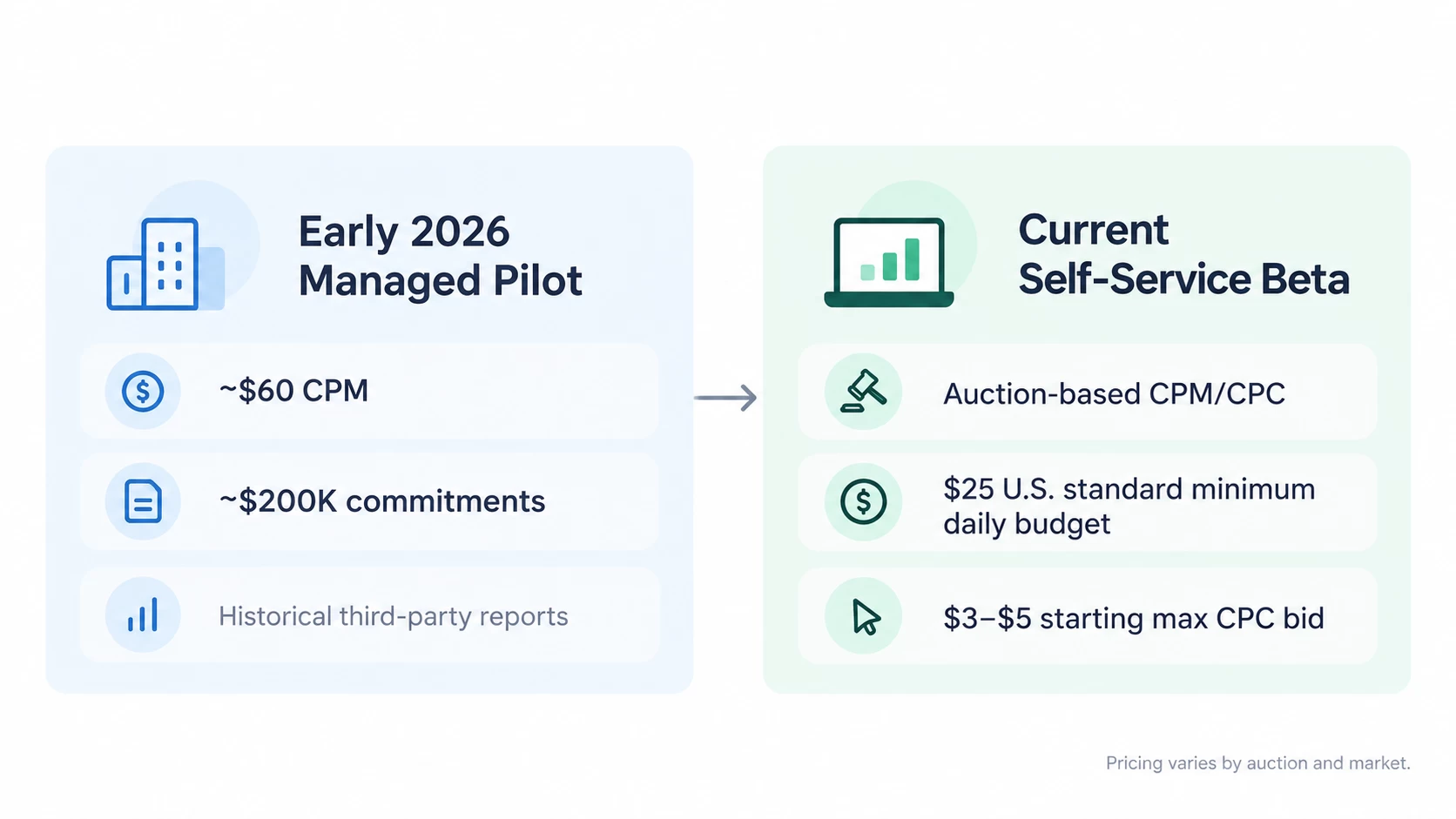
Current ChatGPT Ads cost is auction-based rather than a fixed rate. OpenAI supports CPM, CPC, and conversion-focused campaigns. Its current guidance suggests starting CPC max bids around $3–$5, while the standard U.S. minimum daily campaign budget is $25.
-
Targeting is built around conversational relevance rather than conventional keyword matching. OpenAI uses conversation context, advertiser-supplied context hints, campaign controls, and eligible audience signals, but advertisers do not receive users' private ChatGPT conversations.
What Are ChatGPT Ads?
ChatGPT Ads are paid placements displayed within the ChatGPT experience. OpenAI describes the advertising environment as one built around conversation, context, and moments when people are researching products, comparing alternatives, weighing options, or deciding what to do next.
The ads are designed to remain separate from the assistant's answer. OpenAI says advertisers cannot pay to alter a response, and sponsored placements are clearly identified as advertising.
That distinction is important because advertising on ChatGPT is not the same as paying to become part of an AI-generated recommendation.
For marketers familiar with paid search, a useful way to think about the ChatGPT Ads platform is as a new intent-driven advertising environment. Google Search usually starts with a search query. ChatGPT can instead have considerably more context about what a user is trying to accomplish within the current conversation.
For example, someone may spend several messages comparing software categories, narrowing requirements, asking about pricing, and describing their use case. An eligible ad may then be selected based partly on the context and intent of that conversation.
Who Currently Sees Ads in ChatGPT?
OpenAI says ads may be shown to eligible users on the Free and Go plans. Plus, Pro, Business, Enterprise, and Edu plans are not currently part of the ad-supported experience.
The program started much more narrowly in early 2026. OpenAI initially tested ads with U.S. users before expanding the program to additional countries during the year. Advertiser availability now depends on factors including business location, ad-account country, verification, and the markets supported by Ads Manager.
That means older articles describing ChatGPT advertising as a U.S.-only experiment should not be treated as a current representation of the platform.
How Do ChatGPT Ads Work?
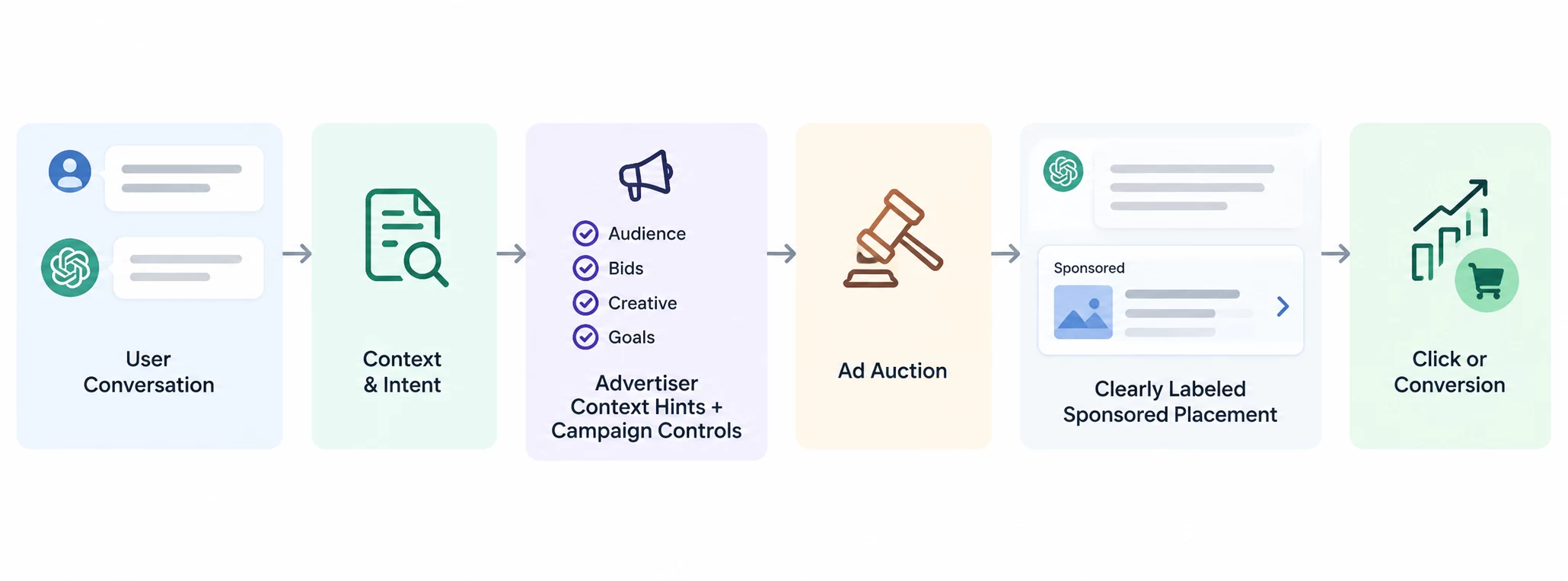
The basic structure now looks increasingly familiar to performance marketers: advertisers create an account, choose an objective, establish campaign and ad-group settings, upload creative, define budgets and bids, launch campaigns, and monitor performance.
The major difference is the relevance system.
Ads Appear Separately From ChatGPT Answers
Current sponsored placements can contain elements such as the advertiser name, headline, description, image, favicon, and landing-page destination. OpenAI says the placement is visually distinguished from the assistant's response.
The advertiser is purchasing an advertising opportunity around the conversation—not control over the answer itself.
An Auction Determines Delivery
OpenAI describes its current system as a relevance-weighted second-price auction. Advertisers can establish maximum bids, while other factors determine which eligible advertisement receives an impression.
This makes the current platform fundamentally different from the original fixed-price launch reports that circulated earlier in 2026.
Context Replaces Traditional Exact-Match Thinking
One of the most important concepts for media buyers is the context hint.
Advertisers can provide context hints at the ad-group level describing the types of conversations, subjects, needs, or situations in which an offer may be useful. OpenAI explicitly describes these as relevance signals rather than conventional exact-match keyword targeting.
Key Insight: A marketer should not build ChatGPT Ads as if they were simply Google Search campaigns copied into another interface. Context hints help the system understand relevance, but they are not exact-match keywords and do not guarantee delivery for a specific phrase.
How Much Do ChatGPT Ads Cost in 2026?
There is no single fixed ChatGPT Ads cost that applies to every advertiser.
The current self-service system supports different objectives and bidding methods.
| Campaign Approach | How Billing Works | Current Advertiser Control |
|---|---|---|
| Views | CPM-based impression buying | Campaign budget and maximum CPM bid |
| Clicks | Valid-click billing | Campaign budget and maximum CPC bid |
| Conversions | Optimized toward a selected conversion event | Conversion objective, measurement setup, budget and supported optimized bidding |
OpenAI currently recommends that advertisers using CPC campaigns consider a starting maximum bid of roughly $3 to $5 per click, then adjust using actual campaign performance. This is a bidding recommendation, not a guaranteed CPC or an average market price.
For CPM campaigns, advertisers establish a maximum CPM bid, and the eventual cost depends on the auction rather than a universal published CPM price.
What Is the ChatGPT Ads Minimum Spend?
This is where many 2026 articles have become outdated.
OpenAI's current daily-budget documentation says the standard minimum daily campaign budget in the U.S. is $25, with minimums varying by market and currency.
You may still see claims that the ChatGPT Ads minimum spend is $200,000 or more. Those figures came from the earlier managed launch period. Digiday reported in February 2026 that some initial advertisers were being asked for commitments around $200,000 and were seeing CPM pricing around $60.
Those historical figures should not be confused with the present self-service budget requirements.
OpenAI's current documentation focuses on daily or total campaign budgets, bidding, billing thresholds, and auction-based delivery rather than requiring every self-service advertiser to make a six-figure commitment.
Research Snapshot: The early enterprise pilot and today's self-service system represent different stages of the product. When evaluating cost benchmarks, always check the publication date and whether the source is discussing the February launch program or the current Ads Manager.
How Does ChatGPT Ads Targeting Work?
The term “targeting” needs some qualification because OpenAI ChatGPT Ads do not simply mirror the audience systems used by mature social or search platforms.
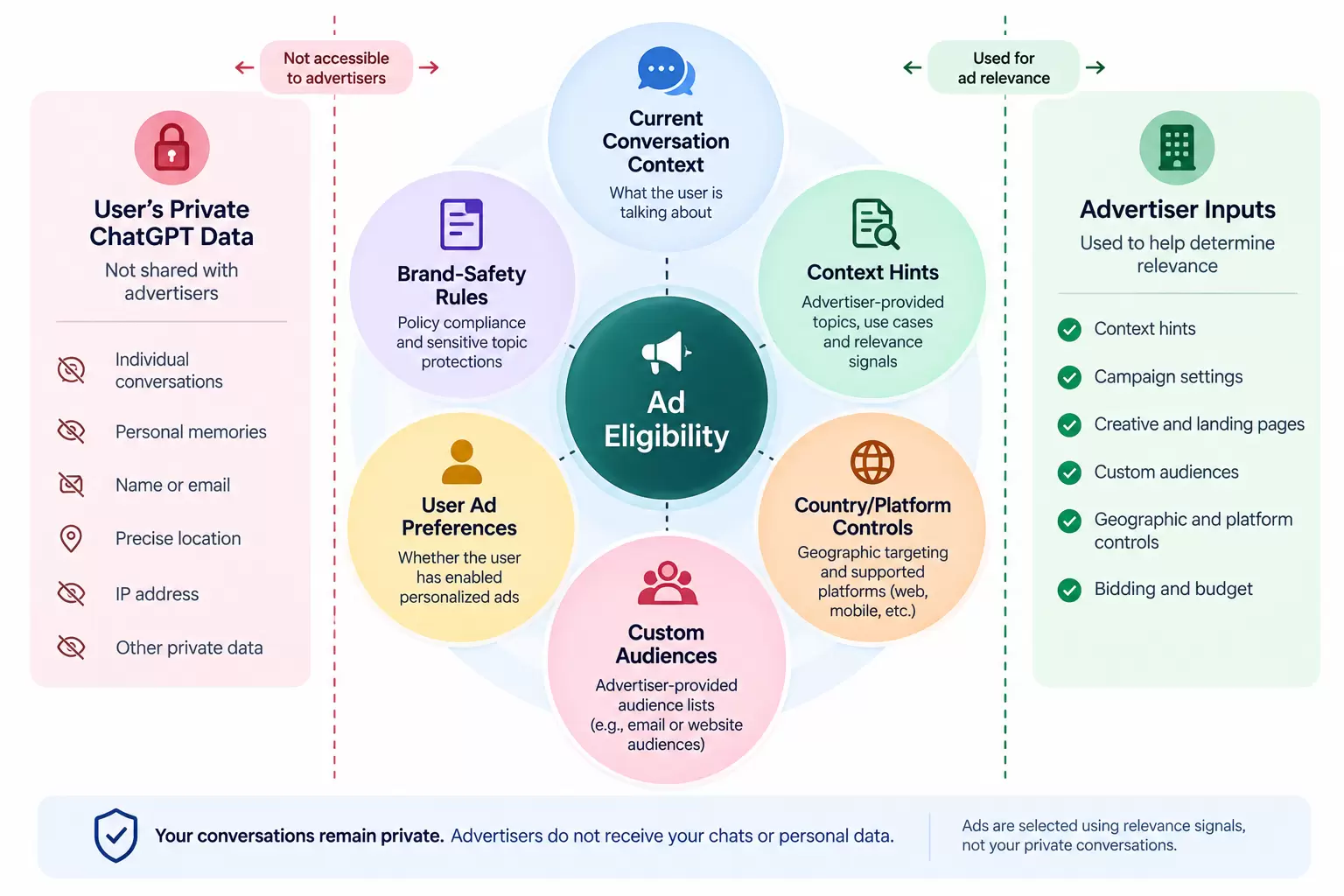
OpenAI currently describes several inputs that can help determine relevance.
Current Conversation Context and Intent
The system can consider what the current conversation is about and what the user appears to be trying to accomplish.
This could be particularly valuable for businesses whose customers spend time researching, comparing alternatives, learning about complex purchases, or narrowing a shortlist before taking action.
Advertiser Context Hints
Context hints allow advertisers to tell OpenAI what kinds of conversations are relevant to an ad group.
For example, rather than targeting one exact phrase, an advertiser might describe a particular business problem, use case, audience need, or buying scenario.
OpenAI warns that context hints are not strict targeting instructions and should not be treated as exact-match keywords.
Country and Platform Controls
Campaign setup supports geographic controls and, where available, platform selections such as web and supported mobile environments.
Custom Audiences
OpenAI also supports custom-audience functionality using advertiser-provided identifiers, subject to platform requirements and privacy controls. Custom audiences can be used for inclusion or exclusion within supported campaign setups.
Personalization Signals
If a user has enabled personalized advertising, OpenAI may use permitted signals from that person's broader ChatGPT experience to improve ad relevance. The company says advertisers themselves do not receive the user's chats, memories, name, email address, precise location, IP address, or other private conversation data.
What Is ChatGPT Ads Manager?
The ChatGPT Ads Manager is OpenAI's self-service environment for creating, launching, managing, and measuring campaigns.
Advertisers can create campaign structures, manage budgets and bids, upload advertisements, view performance, handle billing settings, and access supported account-management functionality. OpenAI has also added capabilities such as bulk workflows and API-related account settings as the beta has expanded.
The platform broadly follows a campaign → ad group → advertisement structure.
Campaign settings can cover objectives, budgets, dates, countries, platforms, conversion events, and eligible audiences. Ad groups organize messaging and contextual relevance. Individual advertisements contain the creative and destination that the user can interact with.
For marketers already running campaigns across Google, Meta, Microsoft, or other networks, this structure will feel familiar even though the relevance signals are different.
Businesses considering ChatGPT alongside other acquisition channels may also want to evaluate it as part of a broader rather than treating it as an isolated experiment.
How to Advertise on ChatGPT in 2026
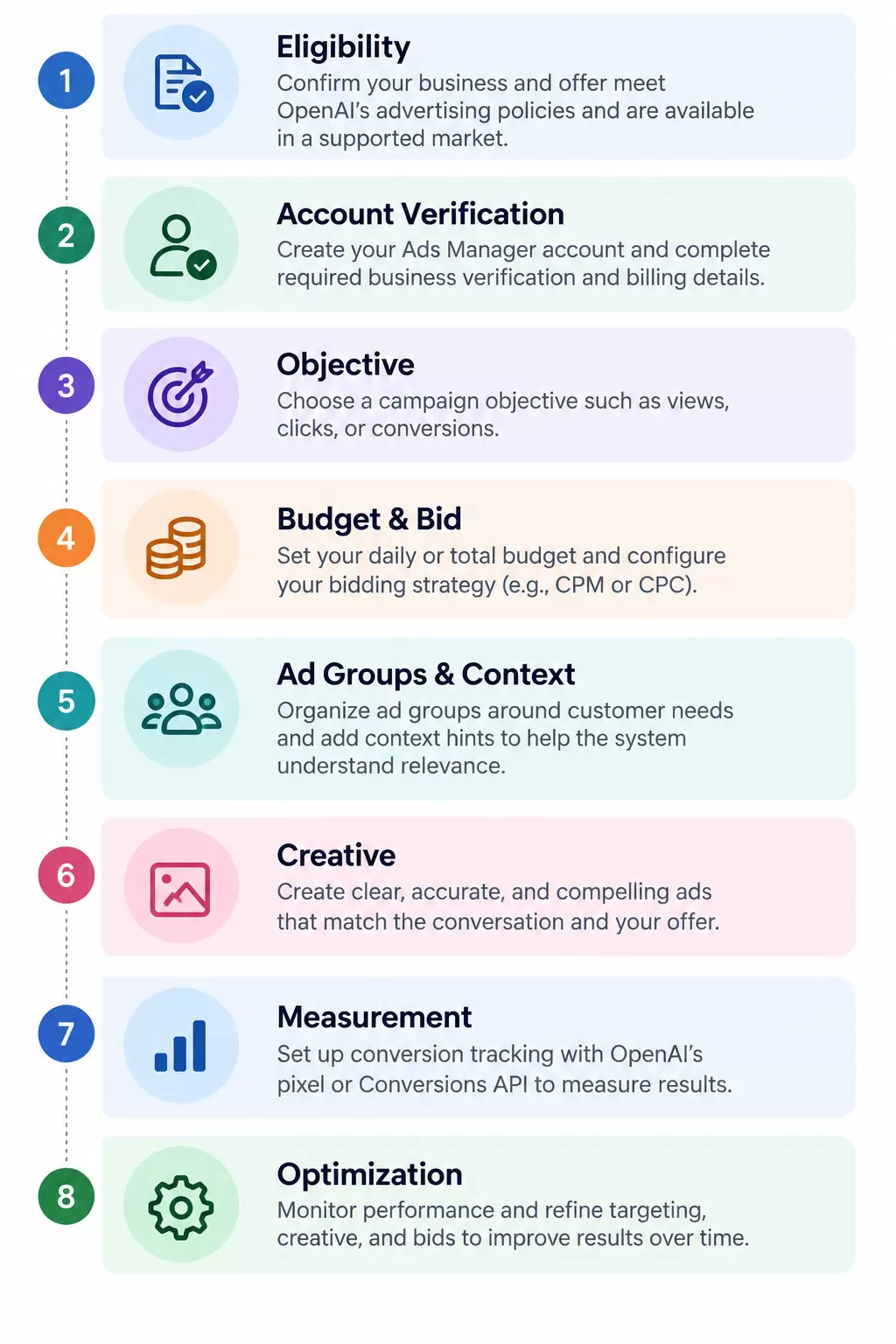
Businesses looking to advertise on ChatGPT can now approach campaign creation through OpenAI's Ads Manager rather than relying exclusively on the original managed pilot.
Step 1: Confirm Advertiser Eligibility
First, check whether your legal business entity and advertising account are eligible in a supported market.
Your offer also needs to comply with OpenAI's advertising policies. The company prohibits or restricts a number of sensitive categories and prevents advertising in certain sensitive conversational contexts.
This should be checked before creative production or campaign planning.
Step 2: Create and Verify an Ads Manager Account
Advertisers provide business information, website details, industry information, billing settings, account country, currency, and related account details.
OpenAI may also require identity or business verification as part of onboarding.
Step 3: Select the Right Campaign Objective
Current objectives include Views, Clicks, and Conversions.
A reach-focused campaign should not be evaluated exactly like a campaign built to generate purchases or qualified leads. The objective should match the business outcome you intend to measure.
Step 4: Establish the Budget and Bid
Set the daily or total campaign budget and then configure the bidding controls associated with the selected objective.
For CPC campaigns, OpenAI's $3–$5 starting max-CPC guidance can be treated as an initial platform recommendation rather than a permanent benchmark. Performance data should determine subsequent changes.
Step 5: Build Ad Groups Around Real Customer Needs
Instead of cloning a large keyword list, organize ad groups around meaningful needs, use cases, products, or customer problems.
Write context hints that help the system understand when your offer is useful without trying to force exact search-query matching.
Step 6: Create Clear, Specific Ad Variations
OpenAI recommends accurate, useful advertisements that clearly communicate the offer.
Creative should connect the conversation someone is having with the next useful action rather than relying on generic promotional language. OpenAI also requires advertisements to be truthful, non-misleading, and compliant with its advertising policies.
Step 7: Configure Conversion Measurement
OpenAI supports measurement through its advertising pixel and Conversions API capabilities. The company says measurement is designed to provide aggregated advertiser insights without revealing individual user conversations.
Before optimizing toward leads or sales, make sure the conversion event represents an outcome that genuinely matters to the business.
The post-click experience matters just as much. A relevant ad that sends users to a confusing page can still waste media spend, which is why should be part of campaign planning.
Step 8: Launch, Measure and Iterate
Ads Manager reports metrics including impressions, clicks, spend, CTR, CPC or CPM metrics, and supported conversion data.
Early optimization should focus on relevance, creative differences, conversion quality, landing-page performance, and whether individual use cases are producing useful business outcomes.
Because the advertising product is still in beta, advertisers should expect functionality, formats, and optimization capabilities to continue changing. OpenAI itself describes the platform as an evolving product.
ChatGPT Ads vs. ChatGPT SEO: What Is the Difference?
Paid placement and organic AI visibility should not be confused.
| Area | ChatGPT Ads | ChatGPT SEO |
|---|---|---|
| Visibility type | Paid sponsored placement | Organic visibility and discoverability |
| Payment | Advertiser budget and auction | No payment to OpenAI for an organic answer |
| Control | Campaign, creative, bidding and supported targeting controls | Content, entities, authority, technical accessibility and overall AI-search optimization |
| Speed | Can generate eligible paid exposure after campaign launch | Usually requires longer-term content and authority development |
| Influence over answers | Ads do not alter ChatGPT's organic response | Organic inclusion remains algorithmic and is not guaranteed |
A company can therefore run paid campaigns while separately improving how its brand and content are understood by AI systems.
For businesses focused on organic visibility, our ChatGPT SEO services address a different problem from paid advertising.
That distinction is likely to become increasingly important as marketers build separate strategies for paid AI advertising and organic generative-search visibility.
How Should Marketers Approach Their First ChatGPT Ads Test?
The platform is new enough that marketers should resist importing every assumption from Google or Meta.
A practical first test starts with a clearly defined use case where people naturally need to evaluate information before making a decision. The landing page should closely match that use case, and a meaningful conversion event should be configured before substantial optimization begins.
| Better Conditions for an Initial Test | Reasons to Prepare More First |
|---|---|
| Your product is naturally researched or compared in conversation | You expect exact-match keyword targeting |
| You have a clear conversion action | Conversion tracking is incomplete |
| Your offer is eligible under OpenAI policies | Your vertical or offer has policy restrictions |
| Your landing page closely matches the ad promise | Paid traffic currently lands on a generic or weak page |
| You can evaluate the channel as a controlled experiment | You need guaranteed CPA or ROAS immediately |
| Your target market is supported | Your required geography is not yet available |
Teams already managing paid search may find it useful to compare performance and intent quality against established channels rather than judging ChatGPT Ads in isolation. JDG's provide additional context for how search-focused paid acquisition is typically structured around intent, landing pages, conversion tracking, and continuous optimization.
Decision Framework: Treat ChatGPT Ads as a new acquisition channel to test against measurable business outcomes—not as a replacement for every existing PPC campaign and not as a shortcut to appearing organically inside ChatGPT answers.
What's New With OpenAI Ads in September 2026?
The platform is already moving beyond basic sponsored cards.
On September 16, 2026, OpenAI announced additional advertising developments including experiments with Sponsored Agents, which can let a user begin a conversation with a business-sponsored agent after interacting with an advertisement. OpenAI also described new AI-assisted advertising workflows and integrations involving platforms such as HubSpot and Shopify.
These developments suggest that the longer-term OpenAI ads model may become more interactive than traditional display or search advertising.
Instead of every advertising journey ending with a click to an external landing page, some experiences may eventually let users move from an ad into an interactive brand experience.
Because these capabilities are new and evolving, marketers should distinguish between functions generally available in Ads Manager and newer formats or integrations that OpenAI is still introducing or testing.
Is ChatGPT Advertising Worth Testing?
There is not yet enough mature public performance data to claim that ChatGPT Ads will consistently beat Google Ads, Meta Ads, or other established channels across industries.
The more useful question is whether the environment matches how your customers make decisions.
ChatGPT can be particularly interesting where customers research complex products, compare options, ask follow-up questions, and need information before converting. But the same contextual environment does not automatically guarantee better economics.
Campaign quality still depends on the offer, relevance, creative, bidding, measurement, landing page, conversion rate, customer value, and competition.
For that reason, companies should measure ChatGPT advertising using the same business discipline they apply to other paid media channels.
Frequently Asked Questions About ChatGPT Ads
Does ChatGPT have ads in 2026?
Yes. OpenAI currently operates advertising in ChatGPT and provides an Ads Manager Beta for eligible advertisers. Ads are clearly labeled and are kept separate from ChatGPT's organic answers.
How much do ChatGPT Ads cost?
There is no universal fixed price. The platform supports CPM and CPC buying as well as conversion-focused optimization. OpenAI currently recommends a starting max CPC bid of roughly $3–$5 for CPC campaigns, but actual costs depend on auction conditions and campaign performance.
What is the ChatGPT Ads minimum spend?
OpenAI currently lists a standard minimum daily campaign budget of $25 for U.S. campaigns using USD, with minimums varying by market and currency. Historical reports of $200,000 or larger commitments referred to the early managed pilot rather than the present self-service budget structure.
Are ChatGPT Ads targeted?
Yes, but the system does not work exactly like conventional keyword advertising. Relevance can incorporate current conversation context and intent, advertiser context hints, campaign controls, supported custom audiences, and permitted personalization signals. Advertisers do not receive private ChatGPT conversations.
How can a business advertise on ChatGPT?
Eligible businesses can create an OpenAI advertising account, complete required verification and billing steps, choose a campaign objective, establish a budget and bid, build ad groups, create compliant ads, configure measurement, and launch campaigns through Ads Manager.
The Bottom Line
ChatGPT Ads have progressed quickly from an early enterprise pilot into a genuine self-service advertising channel.
Marketers can now work with CPM, CPC, and conversion-oriented campaigns, contextual relevance signals, custom audiences, conversion measurement, and an expanding Ads Manager. At the same time, the product is still in beta and should be approached as an evolving channel rather than a mature advertising ecosystem with years of established benchmarks.
The biggest mistake in 2026 is relying on launch-period information as if nothing has changed.
Businesses evaluating ChatGPT Ads should use current platform documentation, establish accurate measurement, build campaigns around real conversational intent, and compare results against existing acquisition channels.
For companies planning how emerging AI advertising fits alongside search, display, landing-page optimization, and broader acquisition efforts, can support a more complete paid-media strategy.

Your comment will appear after approval.