
 Written By :
 ChatGPT
 Perplexity
 Claude
 Gemini
Choosing between search engine optimization (SEO) and pay-per-click advertising (PPC) can be difficult when your main goal is generating more customers.
Both strategies help people discover your business through search engines, but they work differently. PPC can generate leads quickly, while SEO builds organic visibility that can continue attracting customers over time.
So, in the SEO vs PPC comparison, which delivers better leads and return on investment?
The answer depends on your budget, customer acquisition costs, competition, and how soon you need results. This guide compares both channels using lead quality, costs, ROI, and practical business scenarios.
TL;DR: Key Takeaways
-
PPC is usually better for immediate visibility and lead generation. You can reach people searching for your services once campaigns are approved and running, but each click adds to your advertising costs.
-
SEO can provide stronger long-term value. It takes time and ongoing investment, but successful organic pages can continue generating traffic without a per-click charge.
-
The best ROI depends on customer value, not traffic volume. Compare qualified leads, acquired customers, total marketing costs, and profit before deciding which channel deserves more budget.
SEO vs PPC: What's the Difference?
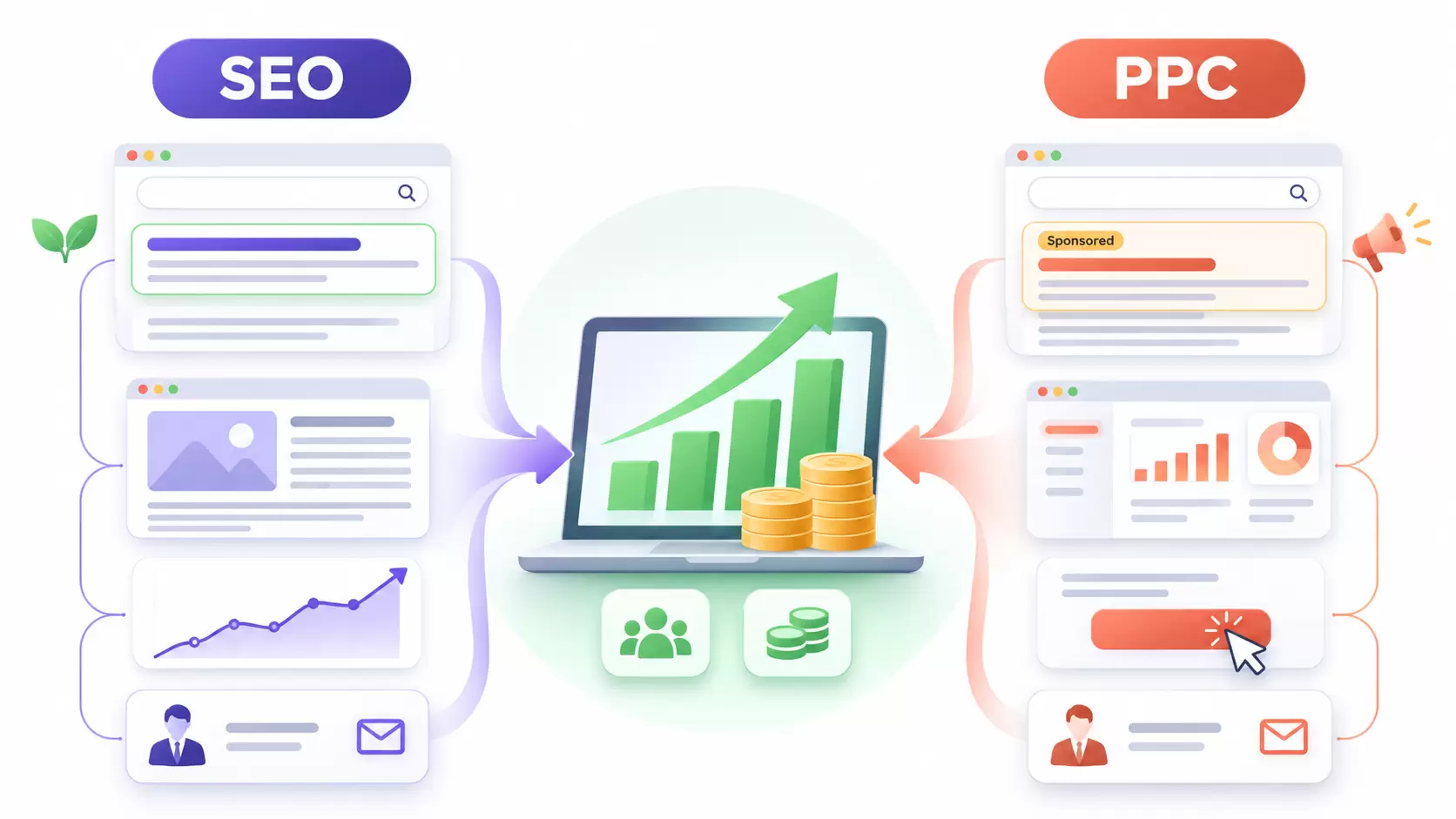
SEO and PPC are two approaches to search engine marketing.
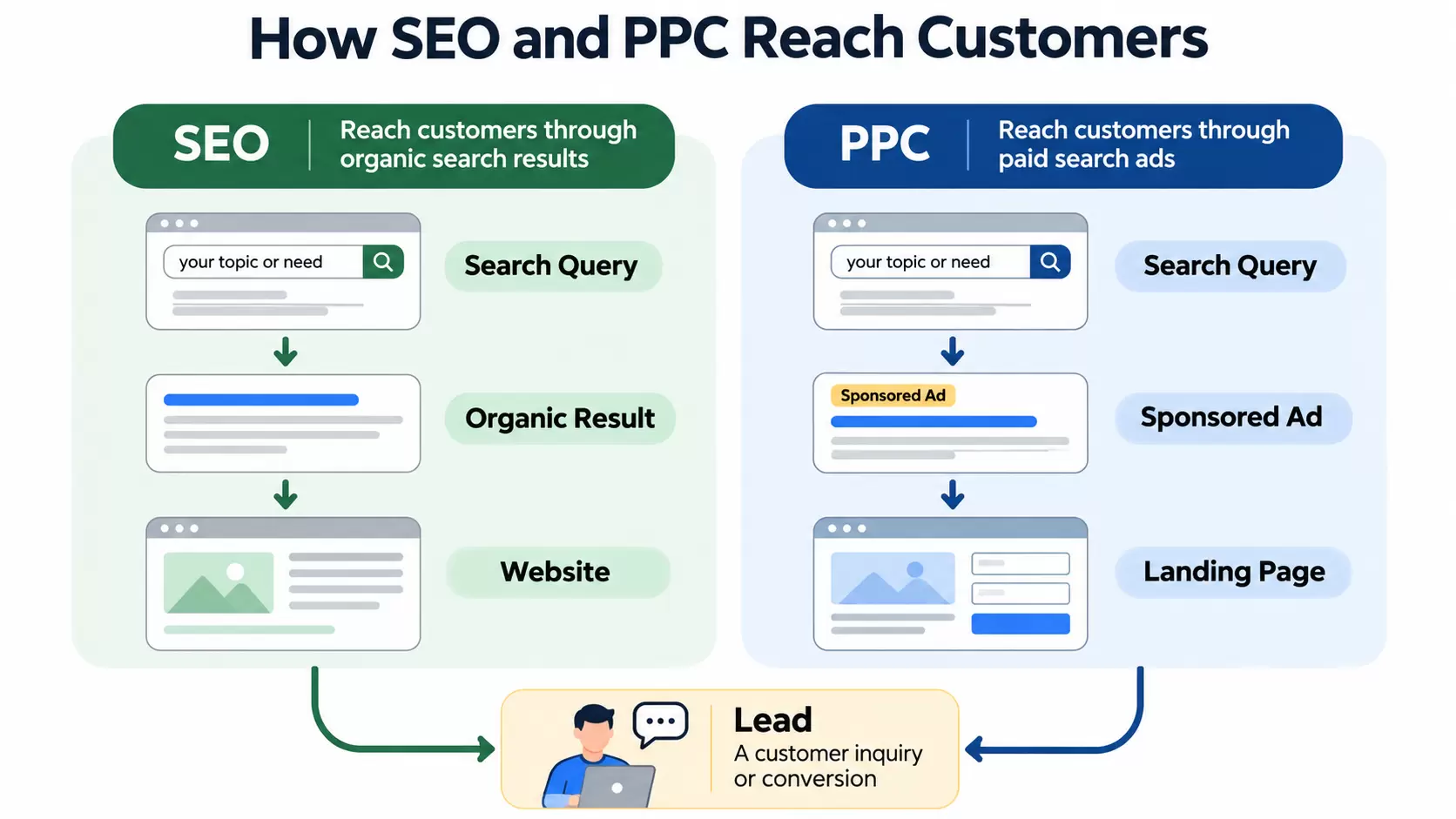
Search engine optimization (SEO) involves improving your website's content, technical performance, relevance, and visibility in unpaid search results. Businesses invest in SEO to attract people searching for information, products, and services related to what they offer.
Pay-per-click advertising (PPC) involves paying for advertising interactions, commonly clicks. In paid search, platforms such as Google Ads allow advertisers to target relevant searches, manage budgets, and direct visitors to selected landing pages.
Google's documentation confirms that businesses cannot pay to improve their organic search rankings. Advertising and organic ranking are separate systems.
SEO vs PPC comparison table
| Factor | SEO | PPC |
|---|---|---|
| Search visibility | Organic search results | Sponsored advertising placements |
| Time to results | Usually gradual, often taking months for substantial gains | Ads can generate visibility soon after approval |
| Main investment | Content, technical SEO, optimization, and maintenance | Advertising spend, management, and landing-page work |
| Cost per click | No direct payment for organic clicks | Advertisers commonly pay per click |
| Targeting | Search intent, keywords, content, and page relevance | Keywords, location, bidding, and campaign controls |
| Traffic sustainability | Can continue after a page gains visibility, but rankings may change | Paid traffic typically stops when ads stop running |
| Control | Limited control over search rankings | Direct control over many campaign settings |
| Main strength | Building long-term discoverability | Capturing demand and testing offers quickly |
| Main limitation | Slower results and ranking uncertainty | Ongoing advertising expenses |
SEO is not completely free. Writing content, fixing technical issues, improving pages, and maintaining rankings require resources.
Likewise, PPC does not guarantee profitable leads just because advertising campaigns can start generating clicks quickly.
The main difference is how each channel builds and maintains visibility.
For more context on how SEO supports a broader online presence, read our guide to website marketing strategies.
SEO vs PPC: Which Generates Better Quality Leads?
A business might receive 100 inquiries from one marketing channel and only 40 from another.
That does not automatically make the first channel more successful.
Some people may be researching options, while others are ready to purchase. The more useful question is how many inquiries become qualified leads and paying customers.
How SEO generates qualified leads
SEO attracts people through the search queries your website appears for.
For example, someone searching for "how to choose accounting software" may be early in the buying process. Another person searching for "accounting software for small construction companies" may have a more specific business need.
SEO can reach both audiences.
Its strength is the ability to provide useful information throughout the customer journey. Service pages, comparison articles, pricing information, and helpful guides can attract visitors at different stages.
However, informational traffic does not always produce immediate inquiries.
For stronger lead generation, an SEO strategy should prioritize commercially relevant keywords alongside useful supporting content.
How PPC generates qualified leads
PPC can focus advertising budgets on searches with clear commercial intent.
For example, a company advertising accounting software might target searches such as:
-
"buy accounting software for small business"
-
"accounting software pricing"
-
"construction accounting software demo"
These searches suggest different levels of buying intent.
PPC offers control over search targeting, geography, budgets, and ad messaging. This makes it useful when you want to reach a specific audience or test demand.
Still, targeting alone does not ensure lead quality. Broad or irrelevant search terms, weak advertising messages, and poorly matched landing pages can generate expensive inquiries that never become customers.
Clear offers and strong landing page optimization help visitors understand whether your business meets their needs.
What actually determines lead quality?
Four factors matter more than whether someone arrived through SEO or PPC:
-
Search intent: Was the person researching, comparing, or ready to buy?
-
Page relevance: Did the page answer the question or match the advertised offer?
-
Lead qualification: Does the prospect have the right needs, location, budget, and buying authority?
-
Sales conversion: How many qualified leads actually became paying customers?
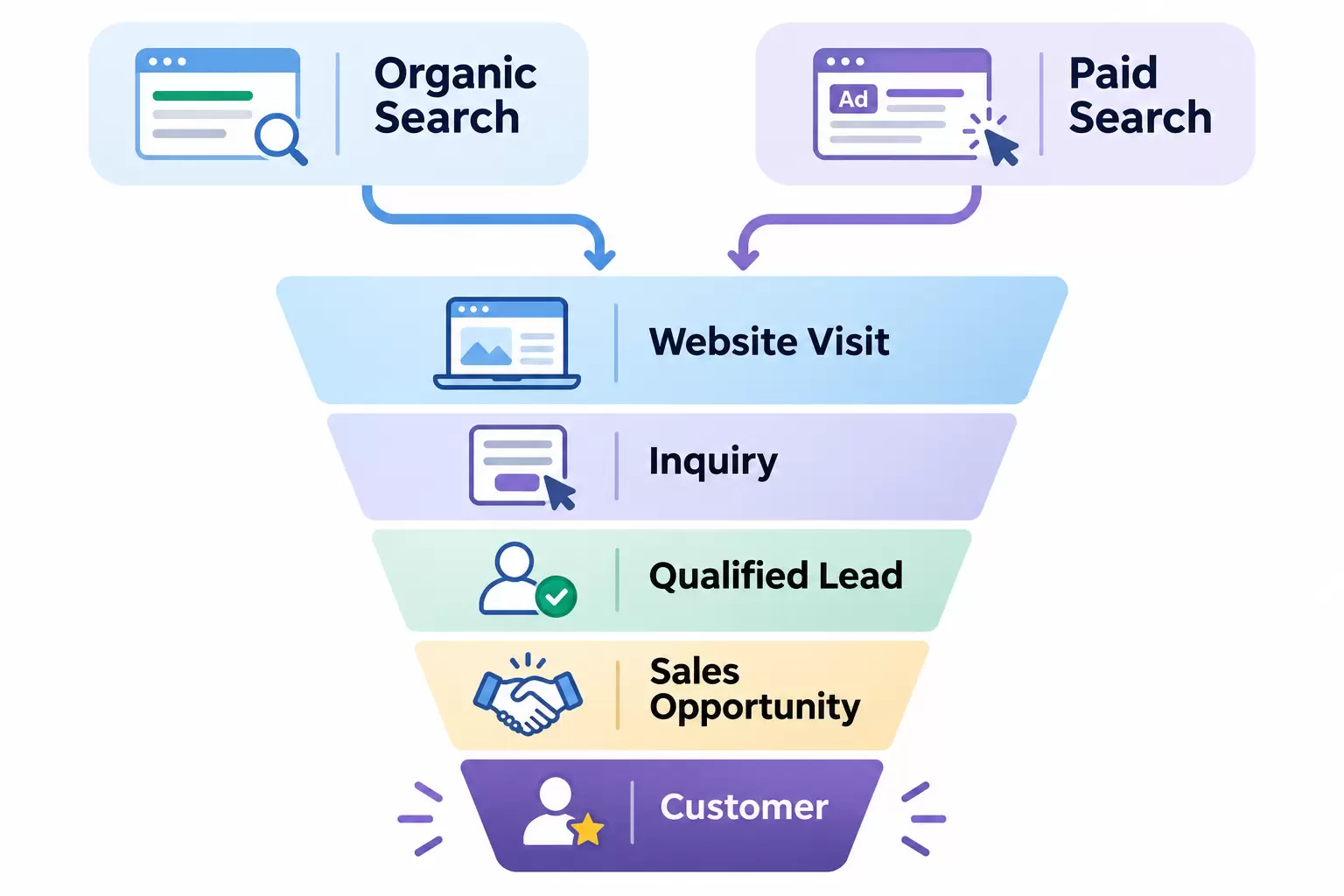
Google Ads supports qualified-lead and converted-lead measurement using data from later stages of the sales process. This helps advertisers assess more than initial form submissions.
Key Insight: Neither SEO nor PPC automatically generates better-quality leads. A high-intent organic visitor may be more valuable than a poorly targeted paid click, and a well-targeted PPC visitor may be more valuable than someone reading a general blog post.
SEO vs PPC ROI: Which Provides a Better Return?
Return on investment is one of the biggest factors when comparing SEO and PPC.
But looking only at clicks, traffic, or form submissions can lead to the wrong decision.
A campaign may generate hundreds of leads and still lose money if those leads rarely become customers.
To make a fair comparison, businesses need to understand the full cost of each channel and the financial value of the customers it produces.
Understanding the real cost of SEO
SEO investment may include:
-
Keyword research and content planning
-
Content creation and updates
-
Technical audits and website improvements
-
On-page optimization and internal linking
-
Digital PR or legitimate link-earning activities
-
Tools, staff time, and agency management
Some SEO expenses help create pages and improvements that remain useful beyond the month in which they were produced.
However, those pages still need monitoring and maintenance, and future traffic is not guaranteed.
If you are planning an organic marketing budget, our SEO cost calculator can help estimate the work involved.
Understanding the real cost of PPC
PPC expenses can include:
-
Advertising budget
-
Campaign management
-
Ad copy and creative development
-
Landing-page design and optimization
-
Conversion tracking
-
Campaign testing and reporting
For example, if a campaign spends $2,000 on advertising and $500 on management, its total marketing cost is $2,500 before any additional expenses.
Using only the advertising spend would make the campaign appear more profitable than it actually is.
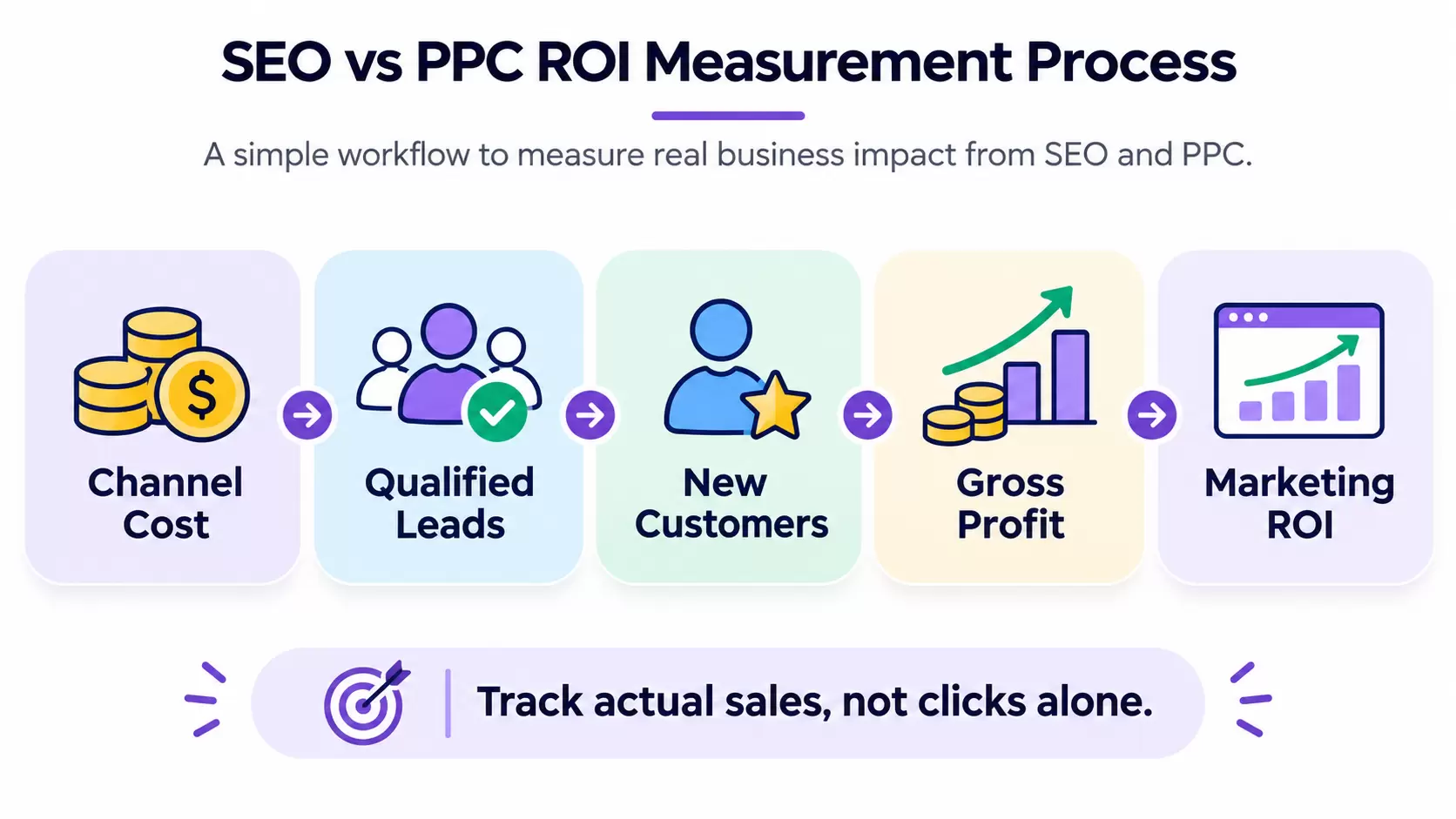
How to calculate SEO and PPC ROI
Use the same financial definitions for both channels.
Cost per qualified lead:
Total Channel Cost ÷ Number of Qualified Leads
Customer acquisition cost (CAC):
Total Channel Cost ÷ New Customers Acquired
Marketing ROI:
(Attributed Gross Profit − Total Channel Cost) ÷ Total Channel Cost × 100
Here, attributed gross profit means the revenue associated with acquired customers after subtracting the cost of delivering the product or service, but before subtracting the marketing cost included in the formula.
If repeat purchases matter, compare customers over an appropriate period and avoid counting future revenue that has not been earned as realized profit.
Example: Comparing SEO vs PPC ROI
Consider a hypothetical service business evaluating two established marketing channels over the same three-month reporting period.
Assume each new customer generates $750 in gross profit before marketing expenses.
| Metric | SEO | PPC |
|---|---|---|
| Total marketing cost | $2,000 | $3,000 |
| Initial leads | 40 | 60 |
| Qualified leads | 20 | 24 |
| New customers | 5 | 6 |
| Attributed gross profit | $3,750 | $4,500 |
| Cost per qualified lead | $100 | $125 |
| Customer acquisition cost | $400 | $500 |
| Marketing ROI | 87.5% | 50% |
Illustrative example only. These figures are not JDG client results or industry performance benchmarks.
In this scenario, PPC generates more leads, more customers, and more total gross profit before marketing costs.
However, SEO produces a higher percentage return on the marketing investment and a lower customer acquisition cost.
The calculations are:
-
SEO ROI: ($3,750 − $2,000) ÷ $2,000 × 100 = 87.5%
-
PPC ROI: ($4,500 − $3,000) ÷ $3,000 × 100 = 50%
This example does not prove SEO always performs better.
A new website might spend heavily on SEO before generating meaningful organic leads. A successful paid campaign might deliver profitable customers much sooner.
Compare both channels over appropriate time periods, and account for earlier SEO investments when judging the full return of an ongoing program.
Is ROAS the same as ROI?
No.
Return on ad spend (ROAS) compares attributed revenue or conversion value with advertising costs. ROI considers the profit generated relative to the broader investment.
A campaign with strong ROAS can still be unprofitable after product costs, agency fees, staff time, and other expenses.
Google Ads provides conversion-value measurement and ROAS-related reporting, but businesses must configure meaningful conversion values to make those metrics useful.
Example: A company might celebrate a low $25 cost per lead. But if only one in 100 leads becomes a customer, its acquisition cost is $2,500 before any other costs. Lead price alone does not tell you whether the campaign is profitable.
SEO vs PPC Pros and Cons
Both strategies have advantages and limitations. Understanding them helps you avoid choosing a channel based only on its popularity or the promise of fast results.
SEO advantages
1. Long-term search visibility
Strong service pages and useful content may keep attracting visitors after the initial work is completed.
2. No charge for each organic click
Your business does not pay a search engine for individual organic visits, although creating and maintaining search visibility costs money.
3. Reach across the buying journey
SEO can help customers discover your company while researching problems, evaluating solutions, and comparing providers.
4. Better use of existing website content
SEO improvements can strengthen important pages and support a broader website marketing strategy.
SEO disadvantages
1. Results may take months
Google explains that changes in search performance can take varying amounts of time, from hours in some cases to several months in others. Substantial growth often requires sustained work.
2. Rankings are not guaranteed
Competitors, search engine updates, content relevance, and changing search behavior can affect visibility.
3. Ongoing work is necessary
Content can become outdated. Technical problems can appear, and competitors can improve their own websites.
PPC advantages
1. Faster visibility
Paid search can begin reaching potential customers soon after a campaign is approved and starts serving.
2. Greater campaign control
Businesses can adjust advertising budgets, target searches, locations, and other available campaign settings.
3. Useful for testing demand
PPC can help evaluate which commercial keywords, messages, and offers generate qualified inquiries.
4. Direct campaign measurement
Advertising platforms provide data on clicks, costs, conversions, and conversion values when tracking is configured correctly.
PPC disadvantages
1. Advertising requires continuous funding
When a campaign stops serving, the traffic generated by those paid placements generally stops too.
2. Poor targeting can waste money
Irrelevant search terms, weak offers, or unsuitable audiences can result in costly clicks.
3. Competition can affect costs
The price of clicks varies by keyword, competition, auction conditions, and other factors.
4. Conversions are not guaranteed
Even well-targeted advertisements need relevant landing pages, clear offers, and effective sales follow-up.
Key Insight: SEO creates the opportunity for ongoing organic discovery, while PPC gives you more direct control over when and where you advertise. Neither eliminates the need for good content, relevant offers, and a website that converts.
SEO vs PPC for Small Business: Which Should You Choose?
Small businesses often have limited resources, which makes the decision more important.
The right approach depends on how urgently you need customers, how competitive your industry is, and how much you can afford to invest before seeing a return.
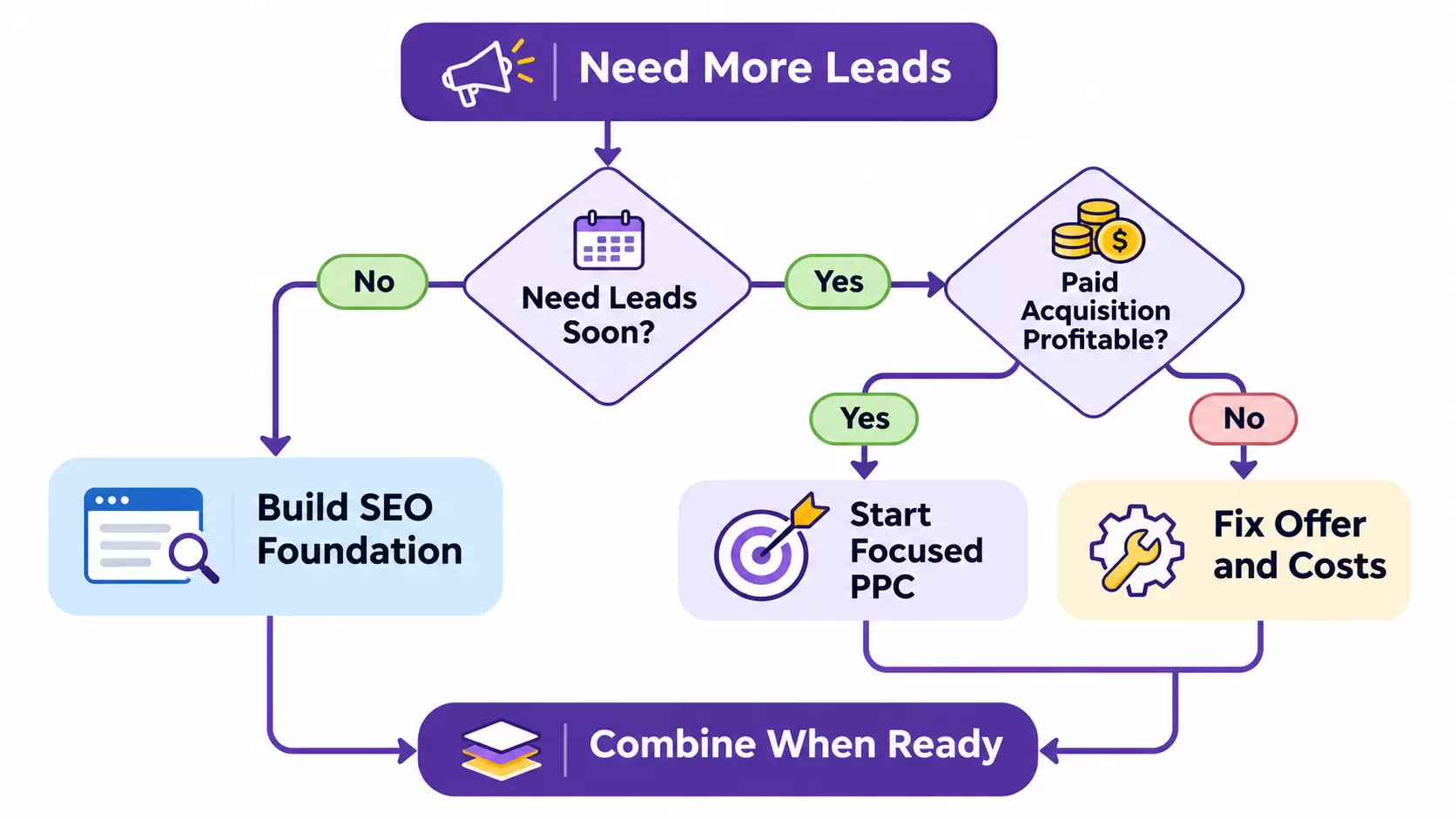
Choose PPC first when you need leads quickly
PPC may be the better starting point if:
-
You are launching a new business, product, or service.
-
You need to test demand for a new offer.
-
You have a short-term campaign or seasonal promotion.
-
You serve an area where your website currently has little organic visibility.
-
You have enough profit per customer to support paid acquisition.
For example, a home services company entering a new city may use location-focused paid search to reach people looking for immediate help.
However, the company still needs to check whether the cost of acquiring customers leaves enough profit.
Choose SEO first when sustainable growth is the priority
SEO may deserve more attention if:
-
You want to reduce long-term dependence on advertising.
-
Your customers research options before making decisions.
-
You have useful service pages that could perform better organically.
-
Paid search costs are too high for your margins.
-
You can invest consistently and wait for results.
A B2B consulting company, for example, may benefit from detailed service pages, comparison articles, and educational content that helps prospective customers evaluate its services.
Compare the decision by business situation
| Business situation | Recommended priority | Reason |
|---|---|---|
| Need leads this month | PPC | Faster opportunity to reach active searchers |
| Planning steady growth over the next year | SEO | Builds ongoing organic visibility |
| Launching an untested offer | PPC test | Helps assess search demand and messaging |
| High advertising costs and narrow profit margins | Evaluate SEO opportunities | May reduce dependence on expensive paid clicks |
| Established business with consistent demand | SEO + PPC | Supports immediate and ongoing acquisition |
| Website converts poorly | Fix landing pages and tracking first | More traffic may simply create additional waste |
| Very limited budget with no urgent sales target | Focused SEO foundation | Prioritizes useful pages and long-term discoverability |
SEO vs PPC: Which is better with a small budget?
There is no universal answer.
If you have enough budget to test paid search properly, strong profit margins, and an immediate need for customers, a focused PPC campaign may be useful.
If your available budget is too small to generate meaningful paid-search data, improving your most important website pages may be a better first investment.
Our guide to affordable website SEO explains which improvements may be worth prioritizing when resources are limited.
How Can SEO and PPC Work Together to Generate More Leads?
For many established businesses, the most useful strategy is not choosing one channel forever.
SEO and PPC can support different parts of the same customer journey.
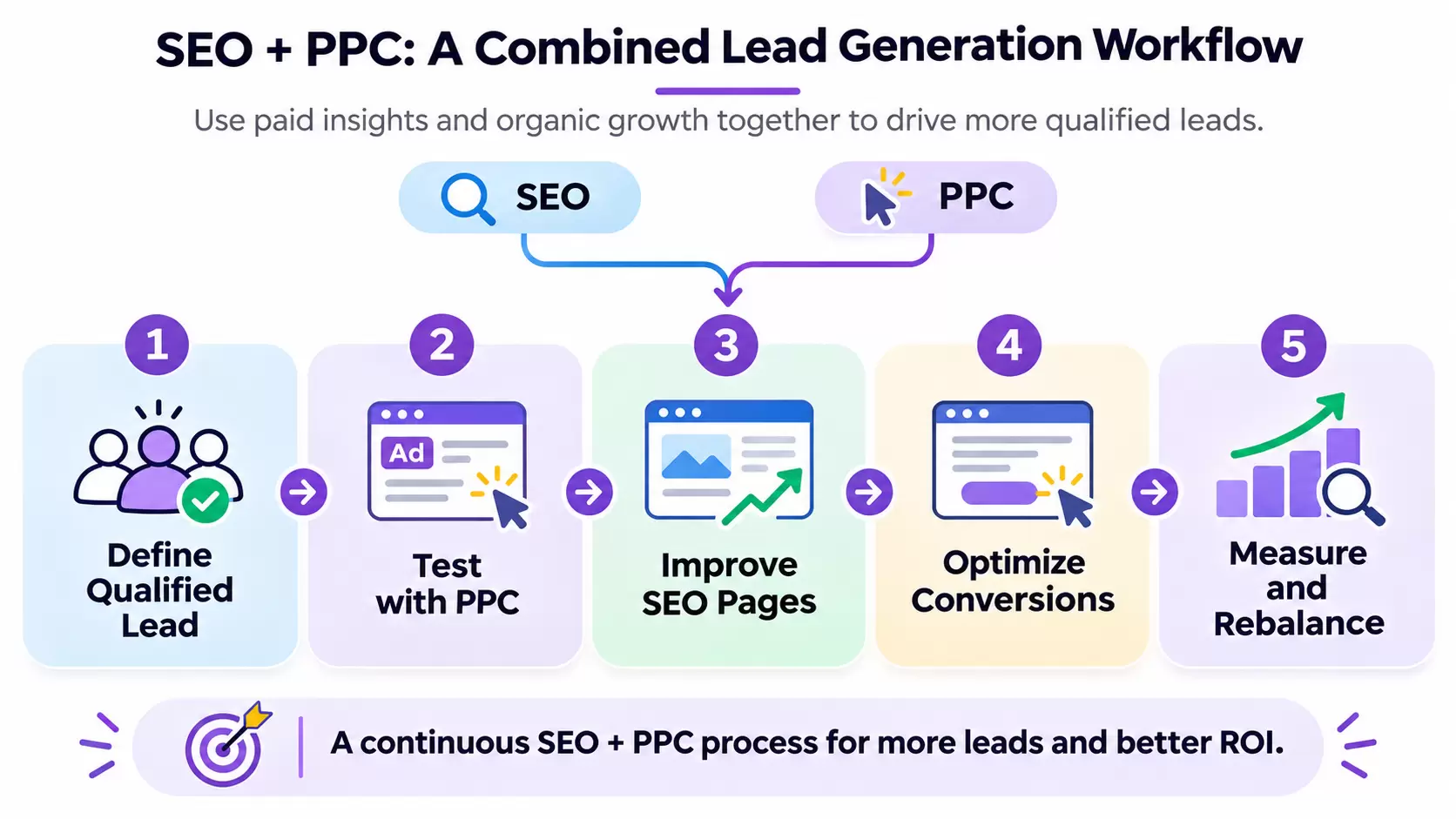
PPC can test which commercial searches convert. SEO can build useful pages around relevant search demand. Both can benefit from better landing pages, clear messaging, and accurate reporting.
Here is a practical way to combine them.
Step 1: Define what counts as a qualified lead
Before investing heavily in either channel, decide what a valuable lead looks like.
For a service business, this may be someone who:
-
Needs the service you offer
-
Is located within your service area
-
Has a realistic budget
-
Has decision-making authority
-
Is ready to discuss a purchase
Make sure your tracking and CRM can distinguish useful inquiries from spam, duplicate submissions, and poorly matched prospects.
Step 2: Use PPC to test commercial search demand
Start with a focused set of high-intent keywords that closely match your services.
Measure which searches produce qualified leads, not just clicks.
For example, a company may discover that people searching for a specific service package convert more effectively than people searching for a broad service category.
This information can guide your future SEO priorities.
However, paid campaign performance is not a guarantee of how the same keyword will perform organically.
Step 3: Strengthen organic pages around relevant searches
Use the findings to improve service pages, create helpful comparisons, and answer questions that appear during the buying process.
A useful organic content strategy should cover both immediate purchase intent and the research that happens before it.
The objective is to help more potential customers discover your business naturally over time.
Step 4: Improve the conversion experience
A weak landing page can reduce the performance of both channels.
Review your:
-
Headlines and service descriptions
-
Calls to action
-
Forms and booking steps
-
Mobile experience
-
Trust signals
-
Page speed
-
Conversion tracking
Businesses already investing in paid campaigns can use landing page optimization services to identify problems after the click.
Step 5: Compare results and adjust the budget
Review which channels produce qualified leads, paying customers, and profitable revenue.
You may increase PPC spending when campaigns are profitable and your business needs more immediate demand.
You may increase SEO investment when important pages show organic growth and a clear path to customer acquisition.
The goal is not to reduce paid advertising automatically whenever SEO improves. Evaluate whether paid campaigns generate additional customers who would not have converted otherwise.
A connected digital marketing strategy can help coordinate these decisions across both channels.
How Should You Measure SEO and PPC Performance in 2026?
To compare the two channels fairly, use a consistent reporting process.
Google Search Console, Google Analytics 4, Google Ads, and your CRM provide different pieces of the picture.
Google's documentation explains how Search Console tracks search visibility and clicks, while GA4 helps analyze visits and activity after users reach a website.
Track the metrics that matter
| Metric | Why it matters |
|---|---|
| Organic search clicks | Shows how many clicks came from unpaid Google Search results |
| Paid search clicks | Shows paid campaign traffic |
| Qualified leads | Measures relevant inquiries |
| Lead-to-customer rate | Shows how effectively leads become customers |
| Cost per qualified lead | Measures acquisition efficiency before a sale |
| Customer acquisition cost | Shows how much you spend to win a customer |
| Gross profit from acquired customers | Connects marketing with commercial value |
| ROI | Compares profit contribution with marketing investment |
| Customer lifetime value | Helps assess longer-term customer economics when measured reliably |
For paid campaign reporting, our comparison of Google Ads reporting tools explains useful dashboard metrics and reporting options.
Account for attribution and delayed conversions
A customer may discover your business through organic search, return through a paid advertisement, and purchase after another visit.
That creates an attribution challenge.
One platform may credit the purchase to paid search, while another report may distribute credit differently.
To reduce reporting confusion:
-
Use consistent conversion definitions across channels.
-
Connect your analytics, advertising, and CRM data where appropriate.
-
Allow for sales cycles and delayed purchases.
-
Separate initial inquiries from qualified leads and closed sales.
-
Avoid adding conversions from different platforms together without checking for duplication.
For a more reliable comparison, examine both channel-attributed results and the overall change in new customers and profit.
Consider how search results are changing
Organic and paid listings compete for attention alongside other search features.
AI-generated summaries can also change how people interact with search results.
In a July 2025 study, Pew Research Center examined U.S. browsing behavior and found that users clicked traditional search results in 8% of visits to search pages with an AI summary, compared with 15% of visits without one. This was an observational study, not proof that every difference was caused by AI summaries.
Research Snapshot: Search impressions and rankings are not the same as visits or revenue. In 2026, businesses should pay close attention to actual click behavior, qualified leads, and sales rather than assuming that more search visibility always means more website traffic.
The lesson applies to both SEO and PPC: measure the business outcome, not just the visibility.
SEO vs PPC: Which Is Better for Your Business?
SEO and PPC can both generate valuable leads, but they solve different business problems.
Choose SEO when you want to build long-term organic visibility, serve customers throughout their research process, and reduce dependence on paid traffic.
Choose PPC when you need faster exposure, want to test a new offer, or have a profitable opportunity to capture immediate search demand.
Use both when your budget supports two channels and each has a clear role in generating profitable customers.
The deciding factor should be the total value created by each investment.
At Just Digital Gurus, we provide SEO, digital marketing, and conversion-focused website support. If you are deciding how to invest in search, explore our digital marketing services to plan a strategy around your goals, budget, and customer acquisition needs.
Frequently Asked Questions
1. SEO vs PPC: Which is better for lead generation?
PPC is often better for generating leads quickly because paid campaigns can reach relevant searchers soon after launch. SEO is useful for attracting leads through organic search over time. The better channel depends on keyword intent, lead quality, conversion rates, and acquisition costs.
2. Is SEO cheaper than PPC?
SEO does not involve paying for each organic click, but it requires investment in content, optimization, and maintenance. PPC typically involves ongoing advertising expenses. Over time, successful SEO may produce a lower cost per customer, but this is not guaranteed.
3. Which delivers better long-term ROI, SEO or PPC?
SEO can deliver strong long-term ROI when useful pages continue generating profitable customers. PPC can also remain profitable for years when campaigns are managed effectively. Compare total channel costs, attributed gross profit, and customer acquisition costs over a meaningful time period.
4. How long does SEO take compared with PPC?
PPC can start generating visibility after campaigns are approved, although profitable results may take testing and optimization. SEO performance develops more gradually, and meaningful gains can take months depending on the website, competition, and target searches.
5. Should a small business invest in SEO or PPC first?
A small business that needs customers immediately may consider a carefully budgeted PPC test. A business focused on gradual growth may prioritize foundational SEO. If the website is slow, unclear, or difficult to convert on, improving the website should come first.
6. Can SEO and PPC work together?
Yes. PPC can help test commercial keywords and offers, while SEO helps build organic visibility for relevant topics. Both channels can use shared conversion insights, better landing pages, and customer acquisition data to guide future investment.

Your comment will appear after approval.