
 Written By :
 ChatGPT
 Perplexity
 Claude
 Gemini
Artificial intelligence in healthcare is moving beyond experiments and into real clinical, administrative, research, and patient-support workflows. AI can help analyze medical images, organize health data, support clinical decisions, automate repetitive office work, assist research, and make healthcare systems more efficient.
But AI is not a replacement for medical expertise. The biggest opportunity comes from combining useful healthcare technology with strong human oversight, high-quality data, security, and clear accountability.
This guide explains how AI is being used in healthcare, where it can add value, the risks organizations need to understand, and the trends likely to shape its next phase.
TL;DR: Key Takeaways
- AI is already being used across diagnostics, medical imaging, documentation, patient communication, research, drug development, monitoring, and healthcare operations.
- The main benefits include faster data analysis, reduced repetitive work, better decision support, more personalized experiences, and greater operational capacity—but results depend on the quality of the system, data, and implementation.
- Bias, inaccurate AI-generated information, privacy, cybersecurity, explainability, regulatory requirements, and overreliance on automation make human oversight essential.
What Is Artificial Intelligence in Healthcare?
Artificial intelligence in healthcare is the use of computer systems that can learn from data, identify patterns, generate or summarize information, and perform or support tasks that normally require human analysis.
WHO describes AI as algorithms integrated into systems and tools that learn from data to perform automated tasks without every step being explicitly programmed by a person. Generative AI is a related category that can create new content such as text or images, while multimodal models can work across more than one type of input.
AI is therefore not one technology. It is a broad group of technologies that can serve different purposes.
| AI technology | What it does | Healthcare examples |
|---|---|---|
| Machine learning | Learns patterns from historical data | Risk prediction, patient classification, forecasting |
| Deep learning | Uses complex neural networks to analyze large datasets | Medical imaging and signal analysis |
| Computer vision | Interprets images and visual information | X-rays, CT scans, MRIs, ultrasound analysis |
| Natural language processing | Interprets written or spoken language | Clinical notes, document classification, information extraction |
| Generative AI | Produces new text, summaries, images, or other content | Draft notes, patient information, research assistance |
| Multimodal AI | Works with several types of data together | Combining text, images, signals, or structured health data |
| AI automation | Combines AI with workflows and connected software | Scheduling, document routing, reporting, administrative processes |
The important distinction is that different healthcare use cases carry very different levels of risk. Automating appointment routing is not the same as using software to influence a diagnosis.
How Is Artificial Intelligence Used in Healthcare?
So, how is artificial intelligence used in healthcare today?
Its role stretches from clinical decision support to work that patients may never see. WHO identifies uses in diagnosis and clinical care, drug development, disease surveillance, outbreak response, and health-system management.
1. Medical imaging and diagnostic support
Medical imaging is one of the most established areas for AI technology in healthcare.
Computer vision models can analyze scans and other medical images to detect patterns, highlight areas that may require closer review, measure structures, or help clinicians prioritize cases.
The FDA's current AI-enabled medical-device list includes authorized technologies across radiology, cardiovascular care, neurology, ultrasound, and other areas. Recent entries include AI-supported ECG analysis, gestational-age assessment using ultrasound, and automated aortic-stenosis software. The FDA notes that its public list is useful for identifying authorized AI-enabled devices but is not comprehensive.
The safest way to think about these systems is generally as decision-support tools within defined clinical workflows, rather than independent substitutes for qualified clinicians.
2. Predictive analytics and risk assessment
Machine-learning models can examine patterns across clinical information to estimate the probability of an event or identify patients who may require additional attention.
Potential uses include:
- identifying higher-risk patients;
- predicting readmission risk;
- supporting population-health planning;
- detecting unusual trends;
- forecasting demand for services; and
- prioritizing cases for human review.
Predictions still need context. A model trained in one hospital, population, or workflow may not perform the same way somewhere else.
3. Clinical documentation and information summarization
Documentation takes a significant amount of time in many healthcare settings.
Natural language processing and generative AI can support tasks such as summarizing conversations, organizing notes, extracting information from documents, preparing draft communications, and converting unstructured text into more usable formats.
WHO specifically identifies clerical and administrative work, including documenting and summarizing patient visits, as an important application of large multimodal and generative AI systems.
Human review remains important because a polished AI-generated summary can still contain missing, incorrect, or misleading information.
4. Patient communication and virtual assistants
AI-powered assistants can help with lower-risk, structured interactions such as:
- appointment information;
- common administrative questions;
- reminders;
- basic navigation;
- intake support; and
- providing approved educational information.
Generative AI makes these systems more conversational than traditional rule-based chatbots. However, a system answering routine office questions needs very different controls from one providing individualized health advice.
Organizations should clearly define when an automated system must stop and transfer the conversation to a qualified person.
5. Remote monitoring and connected health devices
Technology in healthcare increasingly extends beyond hospitals and clinics.
Wearables, home-monitoring devices, mobile applications, and connected sensors can continuously or periodically collect health information. AI can help interpret these large data streams and surface patterns that deserve attention.
The FDA maintains information on authorized sensor-based digital-health technologies that can include wearable devices used for continuous or spot-check monitoring outside traditional clinical settings.
6. Personalized care and decision support
Healthcare decisions often depend on many pieces of information: medical history, current symptoms, tests, medications, genetics, and other patient-specific factors.
AI can help organize complex datasets and identify patterns that may support more individualized decision-making.
This does not mean an algorithm should automatically choose a treatment. In higher-risk applications, AI is more useful when it helps a professional examine information more efficiently while the clinician remains responsible for interpreting the result.
7. Drug discovery and scientific research
AI is also being applied before a treatment reaches the clinic.
Researchers can use machine learning and generative systems to analyze scientific information, explore potential drug candidates, model biological relationships, organize research literature, and identify patterns in large datasets.
WHO identifies scientific research and drug development among the major areas where generative and multimodal models may be applied.
AI can speed parts of the research process, but promising computational results still require appropriate scientific testing and validation.
8. Healthcare operations
Some of the most practical AI applications are not directly clinical.
Healthcare organizations can use automation to support:
- appointment scheduling;
- document classification;
- internal notifications;
- workflow routing;
- inventory or resource forecasting;
- reporting;
- coding assistance;
- repetitive data entry; and
- administrative communication.
These applications can be attractive starting points because organizations may gain operational value without immediately placing AI in control of a high-stakes medical decision.
What Are Some Examples of Artificial Intelligence in Healthcare?
Examples of artificial intelligence in healthcare range from highly regulated medical technologies to everyday administrative tools.
| Example | What AI may do | Human role |
| Medical-image analysis | Detect or highlight patterns in a scan | Clinician reviews findings in context |
| ECG analysis | Identify patterns in cardiac data | Qualified professional interprets clinical significance |
| Ultrasound assistance | Analyze measurements or image features | Clinician confirms and uses results appropriately |
| Risk prediction | Estimate likelihood of an event | Care team evaluates whether action is needed |
| Clinical-note drafting | Create a draft from a consultation | Clinician checks accuracy before saving |
| Document processing | Extract and classify information | Staff review exceptions or sensitive records |
| Patient assistant | Handle routine questions or navigation | Staff take over complex or clinical questions |
| Scheduling automation | Coordinate availability and routine reminders | Staff manage exceptions |
| Research assistance | Summarize or organize scientific information | Researcher verifies sources and conclusions |
| Public-health analysis | Identify patterns across large datasets | Experts interpret findings and decide action |
The FDA's public list provides particularly clear evidence that AI-enabled medical devices have moved into real-world healthcare technology. At the same time, the FDA separates regulatory questions by software function, intended use, and other factors, which is why organizations should not assume every AI product falls under the same rules.
What Are the Benefits of Artificial Intelligence in Healthcare?
The benefits of artificial intelligence in healthcare depend heavily on the use case. A good AI system solves a specific problem; it does not create value simply because it uses AI.
Faster analysis of complex information
AI can process large datasets faster than a person could manually review them.
This is useful where clinicians, researchers, or administrators need to identify patterns across images, documents, records, or operational data.
Less repetitive administrative work
A large amount of healthcare work involves moving information between systems, sorting documents, preparing summaries, scheduling, and completing other repeated steps.
AI automation in healthcare can handle parts of this work so employees can spend more time on tasks that require judgment, communication, or specialized expertise.
Better decision support
AI can surface information that might otherwise take longer to identify.
Its value is highest when it helps a qualified professional ask better questions, compare more information, or recognize something worth investigating—not when it creates blind dependence on an algorithm.
More scalable patient support
Automated systems can provide routine information or support outside normal office hours.
This can improve access to basic administrative and educational resources, provided the system has clear boundaries and users know when they are interacting with AI.
More personalized digital experiences
AI can organize information based on a person's context, preferences, or previous interactions.
In healthcare, personalization needs stronger privacy, accuracy, and governance controls than in many other industries, but it can still improve how information and services are delivered.
Faster research and knowledge work
Scientific teams deal with enormous volumes of published research and data.
AI can support literature organization, information extraction, pattern discovery, and other research workflows. WHO also sees AI as increasingly relevant to evidence synthesis and analysis within health policy, while emphasizing that human judgment must remain central.
What Are the Risks and Challenges of AI in Healthcare?
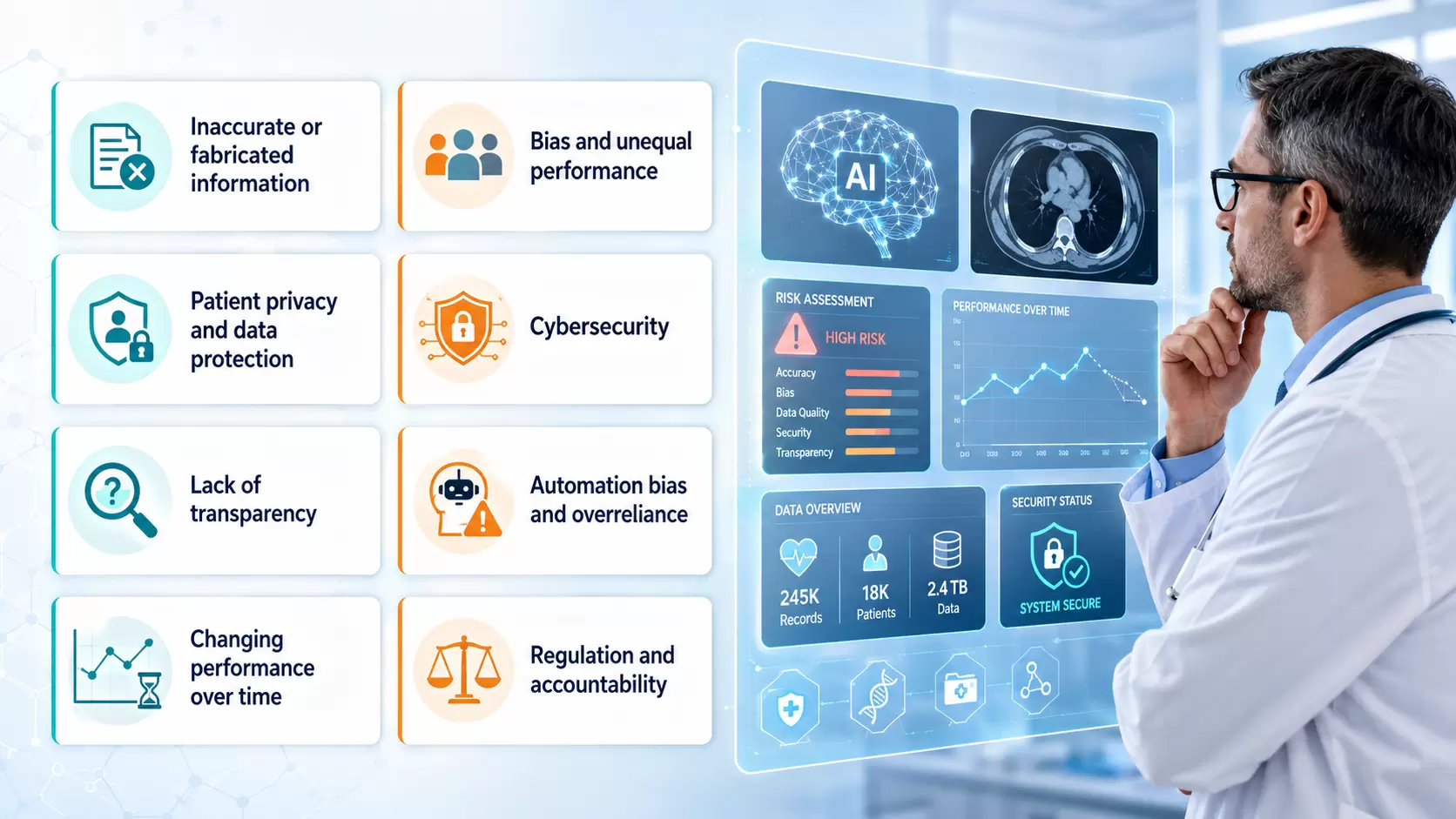
Healthcare is a high-stakes environment. An incorrect movie recommendation is inconvenient. Incorrect medical information can cause real harm.
That makes responsible implementation as important as technical capability.
Inaccurate or fabricated information
Generative AI can produce responses that sound confident even when they are wrong.
WHO has warned that large language models may produce completely incorrect or seriously inaccurate health-related responses and recommends rigorous evaluation and expert supervision before routine healthcare use.
This is why AI-generated clinical or patient-facing content should not be trusted solely because it sounds professional.
Bias and unequal performance
AI learns from data.
If its training or validation data do not adequately represent the people who will use the system, performance can differ between populations. Historical inequalities can also become embedded in data and reproduced by algorithms.
WHO's current work on AI and health repeatedly highlights bias, equity, representativeness, and data governance as core concerns.
Patient privacy and data protection
Health data can include highly sensitive personal information.
Before connecting AI to health records, documents, messages, or other patient information, organizations need to understand:
- what information enters the system;
- where it is processed;
- what vendors or subprocessors can access it;
- how long information is retained;
- what security controls apply; and
- which legal and contractual requirements govern its use.
WHO specifically includes privacy, data protection, and the handling of sensitive health information among key concerns for generative AI.
Cybersecurity
More connected technology creates more systems, integrations, credentials, endpoints, and data flows that need protection.
Healthcare organizations therefore need to evaluate AI as part of their wider security architecture rather than treating it as an isolated software purchase.
Lack of transparency
Some AI models can provide a recommendation without making it easy to understand how the result was produced.
That becomes a major concern when a clinician, patient, auditor, or regulator needs to know why a high-stakes recommendation was made.
Transparency does not always require exposing every mathematical operation. It does require enough information for the intended user to understand what the system does, its limits, and when its output should not be trusted.
Automation bias and overreliance
People can start trusting a system simply because it usually works.
That creates automation bias: the tendency to accept a machine's recommendation even when other evidence suggests it should be questioned.
Healthcare workflows should define when human review is required and make it easy for staff to challenge or override AI output.
Changing performance over time
Real-world data, workflows, populations, clinical practices, and software can change.
A model that performed well during initial testing may therefore need continued monitoring after deployment. FDA guidance increasingly addresses AI-enabled medical-device software across its lifecycle, including change management and ongoing performance considerations.
Regulation and accountability
Not every healthcare AI system is regulated in the same way.
In the United States, the regulatory treatment of software depends partly on what the software does and its intended use. The FDA currently publishes guidance covering areas such as clinical decision support, AI-enabled device software, change-control plans, cybersecurity, and other digital-health functions.
Organizations should involve appropriate clinical, legal, privacy, cybersecurity, and regulatory professionals when an AI use case affects patient care or regulated activity.
Where Does AI Automation in Healthcare Make the Most Sense?
AI automation in healthcare works best when the organization begins with the workflow problem rather than the technology.
A useful question is:
“Which repetitive process creates delay or manual work, and what is the safest part of that process to automate?”
Lower-risk operational opportunities can include:
- appointment scheduling and reminders;
- administrative intake;
- document routing and classification;
- internal notifications;
- approved routine communications;
- report preparation;
- information extraction;
- workflow status updates; and
- routing exceptions to the correct employee.
JDG's AI automation services specifically cover workflow mapping, AI agents, document processing, integrations, human approval checkpoints, and healthcare administrative use cases such as intake, scheduling, document routing, and approved patient communication. Its approach also emphasizes keeping employees involved in sensitive decisions and exceptions.
More complex organizations may need systems built around their own data, permissions, integrations, and workflows rather than a generic chatbot. JDG's custom AI agent development services cover custom agents, internal AI platforms, integrations, permissions, knowledge systems, and human-control mechanisms.
For healthcare organizations, that kind of business automation should still be separated from clinical decision-making unless the appropriate clinical validation, security, governance, and regulatory requirements have been addressed.
How Should a Healthcare Organization Evaluate an AI Project?
Buying an AI tool is easy. Integrating it responsibly into healthcare operations is harder.
A structured process helps.
1. Start with a defined problem
Do not begin with “Where can we use AI?”
Start with a measurable problem such as:
- appointment requests take too long to route;
- employees manually classify hundreds of documents;
- staff repeatedly copy data between systems; or
- a clinical team needs better support reviewing a specific type of information.
The use case should exist before the technology decision.
2. Classify the risk
Ask what happens if the AI is wrong.
A spelling error in an internal draft has a very different risk profile from a missed clinical warning.
The greater the possible harm, the stronger the evidence, validation, oversight, security, and governance should be.
3. Review the data
Understand what information the AI requires and whether that data is complete, accurate, representative, permitted for the intended use, and properly protected.
Poor data does not become good data simply because an advanced model analyzes it.
4. Validate the system in the intended environment
Do not assume a vendor demonstration proves that a system will work for your organization.
Testing should reflect actual users, workflows, populations, edge cases, and failure scenarios.
5. Define human oversight
Write down what AI can do independently and what requires approval.
Also define:
- who reviews exceptions;
- who can override the system;
- what happens when the system is unavailable; and
- who is accountable for the final decision.
WHO's 2026 work on AI governance stresses human oversight, multidisciplinary collaboration, and risk-based regulation while stating that AI should augment rather than replace human judgment.
6. Review privacy and cybersecurity
Map every data flow before deployment.
Security teams should understand integrations, credentials, permissions, retention, third-party access, logs, and fallback procedures.
7. Integrate AI into the real workflow
An accurate model can still fail if employees do not know how to use it or if it adds extra steps.
The technology must fit into existing clinical or business processes and make responsibility clear.
Healthcare organizations developing patient-facing digital experiences may also need secure, usable interfaces around these systems. JDG's web design and development services support custom websites and digital development, while the clinical or regulated components of a healthcare system should remain under appropriate specialized oversight.
8. Monitor performance after launch
Deployment is not the end of an AI project.
Organizations should monitor:
- accuracy;
- errors;
- exceptions;
- user feedback;
- security incidents;
- changes in data;
- unexpected outcomes; and
- whether the automation is actually improving the original process.
What Are the Future Trends for AI Technology in Healthcare?
The next stage of artificial intelligence in healthcare is likely to be less about isolated AI tools and more about AI becoming part of connected workflows.
Several trends are already visible.
Multimodal healthcare AI
Many early AI systems specialized in one type of information.
Multimodal models can work across text, images, and other data types. WHO expects these systems to have broad potential applications across healthcare, research, public health, and drug development.
Future systems may therefore combine different information sources rather than treating every data type separately.
More AI-assisted documentation
Generative AI is likely to become more deeply connected with documentation workflows.
Instead of employees manually preparing every summary or transferring every detail between systems, AI can draft and organize information while people verify the final result.
Accuracy and privacy controls will remain essential because clinical documentation cannot be treated like ordinary AI-generated content.
Agentic healthcare workflows
AI agents are designed to complete a sequence of tasks rather than only respond to one prompt.
For example, an operational agent might receive a request, retrieve approved information, classify it, update a connected system, and then ask a staff member for approval.
WHO's 2026 work on “agentic workflows and human oversight” reflects growing interest in this shift from passive AI tools toward systems that can coordinate more complex healthcare tasks. WHO also highlights new questions around accountability, escalation, reliability, and human judgment.
Continuous monitoring and lifecycle governance
Healthcare organizations will increasingly need to ask not only whether an AI system worked when it launched, but whether it continues to work safely months or years later.
FDA guidance on AI-enabled device software and change-control planning reflects this growing focus on lifecycle management rather than one-time evaluation.
More connected patient monitoring
Wearable devices, remote sensors, home-based monitoring, and digital-health platforms are producing growing amounts of health information.
AI can help turn those streams into alerts, summaries, and patterns that humans can review.
The challenge will be avoiding alert overload while keeping clinicians in control of important decisions.
Greater focus on AI governance and literacy
AI adoption is moving faster than governance in many health systems.
Recent WHO work emphasizes the need for stronger strategies, workforce training, legal safeguards, data governance, and equitable access.
Organizations that teach employees when to trust, question, or escalate AI output may be better prepared than those that focus only on buying new software.
Will Artificial Intelligence Replace Healthcare Professionals?
AI is more likely to change individual tasks than eliminate the need for healthcare professionals.
A system can analyze data quickly, generate a draft, detect a pattern, or automate a repetitive process. It cannot automatically reproduce the full clinical context, accountability, empathy, ethical judgment, and responsibility involved in caring for a person.
WHO's April 2026 guidance on AI in health policy states directly that AI should augment rather than replace human judgment.
The more important question is therefore not, “Will AI replace doctors?”
It is:
Which tasks should technology handle, which decisions require people, and how should the two work together safely?
That is likely to define the next generation of healthcare technology.
Building a More Responsible AI Strategy for Healthcare
Artificial intelligence in healthcare has moved from a future possibility to a practical technology category. Medical imaging, administrative automation, research support, patient communication, predictive systems, and connected devices already show how broad its role can become.
The opportunity is significant, but healthcare organizations should resist using AI simply because it is available.
A better approach is to start with a defined problem, match the technology to the risk of the task, protect sensitive data, validate performance, establish human review, and keep monitoring the system after launch.
For organizations exploring non-clinical operational automation, JDG's AI automation services can support workflow assessment, integrations, document processing, and human-controlled automation. Healthcare businesses that also need stronger search visibility can explore JDG's healthcare SEO services, while its SEO content strategy services can support more structured, useful online content.
Clinical AI, medical-device software, or systems that influence diagnosis or treatment require the involvement of appropriately qualified clinical, legal, security, privacy, and regulatory professionals.
The future of AI in healthcare will not depend only on building more powerful models. It will depend on applying them to the right problems while keeping safety, evidence, accountability, and people at the center.
Frequently Asked Questions
What is artificial intelligence in healthcare?
Artificial intelligence in healthcare is the use of AI technologies to analyze information, identify patterns, generate content, automate tasks, or support decisions across clinical care, research, patient services, and healthcare operations.
How is artificial intelligence used in healthcare?
AI is used for medical imaging, diagnostic support, risk prediction, clinical documentation, administrative automation, patient communication, remote monitoring, research, drug development, and health-system management.
What are examples of artificial intelligence in healthcare?
Examples include AI-assisted medical-image analysis, ECG analysis, ultrasound tools, risk-prediction systems, clinical-note drafting, patient assistants, automated scheduling, document processing, and research-support systems. The FDA currently maintains a public list of authorized AI-enabled medical devices.
What are the main benefits of artificial intelligence in healthcare?
Potential benefits include faster analysis, less repetitive administrative work, better decision support, scalable patient services, more personalized experiences, and faster research workflows. The actual benefit depends on the quality of the data, technology, workflow, and implementation.
What are the biggest risks of AI in healthcare?
Major concerns include inaccurate AI-generated information, bias, privacy, cybersecurity, lack of transparency, overreliance on automation, poor-quality data, changing model performance, and unclear accountability.
What is AI automation in healthcare?
AI automation combines artificial intelligence with workflow software and integrations to complete or support repetitive processes. Examples include scheduling, document classification, intake, information extraction, reporting, and routing requests to employees.
Will AI replace doctors and nurses?
AI is more likely to automate or assist specific tasks than replace the full role of healthcare professionals. High-stakes healthcare decisions require context, responsibility, communication, and human judgment. WHO recommends using AI to augment rather than replace human judgment.
Is artificial intelligence in healthcare regulated?
Regulation depends on what the system does, how it is marketed, its intended use, and the jurisdiction. In the United States, the FDA has guidance covering areas such as clinical decision-support software, AI-enabled device software, change-control plans, and cybersecurity.
Sources / Research References
- WHO — Harnessing Artificial Intelligence for Health — current applications of AI across clinical care, research, public health, and health systems.
- WHO — AI and Evidence-Informed Health Policy, April 2026 — human oversight, bias, equity, governance, and risk-based implementation.
- WHO — Guidance on Large Multimodal Models — definitions of AI, generative AI, and multimodal models.
- WHO — Safe and Ethical AI for Health — risks involving inaccurate information, bias, sensitive data, and insufficient oversight.
- FDA — Artificial Intelligence-Enabled Medical Devices — current U.S. examples and regulatory context for authorized AI-enabled devices.
- FDA — Digital Health Guidance Documents — current guidance covering clinical decision support, AI-enabled device software, cybersecurity, and lifecycle considerations.

Your comment will appear after approval.