
 Written By :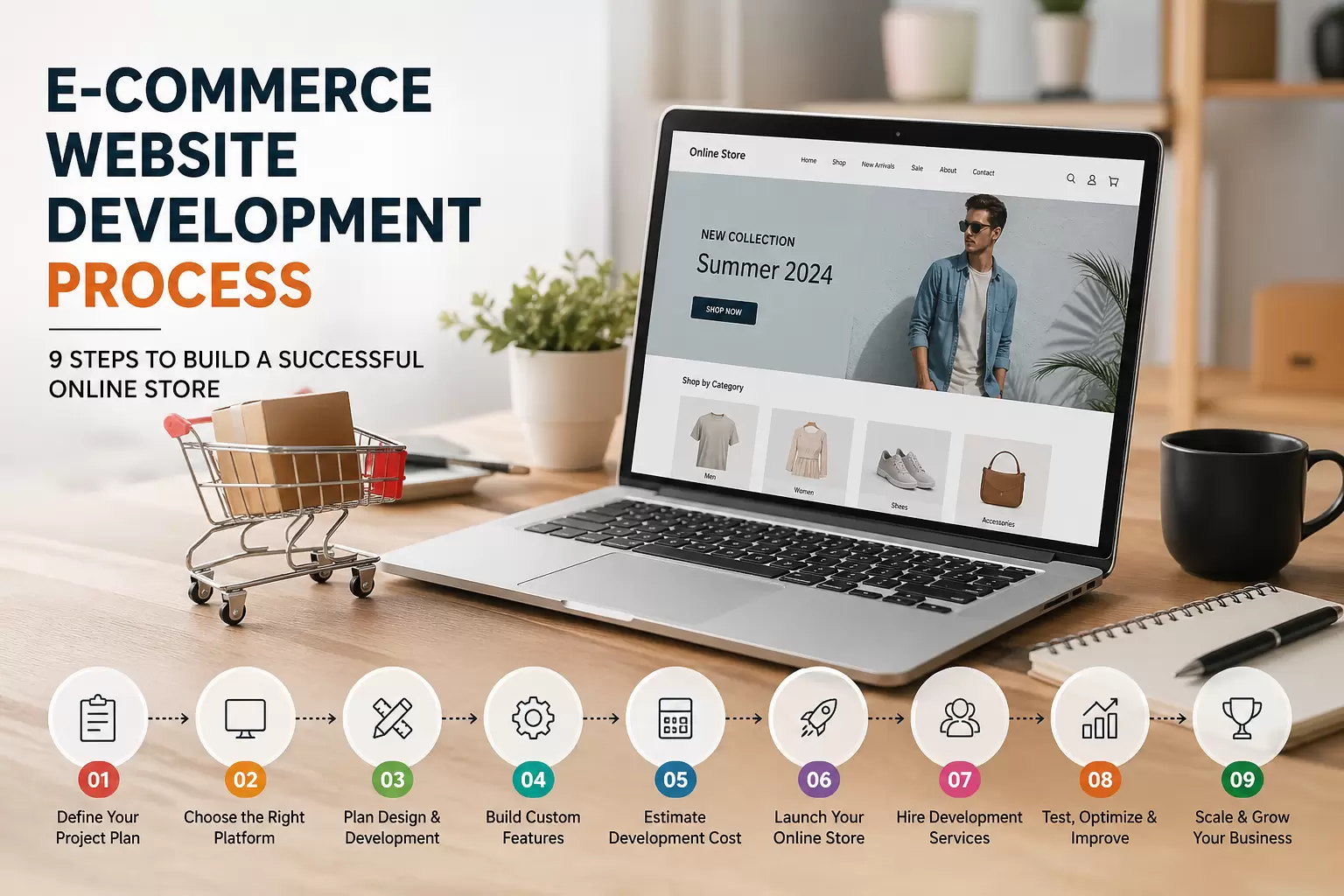
 ChatGPT
 Perplexity
 Claude
 Gemini
Starting an online store can feel overwhelming. You have products to source, a brand to build, and a thousand questions about platforms, design, and cost. But here is the thing: every successful ecommerce store begins the same way, with a clear, repeatable ecommerce website development process. The brands that get it right are the ones that follow a structured path from idea to launch.
In this guide, we will walk you through the complete e-commerce website development journey in nine actionable steps. Whether you are launching your first store or rebuilding an existing one, these steps will save you time, money, and costly mistakes. We have built dozens of online stores at JustDigitalGurus, and this process is the same one we use with every client.
What is E-commerce Website Development?
E-commerce website development is the end-to-end process of building a website where businesses can sell products or services online. It covers everything from planning the site structure and choosing a platform to designing the user interface, integrating payment gateways, setting up inventory management, and launching the store to the public.
But it is more than just technical work. Real e-commerce website development includes a strategy. You need to decide who your customers are, how they will find your store, what kind of shopping experience you want to create, and how you will handle orders and shipping. The development phase is where all of those decisions become reality.
For example, a clothing store selling handmade goods needs a different setup than an electronics retailer shipping nationwide. The first might thrive on Shopify with a simple checkout flow. The second may need a custom-built solution with advanced shipping calculators, real-time inventory syncing, and multi-warehouse support. Understanding what e-commerce website development in your specific context is the first step to getting it right.
Why a Clear E-commerce Development Process Matters
Building an online store without a process is like driving across the country without a map. You might eventually get there, but you will waste time, burn through your budget, and hit unnecessary roadblocks. A defined ecommerce development process keeps your project on track, on budget, and aligned with your business goals.
The e-commerce website development process matters for four key reasons. First, it reduces risk. When you follow a structured approach, you catch issues early before they become expensive problems. Second, it improves quality. Each step builds on the previous one, so your final product is well-thought-out rather than thrown together. Third, it saves money. Clear processes eliminate guesswork, rework, and scope creep. Fourth, it creates accountability. Everyone on the team knows what needs to happen and when.
In our experience at JustDigitalGurus, projects that follow a clear process are three times more likely to launch on time and within budget compared to those built without one.
Step 1. Define Your E-commerce Website Development Project Plan
Every successful store starts with a plan. Before you buy a domain, pick a platform, or design a single page, you need to get clear on the fundamentals. This is where you build your e-commerce website development project plan.
Begin by answering these questions: What are you selling? Who are you selling to? What makes your product different? How will customers find you? What features does your store absolutely need to function? Do you need a blog? A loyalty program? Multi-currency support? Subscription billing?
A strong project plan includes a realistic timeline, a budget range, and a list of must-have features versus nice-to-haves. For instance, a small business selling candles online may only need basic product pages, a cart, and a payment gateway. A growing fashion brand might need customer accounts, wishlists, size guides, product reviews, and social media integration from day one.
We recommend writing a one-page brief that covers your business goals, target audience, key products, and technical requirements. Share this with your development team before any design or coding begins. It will act as your north star for the entire project.
Step 2. Choose the Best Platform for E-commerce Website Development
Your platform is the foundation of your online store. Choosing the wrong one can lead to expensive migrations later, so this decision deserves serious thought. The best platform for e-commerce website development depends on your budget, technical skills, product catalog size, and growth plans.
Shopify ecommerce website development is a popular choice for businesses that want a fast, managed solution. Shopify handles hosting, security, and updates for you, so you can focus on selling. It is especially good for small to medium-sized stores with straightforward needs. You can launch a basic Shopify store in days rather than weeks.
On the other hand, if you need total control and have complex requirements, a platform like WooCommerce (built on WordPress) or a fully custom build might be better. WooCommerce gives you unlimited flexibility with thousands of plugins, but you are responsible for hosting, security, and maintenance. Custom builds offer complete freedom but require a larger upfront investment.
Here is a quick comparison to help you decide:
| Platform | Best For | Ease of Use | Customization | Starting Cost | Scalability |
| Shopify | Small to medium stores, fast launch | Very easy | Moderate (themes + apps) | From $39/month | High |
| WooCommerce | Businesses needing full control | Moderate | Very high (open source) | Free plugin (hosting extra) | High |
| BigCommerce | Growing stores with large catalogs | Easy | Moderate | From $39/month | Very high |
| Magento (Adobe Commerce) | Enterprise-level stores | Complex | Extremely high | From $2,000/month |
Enterprise-grade |
| Custom Build | Unique or complex requirements | Requires developer | Unlimited | $15,000+ |
Depends on the architecture |
Take your time with this step. Research each option, talk to developers who have experience with each platform, and consider where you want your business to be in three years. The right choice now will save you months of frustration later.
Step 3. Plan E-commerce Website Design and Development
Design is not just about how your store looks. It is about how it works. E-commerce website design and development is the phase where you create the visual identity of your brand and map out the customer journey from first visit to final purchase.
Start with wireframes. These are simple, black-and-white layouts that show where each element goes on the page: the logo, navigation bar, product images, add-to-cart button, footer, and so on. Wireframes help you focus on structure without getting distracted by colors and fonts too early.
Next comes the visual design. This is where you apply your brand colors, typography, photography style, and overall look and feel. A good ecommerce design does three things: it builds trust, it guides the eye, and it removes friction. For example, product pages should have high-quality images, clear pricing, visible stock status, and a prominent add-to-cart button. Hidden fees, confusing navigation, or slow-loading pages will kill conversions.
Once the design is finalized, the development phase begins. Developers turn those designs into working code, connecting the front-end (what customers see) with the back-end (inventory, payments, shipping, customer data). This is where your store starts to come alive.
Step 4. Build Custom E-commerce Features
Off-the-shelf themes and plugins work well for standard stores, but many businesses need something unique. This is where custom e-commerce website development comes in. If you need a feature that your platform does not offer out of the box, you build it.
Custom ecommerce website development services cover everything from custom product configurators and subscription management tools to advanced search filters, personalized recommendation engines, and custom checkout flows. For example, a furniture store might need a room visualizer tool that lets customers see how a sofa looks in their living room. A food delivery service might need a dynamic ordering system with real-time delivery slot selection.
Custom development gives you a competitive edge. Instead of working around the limitations of a generic theme, you build exactly what your customers need. However, custom features also add to your development timeline and cost. That is why it is important to prioritize. Focus on the features that directly impact revenue and customer experience first. You can always add more later.
At JustDigitalGurus, we always recommend starting with a minimum viable product (MVP) that includes your core features, then adding custom functionality based on real customer feedback after launch.
Step 5. Estimate E-commerce Website Development Cost
One of the most common questions we hear is, "How much does it cost to build an online store?" The honest answer is that e-commerce website development costs vary widely depending on complexity, features, platform, and who builds it.
A basic Shopify store using a pre-made theme might cost between $3,000 and $8,000. A mid-range WooCommerce store with custom design and a handful of custom features typically ranges from $10,000 to $30,000. A full-scale enterprise solution on Magento or a fully custom platform can run anywhere from $40,000 to $150,000 or more.
Beyond the initial build, you also need to factor in ongoing costs: hosting, domain, SSL certificate, app subscriptions, payment processing fees, marketing, and maintenance. A realistic monthly operating budget for a small e-commerce store is between $200 and $1,000. For larger stores, it can be significantly more.
The key is to view this as an investment rather than an expense. A well-built e-commerce site generates revenue every single day. The upfront cost is quickly recovered if your store is built to convert.
Quick Cost Snapshot
Simple store: $3,000 - $8,000 | Mid-range store: $10,000 - $30,000 | Enterprise store: $40,000+
Step 6. Launch Your Online Store
Launch day is exciting, but it is not the finish line. Launching successfully means more than just flipping a switch. It requires thorough testing, a marketing plan, and a strategy for the first 30 days after launch.
Before you hit publish, test everything. Go through the entire purchase flow on desktop, tablet, and phone. Add a product to the cart, apply a discount code, enter shipping details, and complete the purchase. Then check that the order confirmation email arrives, that the payment was captured correctly, and that the inventory was reduced. Test your site speed. Check all your links. Make sure your contact forms work.
Online store development also includes setting up analytics, search console, and marketing tools before launch. Install Google Analytics, set up conversion tracking, and configure your email marketing platform. Have at least a few products with reviews and social proof ready. Plan a launch promotion, whether it is a discount for first-time buyers, a giveaway, or an email campaign to your existing audience.
A soft launch can be a smart strategy. Launch to a small audience first, gather feedback, fix any issues, and then do a full public launch. This reduces the risk of a bad first impression.
Step 7. When Should You Hire E-Commerce Website Development Services?
You might be wondering whether to build the store yourself or hire professionals. The answer depends on your goals, budget, and technical comfort level. Many business owners start with a DIY approach using a platform like Shopify or WooCommerce, and that can work well for simple stores. But as your business grows, the limitations of a DIY store become more apparent.
You should consider e-commerce website development services when you need more than a basic store. If your project requires custom features, complex integrations, a unique design, or optimized performance, working with an e-commerce website development company is the smart move. Professionals bring experience, efficiency, and a level of quality that is hard to achieve alone.
Here are the signs that it is time to hire help:
- You have tried building it yourself and feel stuck or overwhelmed.
- Your store needs custom functionality that no plugin can provide.
- You want a unique, professional design that stands out from competitors.
- You need the store to launch quickly and cannot afford trial and error.
- You plan to scale and need a site that can handle growth without breaking.
- You prefer to focus on running your business rather than managing technical details.
At JustDigitalGurus, we have helped dozens of businesses launch successful online stores. Our e-commerce website development services cover everything from strategy and design to custom development, testing, and post-launch support. Whether you need a simple Shopify store or a complex custom solution, we can help you build it right.
The 80/20 E-commerce Development Framework
Here is something most blog posts will not tell you. Through years of building e-commerce stores, we have noticed a pattern: 80% of your revenue will come from 20% of your features. And yet, most store owners spend 80% of their budget on the 20% of features that matter least.
The 80/20 E-commerce Development Framework flips that. Instead of trying to build everything at once, we focus on the features that directly impact revenue: fast load times, clear product pages, a frictionless checkout, mobile responsiveness, and trust signals like reviews and secure payment badges. These are the non-negotiable elements that every successful store needs.
Everything else, the fancy animations, the advanced filters, the multi-language support, the complicated loyalty programs, can be added later. But too many store owners delay their launch, trying to perfect features that will not move the revenue needle. They end up spending six months and their entire budget on a site that looks beautiful but struggles to make sales.
Here is how the 80/20 Framework works in practice:
- Phase 1 (The Core 20%): Build a fast, mobile-optimized store with 5-10 products, a simple checkout, and basic analytics. Launch in 4-6 weeks.
- Phase 2 (Test & Learn): Run the store for 60-90 days. Collect real data on what customers do, what they buy, and where they drop off.
- Phase 3 (Iterate): Use that data to decide which features to build next. Add the features that your customers are actually asking for, not the ones you assumed they wanted.
- Phase 4 (Scale): Once the store is generating consistent revenue, reinvest in advanced features, marketing automation, and growth tools.
This framework has saved our clients thousands of dollars and months of wasted effort. If you take one thing away from this guide, let it be this: launch fast, learn fast, and build only what your customers prove they need. Most features can wait. Revenue cannot.
Build Your E-commerce Store the Right Way
Building an online store is one of the most rewarding things you can do for your business. But it is also one of the most complex. The difference between a store that struggles and one that thrives often comes down to the process you follow.
We have covered nine steps that form a complete ecommerce website development process: defining your project plan, choosing the right platform, designing for conversion, building custom features, understanding the cost, launching strategically, and knowing when to bring in experts. Each step matters. Skipping any one of them creates risk.
At JustDigitalGurus, we specialize in e-commerce website design and development. Whether you need custom e-commerce website development services or guidance on your existing store, we are here to help. Our team has built stores across Shopify, WooCommerce, and custom platforms, and we know what it takes to create a site that not only looks great but actually sells.
Ready to start your e-commerce journey? Get in touch with us for a free consultation. We will help you map out your project plan, estimate your e-commerce website development cost, and build a store you can be proud of.

Your comment will appear after approval.