
 Written By :
 ChatGPT
 Perplexity
 Claude
 Gemini
Posing is one of those things that looks effortless in the final images and feels anything but in the moment. Most couples aren't models. They're nervous, excited, and very aware that a camera is pointed at them. Your job as the photographer is to make them forget about that, and the way you do it matters more than any specific wedding photography poses you've memorized.
This guide is for photographers who want to build a practical posing repertoire, connect it to a real workflow, and understand how all of it ties into the broader client experience from the first questionnaire to the final gallery delivery.
We'll cover specific wedding photography poses by session type, how to direct couples naturally, what to include in your shot list, common mistakes that quietly hurt your work, and how the right workflow keeps everything from falling apart on the day.
Why Wedding Photography Poses Matter
Creating Timeless Memories
The best wedding photos don't look posed. They look like moments that happened to be captured. Getting there requires a photographer who knows enough about posing to set things up correctly and then get out of the way.
Wedding photography poses give you a structural starting point. From that foundation, you prompt genuine emotion, adjust for the light, and let real moments unfold. The pose is the scaffolding. The image is what happens when the couple stops thinking about the pose.
Couples look back at wedding photos for decades. The images they cherish most are usually not the technically perfect portrait shots. They're the ones where they look like themselves, comfortable, connected, and present. Your posing approach determines how often you capture those moments.
Building Client Confidence
Most couples have never been photographed professionally as a pair. They arrive at the portrait session genuinely unsure of what to do with their hands, how close to stand, where to look. That uncertainty shows in the images unless you address it early.
Confident direction from a photographer immediately puts couples at ease. When you say "Turn toward each other, hold hands, now just have a conversation for a moment," and something natural happens, the couple realizes they don't need to perform. They just need to be with each other. That shift is the foundation of great portrait work.
Improving Storytelling
Wedding photography poses are ultimately in service of story. The story of how these two people feel about each other on this specific day. Romantic poses tell one part of that story. Candid moments tell another. The getting-ready images, the quiet pre-ceremony nervousness, the unguarded laughter at the reception: all of it together creates a coherent narrative.
Thinking about posing as storytelling rather than composition changes how you approach it. You're not arranging people for a photograph. You're setting conditions for genuine moments to occur.
Essential Wedding Photography Poses Every Photographer Should Know
Classic Posing Techniques
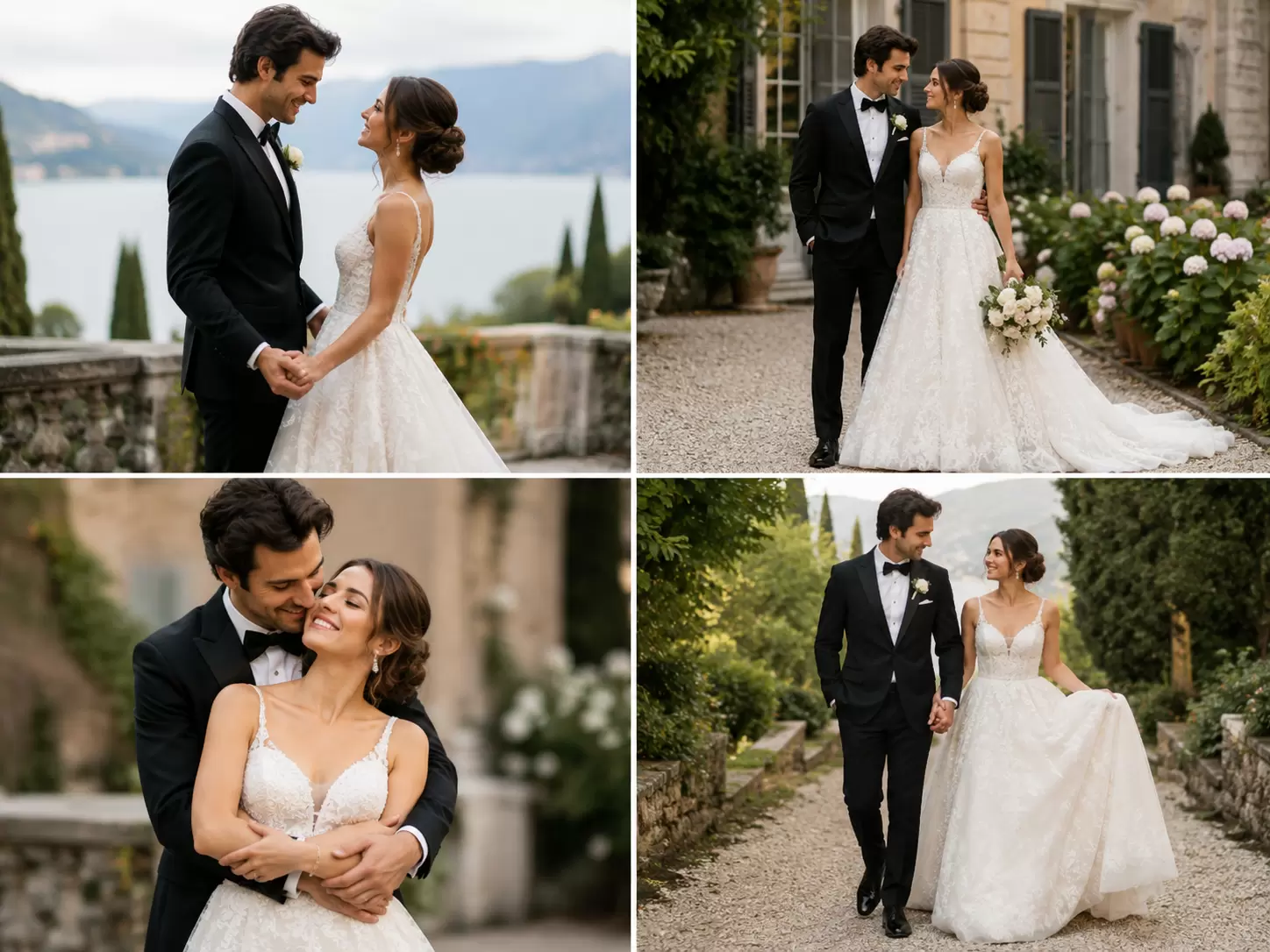
These are your reliable starting points. Every photographer should have a handful of poses they can deploy immediately without having to think too hard. When you have a couple in front of you and only 15 minutes for portraits, you don't want to be inventing from scratch.
Standing poses to always have ready:
- The classic hold: Couple facing each other, both sets of hands intertwined, slight lean toward each other. Simple, clean, works in any setting.
- Side by side: Both facing slightly toward each other, groom's arm around the bride's waist. Good for showing the full look: dress, flowers, venue backdrop.
- Behind hold: Groom stands behind the bride, arms wrapped around her from behind. Bride looks forward or tilts her head back toward him. Works beautifully with a strong background.
- The walk-and-stop: Ask them to walk naturally, then call "stop." The mid-movement freeze often produces a natural, unstaged energy that traditional standing poses miss.
Romantic Couple Poses
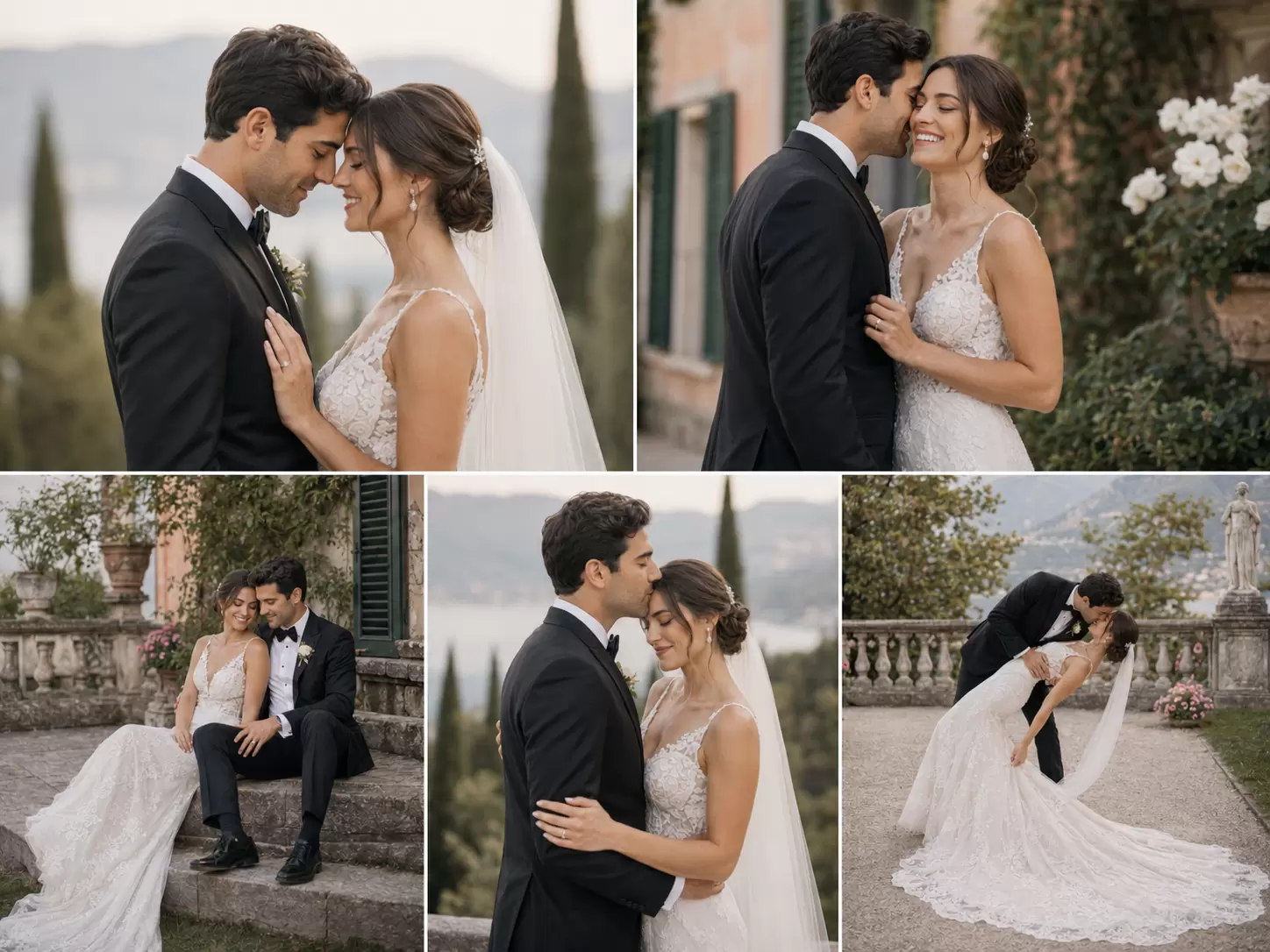
These are the wedding photography poses that make albums. They work because they're intimate without being over-the-top, and they prompt genuine emotion rather than performed expressions.
Forehead to forehead: Have the couple face each other, tilt their foreheads together, and just breathe for a moment. Eyes can be open or closed. Both produce beautiful results. The proximity creates intimacy; the pause creates presence. It's one of the most consistently successful poses in wedding photography.
The whisper: Ask the groom to whisper something in the bride's ear. Something only she would want to hear. What he says doesn't matter as much as what happens next: the smile, the laugh, the slight blush. That's what you're capturing. Shoot in rapid succession.
The quiet moment: Couple sitting together, not looking at the camera, just existing in the same space. On a bench, on the ground, on venue steps. These images feel like stolen moments, which is exactly what makes them compelling.
Forehead kiss: Groom places a gentle kiss on the bride's forehead while she tilts slightly toward him. Her expression is what makes this shot. Shoot from slightly below to get both faces.
The dip: Classic and dramatic. The groom dips the bride back (she should feel supported, so her body weight needs to be fully committed). Works best when there's a clear background and enough space to shoot from a low angle.
First Look Poses
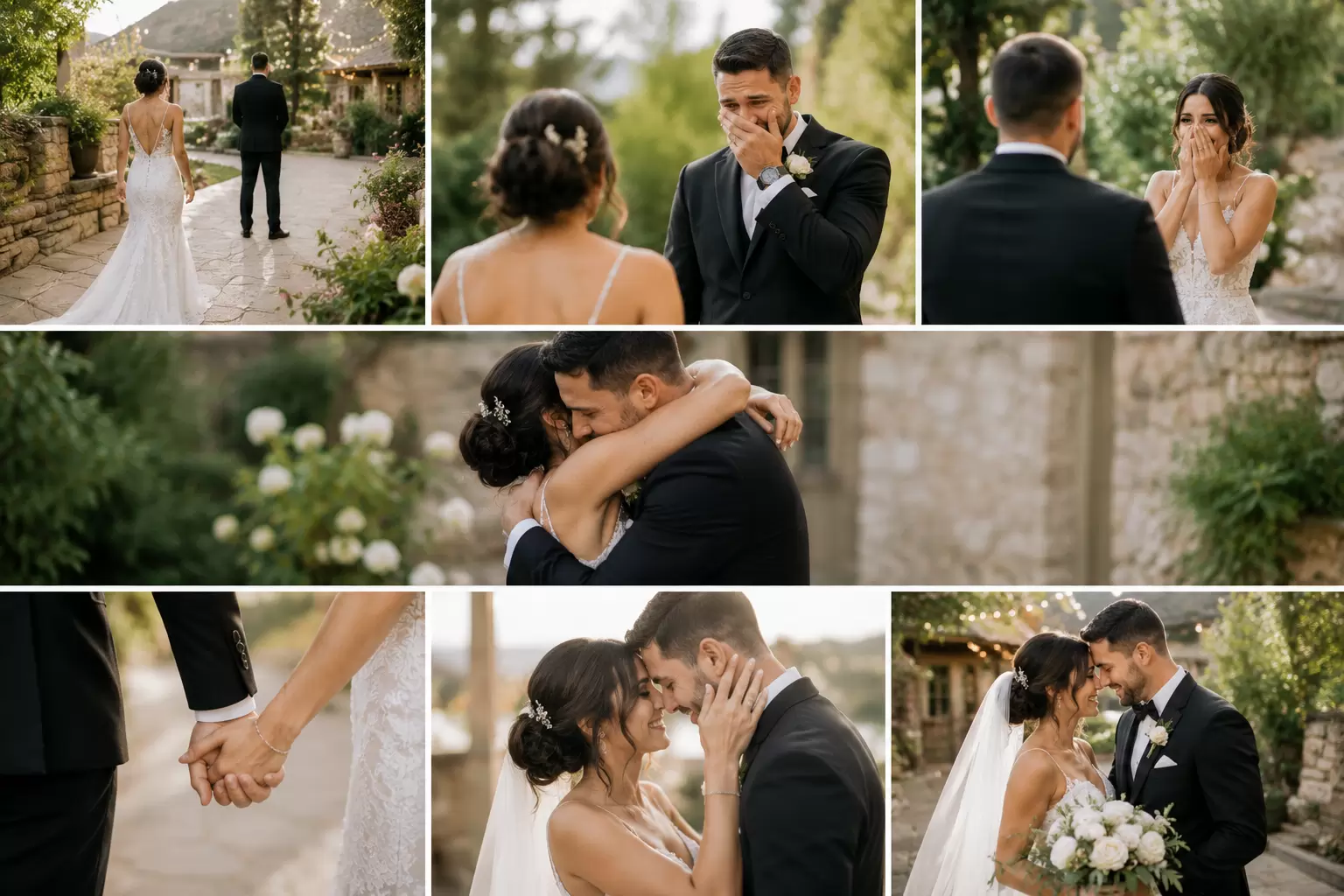
The first look is one of the most emotionally rich moments of the wedding day, and it offers distinct posing and positioning opportunities.
Setup: Position the groom with his back to the direction the bride will approach. Have the bride tap his shoulder or simply approach until she's close enough that he senses her presence and turns.
Your position: Stand to the side where you can capture both faces simultaneously as he turns. Have a second shooter positioned to catch the bride's approach from behind the groom.
What to capture:
- The approach (wide shot of the distance closing)
- The moment he turns (his expression before he fully registers what he's seeing)
- Her expression watching his reaction
- The first embrace
- Hands finding each other
- Any tears, laughter, or whispered words immediately after
After the initial reaction settles, move into couple portraits while the emotion is still fresh.
Bride Solo Portraits
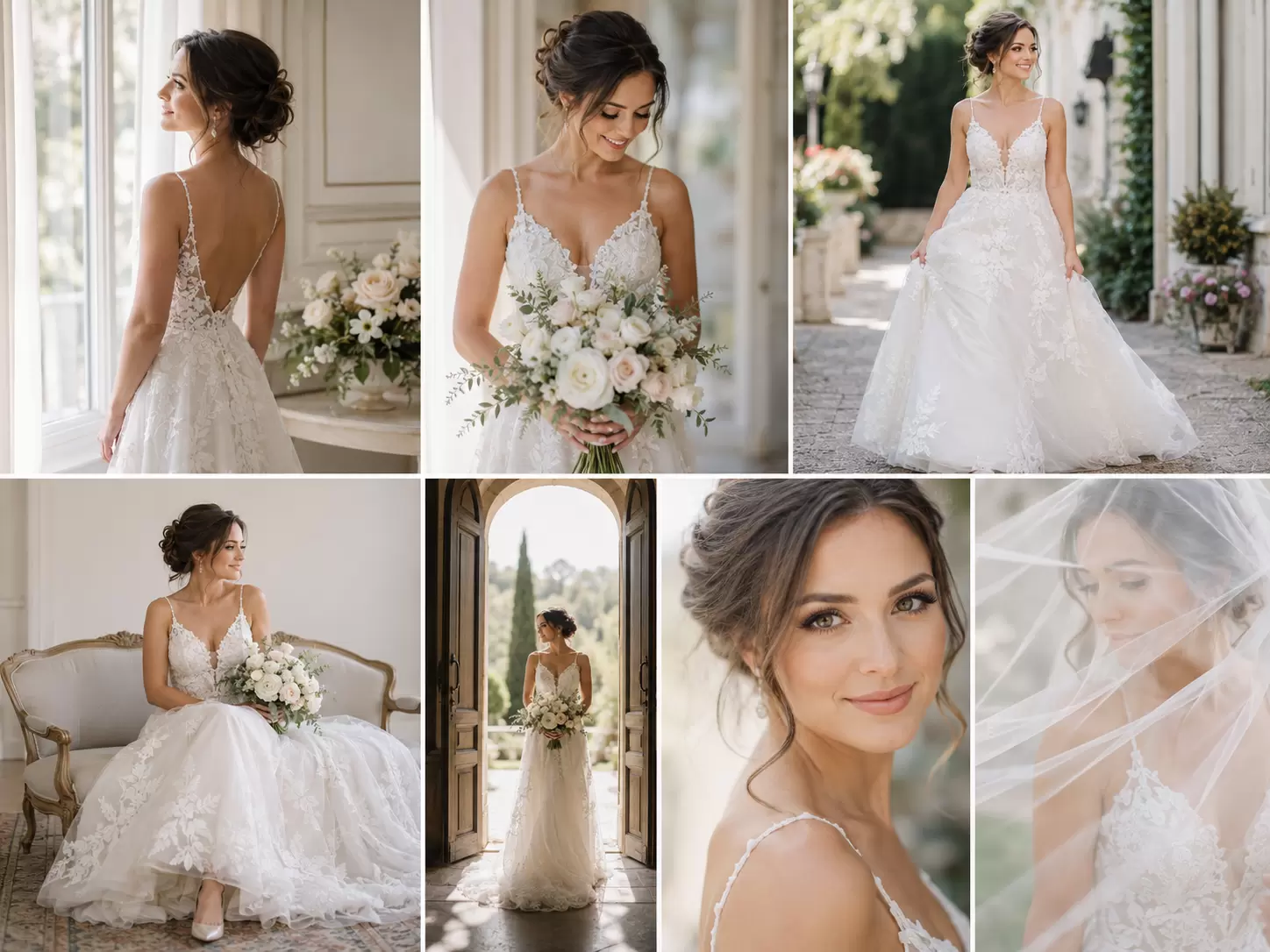
Solo bride portraits are worth dedicated time in your wedding photography poses repertoire. These are often among the most treasured images from the day.
Poses that work for solo bridal portraits:
- Looking away from camera, slightly toward window light
- Looking down at bouquet (not forced, a genuine glance)
- Walking toward camera at a slight angle
- Seated with dress arranged, looking to the side
- Standing in a doorway or archway, full-length shot
- Close-up of just the face, clean background
- Veil detail: veil being held up in wind or light, bride partially obscured
Natural light is your best friend for bridal portraits. A window, an open doorway, or shaded outdoor light produces the soft, flattering quality that most brides want.
Groom Portraits
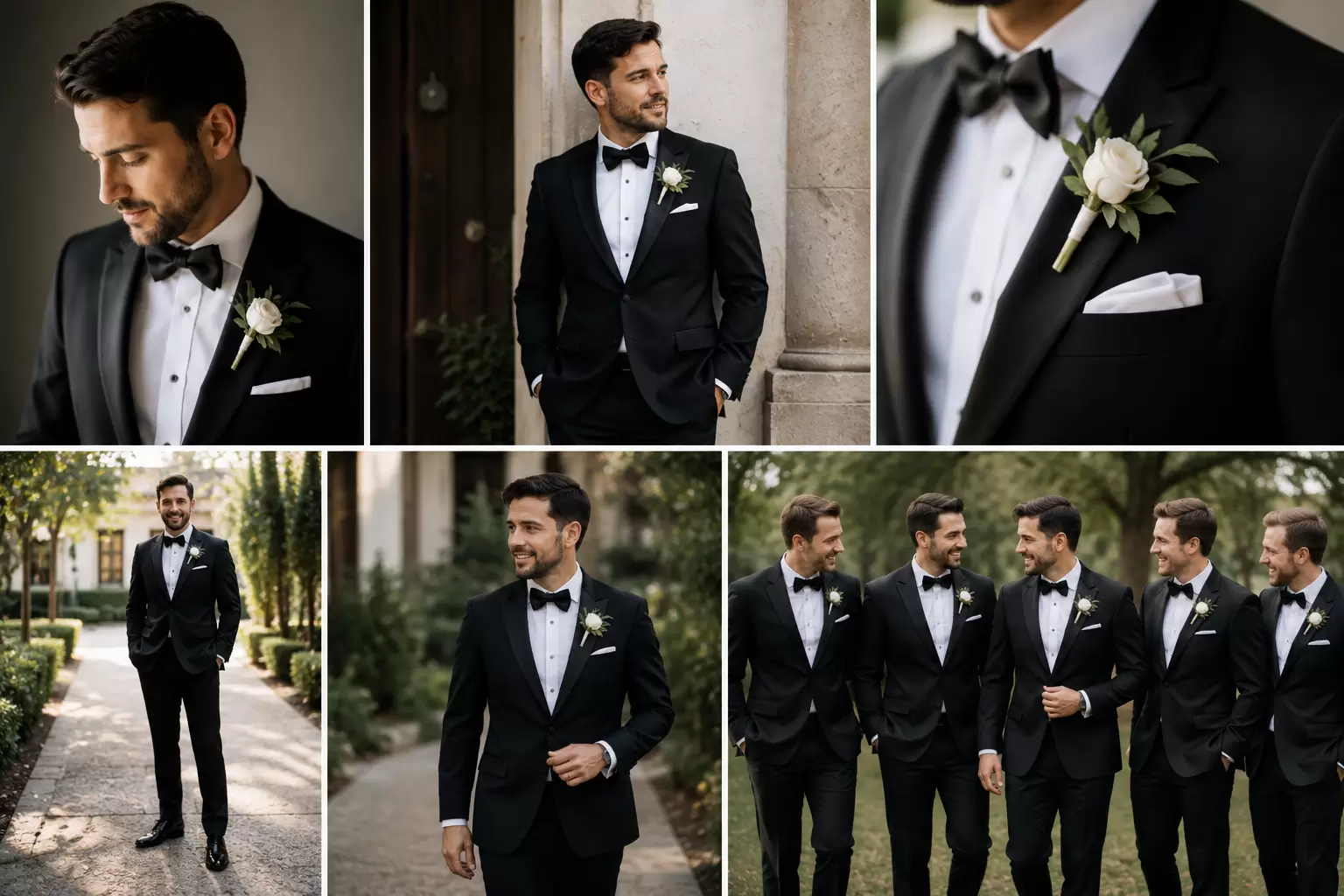
Groom portraits often get less attention than they deserve in planning. A few reliable approaches:
- Looking down or to the side (contemplative, natural)
- Hands in pockets, slight lean against wall or doorframe
- Close-up of boutonniere and jacket lapel detail
- Full-length standing in a clean, well-lit location
- Walking toward camera, looking slightly off-axis
- With groomsmen in a relaxed, unscripted moment
The groom's expression matters as much as his posture. Avoid the stiff, unsmiling "stand straight" portrait. A slight smile, a relaxed jaw, and natural hands make the difference.
Bridal Party Poses
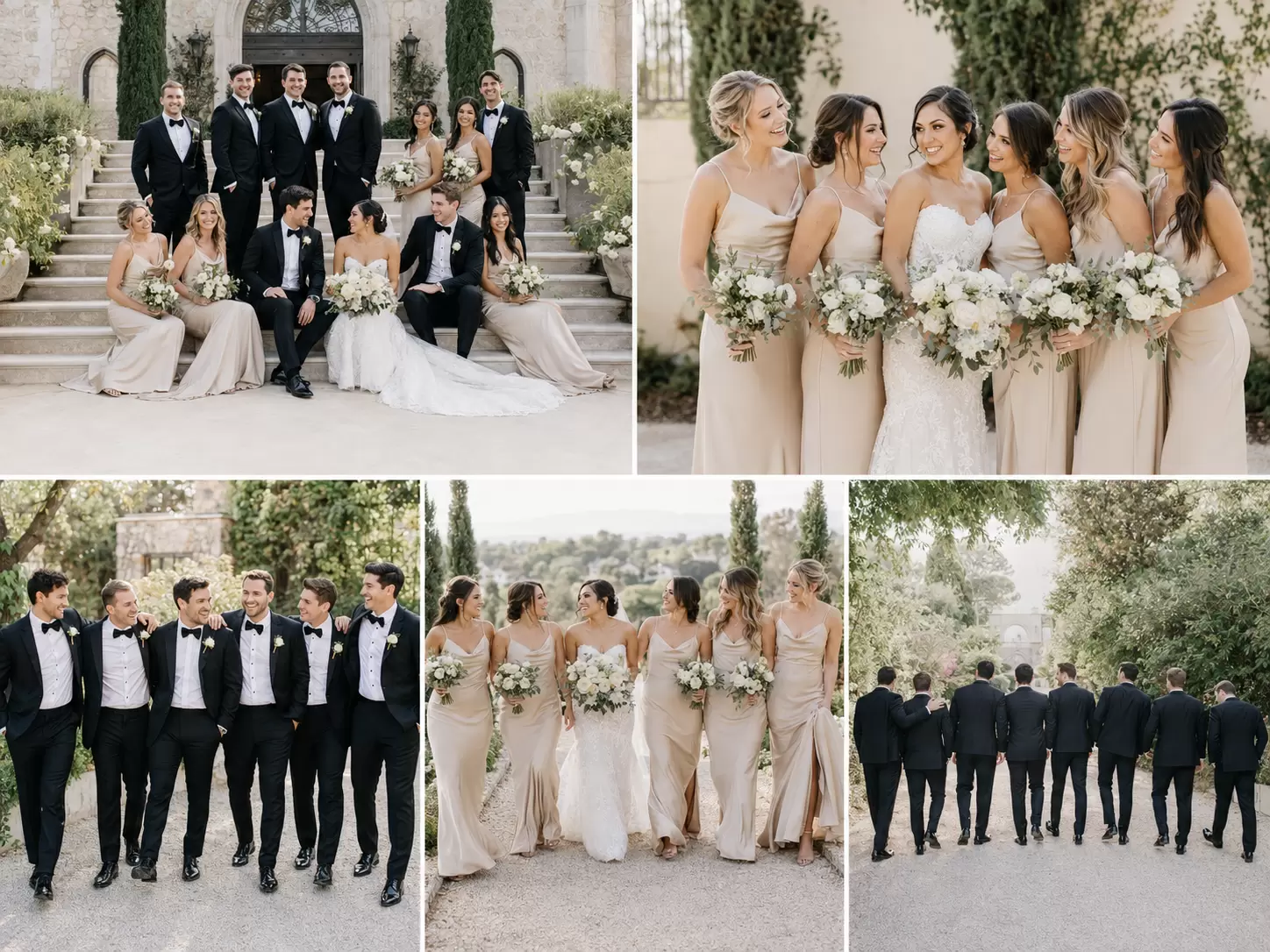
Group wedding photography poses require slightly different thinking than couple portraits. The challenge is creating something that looks natural while actually being choreographed.
Tips for bridal party groups:
- Use levels: standing, sitting, on stairs, some leaning. Flat same-height groups look static.
- Keep groups tight. People instinctively spread out; physically move them closer.
- Give everyone something to do with their hands (hold flowers, hands on shoulders, arms linked)
- Shoot multiple frames rapidly for any group over six people
- Try a candid laugh: say something to make them laugh genuinely rather than holding a forced smile for too long
Specific groupings to plan:
- Full wedding party together
- Bridesmaids alone with bride (formal and candid)
- Groomsmen alone with groom (formal and candid)
- Bridesmaids with bride in walking formation
- Groomsmen walking away from camera (candid, dynamic)
Family Portrait Arrangements
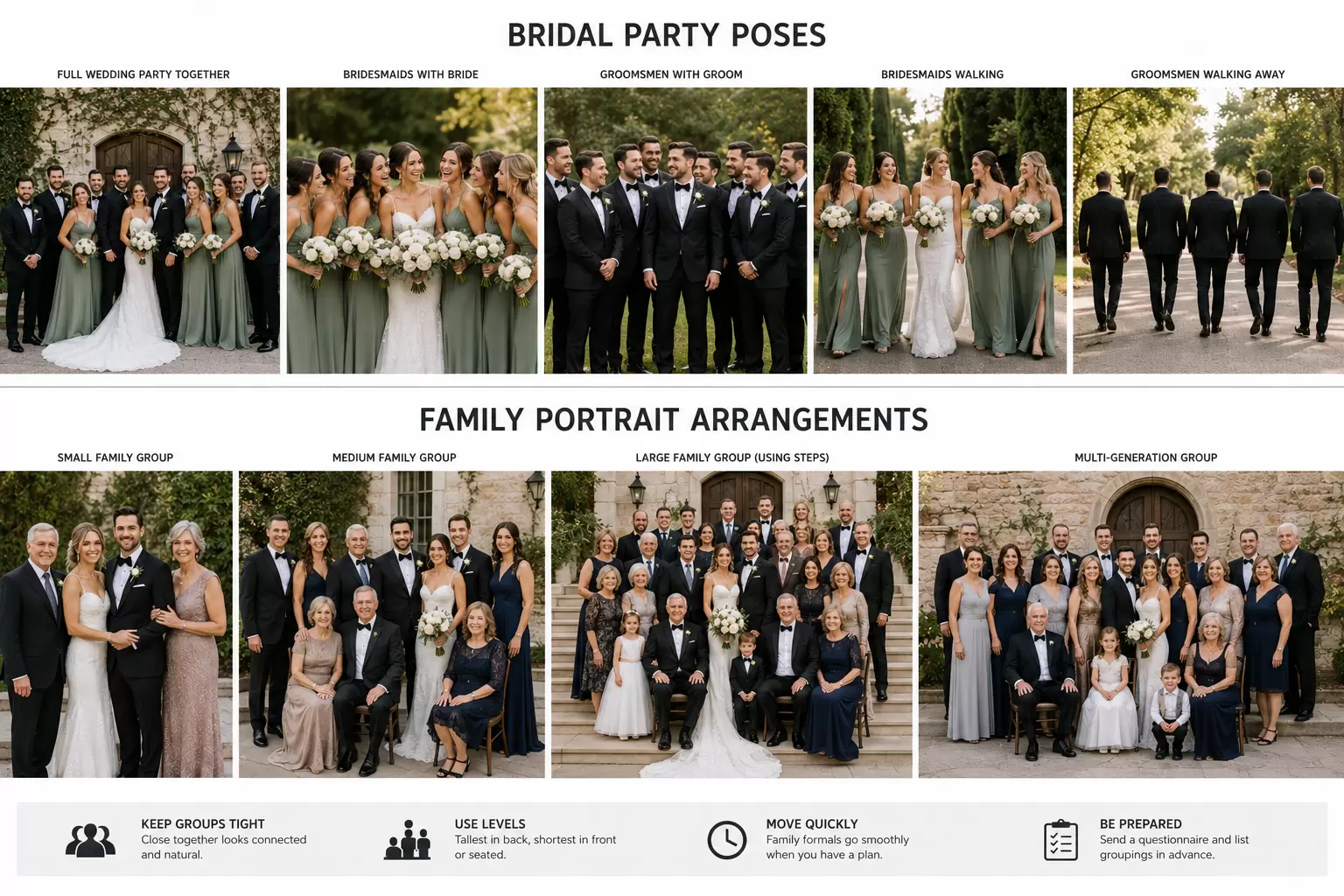
Family portraits benefit enormously from preparation. Without a specific list from the wedding photography questionnaire sent in advance, this section of the day becomes chaotic. With a numbered list, you move through it systematically in 20 to 30 minutes.
For the poses themselves:
- Keep groups physically close. Gaps between people look awkward in photos.
- Tallest people in back, shortest in front or seated.
- For very large groups, use venue steps or levels to create visual variety.
- Move through groups quickly. The longer family formals run, the more the energy drops.
Reception Poses
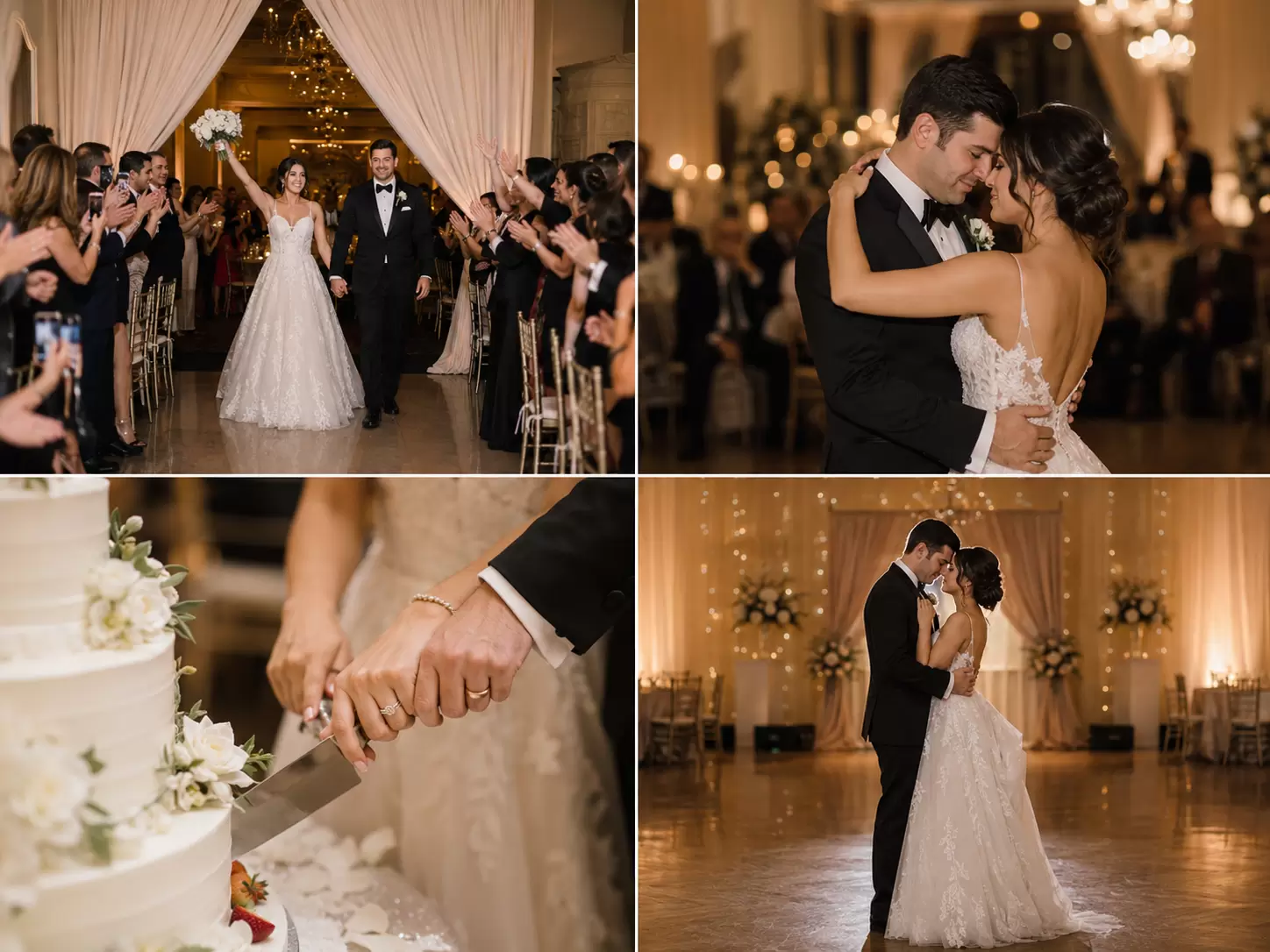
The reception is where structure mostly dissolves and candid opportunities take over. That said, a few posed moments are worth planning:
- Grand entrance framing: position yourself to catch both the couple's faces and the guest reactions simultaneously
- First dance: move around them to capture multiple angles, including close-up during emotional moments
- Cake cutting: get the close-up of hands and rings first, then step back for the feeding moment
- Last dance or final moment of the night: often the most emotionally genuine portrait of the entire day
Romantic Wedding Photography Poses for Different Settings
Outdoor Posing Ideas
Outdoor settings offer the most natural light and backdrop variety. A few approaches that consistently work:
In open fields or meadows:
- Walking through the grass holding hands, not looking at camera
- Sitting in the grass, facing each other, candid conversation
- One person lying down, the other leaning over them (editorial, dramatic)
In forests or wooded settings:
- Both looking up through the tree canopy
- Walking along a path, camera positioned ahead of them on the path
- Leaning against a large tree, one in front of the other
At water (beach, lake, river):
- Walking along the shoreline barefoot (shoes off for candid feel)
- Looking out at the water together, backs partially to camera
- Sitting on a dock or pier, legs dangling
At golden hour specifically:
- Silhouette against the sky with the couple facing each other
- Walking away from camera with the sunset in the frame
- Backlit portrait with lens flare (intentional and controlled)
Indoor Posing Ideas
Indoor portraits often mean navigating challenging lighting situations, but they also offer architectural elements that create visually interesting frames.
In churches or chapels:
- Walking up the aisle together after the ceremony (recessional or recreated)
- Seated in a pew, one person's head on the other's shoulder
- Standing in a doorway or archway with stained glass behind
In hotel rooms or suites:
- Window light portrait, both facing the light source
- Sitting on bed or window seat, natural and relaxed
- Close-up details: hands, rings, shoes, jewelry in the suite light
In ballrooms or reception halls:
- Wide shot with chandeliers or grand architecture as background
- Couple alone on the dance floor before guests arrive
- Table setting detail shots that don't require posing but tell the story
Wedding Photography Shot List to Never Miss Important Moments
A thorough wedding photography shot list built before the day is what protects you from arriving home and realizing you missed something the couple specifically wanted.
Our full wedding photography shot list guide covers every section of the day in detail. Here's a condensed reminder organized by stage:
Getting Ready
- Dress hanging, shoes, jewelry, invitation details
- Hair and makeup in process
- First mirror moment fully dressed
- Bride with mother, bridesmaids, father
- Groom putting on suit, boutonniere pinned
- Groom with groomsmen and father
Ceremony
- Processional (all parties including parents and grandparents)
- Couple at the altar from multiple angles
- Declaration of intent and vows (close-up of faces)
- Ring exchange
- First kiss (wide and close)
- Guest reactions at key moments
- Recessional celebration
Details
- Ceremony florals and decor before guests arrive
- Reception table settings, centerpieces, signage
- Cake before cutting
- Stationery, menus, place cards
- Bouquet and boutonnieres
Family Portraits
Use the numbered list from your wedding photography questionnaire. Move through them systematically and quickly.
Reception Highlights
- Grand entrance
- First dance and parent dances
- Toasts and speeches (speaker and couple's reactions)
- Cake cutting
- Open dancing (candid energy on the floor)
- Quiet couple moments away from the crowd
Professional Wedding Photography Tips for Better Poses
Communication Techniques
The biggest mistake photographers make isn't a technical one. It's failing to communicate clearly with their couples. Nervous clients need direction, and direction requires clear, confident communication.
Speak in simple, specific terms: "Can you turn your body toward him, keep your feet where they are, and tilt your chin slightly down?" is clearer than "Just, like, turn a bit and look more natural."
Tell people what the result will look like: "This is going to create a really beautiful silhouette of you both." When clients understand what you're going for, they commit more fully to the pose.
Directing Couples Naturally
The best wedding photography tips for natural-looking images involve prompts rather than poses. A prompt creates authentic behavior; a pose creates compliance.
Effective prompts:
- "Tell each other something about today that you want to remember."
- "Walk toward me like you're leaving the ceremony and just got married."
- "Groom, whisper to her where you're taking her for your first anniversary."
- "Bride, close your eyes for a moment, then open them and look at him."
The specific prompt matters less than the intention behind it: creating genuine connection and real emotional response.
Using Natural Light
Wedding photography tips around light are probably the most technically impactful. Natural light produces the most flattering results for wedding photography poses, and knowing how to find and use it quickly is a fundamental skill.
Practical light tips:
- Open shade (the shadow side of a building or under trees) produces soft, even light that flatters skin tones
- Direct midday sun creates harsh shadows; avoid it for portraits or use it for intentional editorial looks
- Window light: position the couple so the window is to the side, not behind them (unless you want a silhouette)
- Golden hour (30 to 45 minutes before sunset) is when the most romantic, warm outdoor light occurs. Build it into the timeline.
- Overcast days actually produce beautifully diffused light for portraits. Don't panic about clouds.
Lens Selection for Poses
Different lenses produce distinctly different looks for wedding photography poses:
- 85mm f/1.4 or f/1.8: Classic portrait focal length. Flattering compression, beautiful background blur, great for close-up couple and individual portraits.
- 50mm f/1.4 or f/1.8: More environmental context than the 85mm. Good for medium-distance portraits where you want some background visible.
- 35mm: Great for getting ready shots and tight spaces. Less flattering for close-up portraits due to slight distortion.
- 70-200mm: Excellent for candid ceremony shots from the back of the room. Also useful for pulling the couple out of a busy background using compression.
- 24-70mm: Versatile workhorse for ceremony coverage, group shots, and getting ready.
Composition Tips
Even with perfect wedding photography poses, weak composition limits the image. A few principles worth keeping front of mind:
- Rule of thirds: Don't always center your subjects. Placing the couple off-center with negative space creates visual interest.
- Leading lines: Paths, fences, aisle runners, architecture can draw the eye toward your subjects.
- Framing: Doorways, archways, tree branches, windows frame the couple and create depth.
- Foreground elements: Placing something slightly out of focus in the foreground adds layers and dimension.
- Negative space: Sometimes the most powerful portrait is the subject small in a vast landscape.
Common Wedding Photography Mistakes to Avoid
Over-Posing
The most common wedding photography mistakes aren't dramatic failures. They're the quiet, cumulative result of directing too much. When photographers spend the entire portrait session moving people like furniture, the images start to look like magazine layouts rather than real memories.
Balance structured wedding photography poses with unstructured time. Give the couple a task ("just walk over there and look at the view") and shoot what happens when they forget they're being photographed.
Missing Candid Moments
Candid moments don't announce themselves. They require a photographer who's consistently paying attention to the periphery: the grandmother being helped into her seat, the groom's hands shaking slightly during the vows, the bridesmaids holding back tears during the first dance.
These are the images that couples discover in their gallery and don't remember being taken. They're often the most emotionally resonant ones.
Poor Lighting Preparation
Walking into a dark reception venue with no plan is a wedding photography mistake that shows clearly in the final images. Know the venue's lighting situation in advance. Scout it beforehand if possible. Bring appropriate off-camera flash equipment and know how to use it quickly.
Forgetting Backup Equipment
Equipment fails at the worst possible times. A second camera body, extra batteries, and extra memory cards are not optional accessories. They're insurance against a situation that cannot be recovered.
Ignoring Timelines
The timeline affects your portrait opportunities more than almost anything else. If family formals run 45 minutes instead of 25, the couple portrait session gets compressed. If the ceremony runs long, golden hour portraits disappear.
Keep an eye on the time throughout the day without being visibly anxious about it. Communicate proactively with the coordinator when you're approaching important transitions.
Not Preparing Couples for What to Expect
Couples who arrive at their portrait session knowing what to expect are more relaxed and easier to direct. Walk them through the process in advance, either at a consultation or via email. Tell them how long portraits will take, what kinds of prompts you'll use, and why the engagement session (if they did one) was preparation for exactly this.
For a complete rundown of what to watch out for, our wedding photography shot list guide addresses many of these workflow and preparation issues in detail.
Wedding Photography Workflow for Smooth Sessions
A strong wedding photography workflow is what keeps the day from feeling reactive and chaotic. Here's how to think about it across the full arc of the client relationship.
Before the Wedding
6 to 8 weeks out:
- Send the wedding photography questionnaire and follow up to ensure it's completed
- Review the responses and build your customized shot list and family photo list
- Confirm timeline with the couple and their coordinator
- Scout the venue if you haven't shot there before
1 to 2 weeks out:
- Review questionnaire responses again and note any specific requests or sensitivities
- Prepare printed copies of the shot list and family photo list
- Check all equipment and confirm second shooter details
- Map the venue for logistics: parking, entry points, portrait locations
Day before:
- Final gear check and battery charge
- Review the timeline one more time
- Get a good night's sleep (weddings are physically demanding)
During the Wedding
Your job on the day is to stay ahead of the timeline. Know what comes next before it arrives. Position yourself at the right location before each major moment.
During getting ready, move between detail shots and candid moments. During the ceremony, find your positions early and limit movement. During family formals, work through the numbered list methodically. During portraits, balance structured wedding photography poses with unscripted time.
Stay in communication with the coordinator. If you're running behind on portraits, flag it early rather than hoping to make up time.
After the Wedding
Same day:
- Download all cards to a laptop or external drive immediately
- Back up to a second location before doing anything else
- Never format a card until images exist in two separate places
Editing workflow:
- Ingest and back up
- Cull: select your final delivery images
- Apply your base color grade to all selected images
- Adjust exposure, color, and tone individually where needed
- Export in full resolution
- Upload to your gallery platform and organize by section
Delivery:
- Most photographers deliver within 4 to 8 weeks
- Use a professional gallery platform (Pixieset, ShootProof, CloudSpot)
- Send a personalized delivery email with clear download and sharing instructions
- Follow up with a review request a few days after delivery
Why Every Photographer Needs a Wedding Photography Questionnaire
A wedding photography questionnaire sent two to four weeks before the wedding is one of the most practical tools in your professional workflow. It collects everything you need in one place, reduces last-minute scrambling, and signals to couples that you're genuinely prepared.
Understanding Client Expectations
Couples arrive at their wedding with a mental image of what their photos will look like. Without explicitly discussing this, there's a real chance your vision and theirs diverge in ways that don't surface until gallery delivery.
Ask directly: "Are there specific styles or images you've saved that represent what you're hoping for?" Pinterest boards are particularly useful to review because they reveal the actual aesthetic a couple has in mind, not just the abstract description they'd give verbally.
Essential Questions to Include
Timeline and logistics:
- What time does the getting-ready phase begin?
- Is there a first look planned, and if so, when?
- What time does the ceremony start?
- What is the reception timeline (grand entrance, dinner, first dance, speeches, cake cutting)?
- Is there a specific end time for your coverage?
People:
- Full names of the wedding party
- Any guests who should specifically be photographed (elderly relatives, out-of-town family, childhood friends)
- Any family dynamics we should be aware of (divorced parents, estranged relatives, family members who shouldn't be in the same frame)
Shot priorities:
- Are there specific moments that are most important to you?
- Any cultural, religious, or personal traditions we should know about?
- Anything you specifically don't want photographed?
Venue and vendors:
- Ceremony and reception addresses
- Name and contact of your wedding coordinator
- Any vendor restrictions we should know about
Family Photo Requests
Ask for a numbered list of specific family groupings. Having it numbered means you can call groups efficiently on the day without confusion or delay. The specificity keeps this section moving at pace and prevents the awkward "wait, did we get grandma with just the bride?" moment an hour later.
Timeline Preferences
Ask the couple what parts of the day are most important to them photographically. Some couples care deeply about having long portrait sessions. Others would rather spend cocktail hour with their guests and keep portraits to 20 minutes.
Knowing this in advance lets you plan and communicate realistic expectations rather than assuming your priorities match theirs.
Wedding Photography Poses as Content for Your SEO Strategy
Here's something worth thinking about if you're a wedding photographer building an online presence: the topics covered in this guide, wedding photography poses, shot lists, workflow, and questionnaires, aren't just practical tools. They're also excellent content for attracting organic traffic to your website.
Couples planning weddings search for all of these things. "What poses should we do at our wedding?" and "What does a wedding photographer need from us?" are real searches with real volume.
When your photography website has helpful content that answers these questions, you attract couples in the research phase, before they've even decided who to hire. That early-stage relationship is incredibly powerful for conversion.
Our photography SEO keywords list covers specific keyword opportunities for wedding photographers across all of these content categories. And our full photography SEO guide explains how to build a content strategy that drives consistent organic traffic to your photography business.
If you're serious about growing your photography business through search, our SEO for wedding photographers service handles the keyword research, content strategy, on-page optimization, and local SEO that brings couples to your website and converts them into inquiries.
Frequently Asked Questions
What are the best wedding photography poses for couples?
The most effective wedding photography poses for couples are ones that feel natural rather than staged. The forehead-to-forehead pose, whispering prompts that produce genuine laughter, walking poses, and the behind-hold are reliably strong starting points. The key is balancing structured poses with unscripted prompts that create real emotional responses.
How do photographers create natural wedding poses?
Natural-looking wedding photography poses come from prompts, not just positioning. Instead of telling couples exactly where to put every limb, give them a task or a conversation. "Tell each other something you're looking forward to about today" creates authentic body language and expression that a pose instruction cannot.
What should be included in a wedding photography shot list?
A complete wedding photography shot list should cover: getting-ready details, first look (if applicable), couple portraits, ceremony processional through recessional, family and wedding party formals, and reception moments. Customize it for each couple using their questionnaire responses. Our full guide on wedding photography shot list covers every section in detail.
What questions should be in a wedding photography questionnaire?
A good wedding photography questionnaire should cover: timeline and logistics, family photo combinations, venue and vendor details, shot priorities, cultural or religious traditions, and the couple's inspiration and style preferences. Getting detailed answers in advance is what separates a prepared, confident photographer from one who's figuring things out on the fly.
What are the most common wedding photography mistakes?
The most common wedding photography mistakes include over-posing couples instead of prompting natural moments, missing candid emotional beats, arriving at a dark venue without a lighting plan, forgetting backup equipment, and losing track of the timeline during family formals.
Final Thoughts
Wedding photography poses are the visible part of a much larger professional system. The poses you know are only as useful as the preparation, communication, and workflow that support them.
Couples remember how they felt during their wedding photography session as much as they remember the images it produced. When you're confident in your posing direction, prepared with your shot list, and informed by a thorough questionnaire, that confidence translates into a better client experience and better images.
Build your posing repertoire. Develop your workflow. Send the questionnaire. Prepare the shot list. Show up ready.
And if you're a wedding photographer who wants more couples to find your work through organic search, the team at Just Digital Gurus specializes in exactly that. Our SEO for wedding photographers service, wedding SEO services, and wedding business marketing are built for photographers who want a consistent pipeline of inquiries from Google, not just referrals and social media.
Book a call or get in touch to talk about what that looks like for your photography business.

Your comment will appear after approval.