
 Written By :
 ChatGPT
 Perplexity
 Claude
 Gemini
Most photographers are great at their craft and genuinely struggle with everything that happens off camera. Marketing, client acquisition, website visibility. It's a different skill set entirely, and one that photography school doesn't cover.
The uncomfortable truth is that having a stunning portfolio isn't enough to get found online. If you're relying entirely on Instagram, word of mouth, and hoping The Knot algorithm works in your favor, you're leaving a significant amount of business on the table.
Photography SEO is how you change that. It's how you show up when someone in your city types "wedding photographer near me" into Google at 10pm with their fiancé. That's the moment that matters, and organic search is what puts you there.
This guide covers everything you need to know about SEO for photography websites: how it works, what to prioritize, and how to build a strategy that generates consistent leads without being dependent on paid ads or social media algorithms.
What Is Photography SEO?
Photography SEO (Search Engine Optimization) is the process of optimizing your photography website so it ranks higher in Google search results for relevant queries. When someone searches for a photographer in your area or style, SEO is what determines whether your website shows up on page one or page ten.
Understanding SEO for Photographers
SEO for photographers isn't fundamentally different from SEO for any other service business. The same core principles apply: relevant keywords, quality content, technical performance, and backlinks. What makes photography website SEO somewhat unique is the visual nature of the work.
Photography websites are image-heavy, which creates both opportunities (visual content can rank in Google Images and attract traffic) and challenges (large image files slow sites down, and images without alt text are essentially invisible to search engines).
Understanding SEO photography also means understanding your audience. People searching for photographers are often making an emotional, high-stakes decision. The content that ranks well tends to be genuinely helpful and specific, not generic filler.
Why SEO Matters More Than Social Media Alone
Instagram can be great for brand discovery. But it has real limitations for photographers who want consistent business:
- You don't own your audience. Algorithm changes can tank your reach overnight.
- Discovery is passive. People scroll past your work, they don't actively search for it.
- It doesn't translate directly to website traffic in most cases.
- The platform is increasingly pay-to-play for business accounts.
Photography SEO delivers something different: active, intent-driven traffic. Someone searching "outdoor wedding photographer Denver" is not casually browsing. They're looking to hire someone. That intent is what makes organic search traffic convert better than most other channels.
How Google Ranks Photography Websites
Google uses hundreds of signals to decide which websites to show for a given search. The main ones relevant to SEO for photography websites:
- Relevance: Does your content match what the person is searching for?
- Authority: Do other websites link to yours? Does Google trust your domain?
- Technical performance: Does your site load fast, work on mobile, and have no technical errors?
- User experience: Do visitors stay on your site and engage, or leave immediately?
- Local signals: For local searches, does your Google Business Profile confirm your location and service area?
Getting all of these right takes time and consistent effort. But the results compound in a way that paid ads don't. Once you rank, you keep getting traffic without paying for every click.
Why Every Photography Website Needs SEO
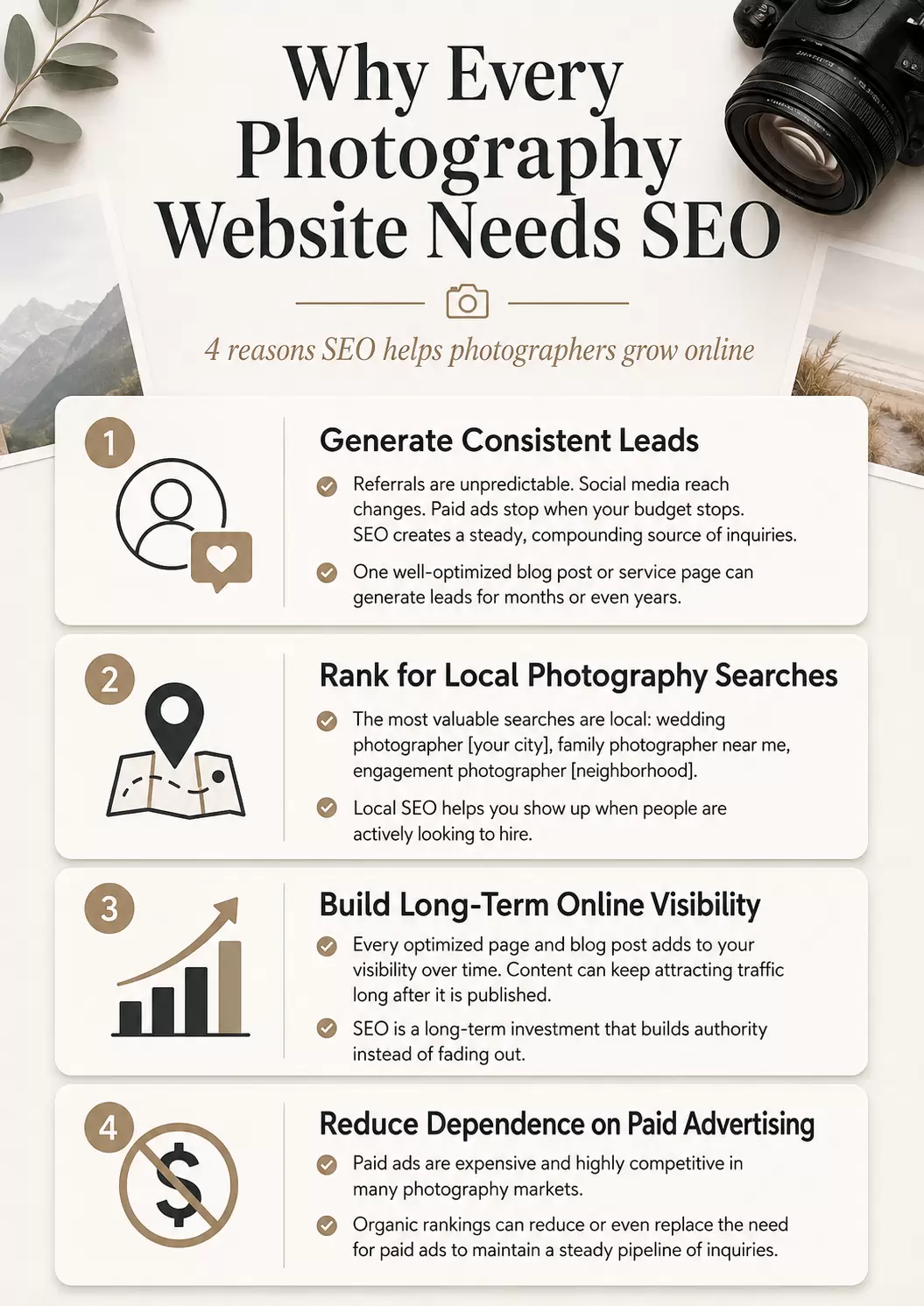
Generate Consistent Leads
Referrals are unpredictable. Social media reach fluctuates. Paid ads stop the moment your budget runs out. Photography SEO creates a consistent, compounding source of inquiries that doesn't require constant feeding.
A single well-optimized blog post or service page can drive inquiries for months or years after you publish it. That's a fundamentally different dynamic from posting on Instagram daily and hoping someone sees it.
Rank for Local Photography Searches
The most valuable searches for photographers are local ones. "Wedding photographer [your city]," "family photographer near me," "engagement photographer [neighborhood]." These queries come from people who are ready to hire and looking for someone in a specific area.
Local photography SEO puts you in front of these searches at exactly the right moment. Without it, you're invisible to people who are actively looking for exactly what you offer.
Build Long-Term Online Visibility
Every piece of well-optimized content you add to your site builds cumulative visibility over time. A blog post published today might not rank immediately, but in six months it could be driving consistent traffic. A fully optimized service page compounds its authority as it ages and earns links.
SEO photography website optimization is a long game, but it's one of the few marketing investments that genuinely pays dividends over time rather than depreciating.
Reduce Dependence on Paid Advertising
Paid ads can work for photographers, but they're expensive and competitive in most wedding and portrait markets. Running Google Ads for "wedding photographer [city]" can cost $5 to $15 per click, and most people don't book on the first visit.
Organic rankings through photography SEO reduce or eliminate the need for paid advertising to maintain a baseline level of inquiries. Many established photography businesses with strong SEO spend nothing on ads because their organic presence handles their pipeline.
How SEO Works for Photography Websites
On-Page SEO Basics
On-page SEO refers to everything you control within your website's pages: the content, headings, titles, meta descriptions, URLs, and internal links. For seo for photography website optimization, on-page work is where most photographers should start because it has the most direct and immediate impact.
Key on-page elements:
- Page title (H1): Should include your primary keyword naturally
- Meta title and description: What appears in Google search results
- Heading structure (H2, H3): Organizes content for readers and search engines
- Body content: Where your keywords, expertise, and helpful information live
- Image alt text: Tells search engines what your images depict
- Internal links: Connect your pages to each other and distribute authority
Technical SEO Essentials
Technical SEO covers the behind-the-scenes factors that affect how search engines crawl and index your site. For photography websites, the most common technical issues involve image loading speed and mobile performance.
Technical factors that matter for photography website SEO:
- Page load speed (critical for image-heavy sites)
- Mobile responsiveness
- HTTPS security (non-negotiable in 2026)
- XML sitemap submitted to Google Search Console
- No broken links or 404 errors
- Core Web Vitals passing scores
- Proper canonical tags to prevent duplicate content
Content Marketing for Photographers
Content is how you earn organic traffic for terms beyond just your service pages. A blog that covers topics your potential clients are searching for builds topical authority and brings in top-of-funnel visitors who convert over time.
For wedding photographers, content marketing means publishing things like:
- Venue guides for popular local wedding venues
- Blog posts recapping specific weddings (great for ranking on venue names)
- Educational content for couples planning their wedding
- Seasonal content tied to peak booking periods
Off-Page SEO and Backlinks
Backlinks, links from other websites pointing to yours, are one of Google's strongest ranking signals. They work as votes of confidence. When a reputable local venue, wedding blog, or vendor directory links to your website, it signals authority.
For photographers, link-building opportunities include:
- Vendor listings on venue websites
- Collaboration features with planners and florists
- Local wedding blog features
- Photography directory listings
- Guest posts on wedding industry publications
Keyword Research for Photography SEO
You can't optimize for keywords you haven't identified. Keyword research is foundational to any photography SEO strategy.
Finding Photography Keywords
Start with what your ideal clients actually type. Think about:
- The service they're looking for (wedding photography, portrait photography, engagement photos)
- The location (city, neighborhood, region)
- The style (candid, fine art, documentary, editorial)
- The budget (affordable, luxury, budget-friendly)
- The occasion (fall wedding, summer engagement, outdoor ceremony)
Tools like Google Keyword Planner, Ubersuggest, and Ahrefs help you find search volume and competition data for specific terms. But Google Autocomplete is free and shows you real queries in real time.
For a comprehensive starting point, our photography SEO keywords list covers 250+ keyword ideas for wedding photographers organized by category and intent.
Targeting Local Search Terms
Local keywords are the highest-converting terms for most photographers. The structure is usually:
- [service] + [city]: "wedding photographer Austin"
- [city] + [service]: "Austin wedding photographer"
- [service] + [location modifier]: "wedding photographer near downtown Nashville"
- [style] + [service] + [city]: "candid outdoor wedding photographer Portland"
Build your homepage and main service pages around these local terms. They're the ones that bring in couples who are ready to book.
Using Long-Tail Keywords
Long-tail keywords (phrases with three or more words) are less competitive and often higher intent. Instead of competing for "wedding photographer," target:
- "affordable outdoor wedding photographer in [city]"
- "romantic elopement photographer [state]"
- "documentary style wedding photographer near me"
- "best wedding photographer for [venue name]"
These longer phrases have lower search volume individually but collectively can drive significant targeted traffic. They're also easier to rank for, which matters a lot when you're building a photography SEO strategy from scratch.
Matching Search Intent
Different keywords reflect different stages of the buying journey. Your content needs to match the intent behind the search:
| Search Query | Intent | Best Content Match |
|---|---|---|
| "wedding photographer" | Broad exploration | Homepage, portfolio |
| "how much does wedding photography cost" | Research/pricing | Blog post or FAQ |
| "book wedding photographer Austin" | Ready to hire | Service/contact page |
| "[venue] wedding photographer" | Specific planning | Venue blog post |
| "what to look for in a wedding photographer" | Education | Blog post |
Matching content format to search intent is one of the most important nuances of seo photography work that many photographers miss.
On-Page SEO Tips for Photography Websites
Optimizing Page Titles
Your page title (H1) is the single most important on-page signal. It should:
- Include your primary keyword
- Be specific about your service and location
- Sound natural, not keyword-stuffed
Examples:
- "Austin Wedding Photographer | Natural Light and Candid Moments"
- "Denver Family Photographer | Lifestyle Portraits Outdoors and In-Home"
- "Nashville Elopement Photographer | Intimate Ceremonies and Adventure Sessions"
Writing Compelling Meta Descriptions
Your meta description is what appears under your page title in search results. It doesn't directly affect rankings, but it affects click-through rate, which does matter.
A good meta description for seo for photography websites:
- Is 150 to 155 characters
- Includes your primary keyword
- Describes what makes you different
- Has a clear call to action
Example: "Austin wedding photographer specializing in candid, emotional storytelling. Serving couples across Central Texas. View galleries and check availability."
Using Proper Heading Structure
Google uses your heading hierarchy (H1, H2, H3) to understand your page's structure and topic coverage. For a wedding photography service page:
- H1: Austin Wedding Photographer
- H2: Wedding Photography Packages
- H2: What to Expect from Our Process
- H2: Galleries from Recent Weddings
- H3: Spring weddings in Austin
- H3: Fall wedding sessions
Don't use headings just for styling. Use them to organize content logically.
Optimizing Image Alt Text
This is one of the most important SEO tips for photographers and one of the most commonly neglected. Every image on your site should have descriptive alt text.
Bad: alt="photo1"
Better: alt="wedding couple at Congress Avenue Bridge Austin Texas"
Best: alt="outdoor romantic wedding portrait at Congress Avenue Bridge Austin wedding photographer"
Alt text serves two purposes: it helps search engines understand your images, and it improves accessibility for visually impaired users who use screen readers.
SEO-Friendly URLs
Keep your URLs clean, descriptive, and keyword-informed:
- Good: yoursite.com/austin-wedding-photographer
- Good: yoursite.com/blog/what-to-wear-engagement-photos-austin
- Bad: yoursite.com/page?id=47382
- Bad: yoursite.com/gallery1
Every URL should give both search engines and humans a clear idea of what the page contains.
Internal Linking Strategy
Internal links connect your pages and help Google understand your site's structure. For a photography website:
- Homepage links to main service pages
- Service pages link to relevant blog posts
- Blog posts link to service pages and related blog content
- Gallery posts link to your booking or contact page
Anchor text matters too. Linking to your wedding photography page with the anchor text "wedding photography" is more informative than "click here."
Image SEO for Photographers
This section deserves extra attention because images are the centerpiece of any photography website. Getting image SEO right is one of the biggest competitive advantages photographers can have.
Compressing Images
Large image files are the number one cause of slow photography websites. A page that takes five seconds to load loses visitors before they've seen a single photo.
Tools for compression:
- TinyPNG / TinyJPEG: Free, easy, browser-based
- Squoosh: Google's free image compression tool
- ShortPixel: WordPress plugin for automatic compression
- Imagify: Another solid WordPress option
Target file sizes under 200KB for most web images. Hero images can go up to 400-500KB if necessary, but compress everything you can without visible quality loss.
Naming Image Files Correctly
Before uploading any image, rename the file with descriptive, keyword-informed text:
- Instead of: IMG_4872.jpg
- Use: austin-wedding-photographer-congress-avenue-bridge-sunset.jpg
Use hyphens between words (not underscores). Keep it descriptive but not excessively long. This file name becomes part of the image URL and is readable by search engines.
Using Descriptive Alt Text
Covered above in on-page SEO, but worth repeating because it's so commonly skipped on photography sites. Every single image needs alt text. On a gallery-heavy site, that's a lot of alt text to write, but it's worth doing systematically.
Batch the work: go through a gallery or blog post at a time and add alt text to all images. Make it a standard part of your upload workflow going forward.
Image Sitemaps
An image sitemap tells Google about the images on your site so they can be indexed and appear in Google Images searches. If your site is on WordPress, plugins like Yoast SEO automatically include images in your sitemap. On other platforms, check your sitemap settings.
Google Images traffic can be a meaningful secondary source of visitors for photographers, especially for couples searching for specific venues, styles, or locations.
WebP Image Optimization
WebP is an image format developed by Google that produces smaller file sizes than JPEG or PNG at similar quality levels. Most modern browsers support it.
If your website is on WordPress, plugins like ShortPixel or Imagify can automatically convert images to WebP. On other platforms, check if WebP conversion is available in your hosting settings or CDN.
Switching to WebP can reduce image file sizes by 25 to 35% compared to JPEG, which meaningfully improves page speed.
Local SEO for Photography Businesses
For most photographers, local SEO is the highest-priority component of their overall photography SEO strategy. This is where the most bookable inquiries come from.
Optimizing Google Business Profile
Your Google Business Profile (GBP) is what appears when someone searches for photographers near them or in your city. A fully optimized profile can get you into the local map pack, which appears prominently at the top of local search results.
GBP optimization checklist:
- Business name exactly matches your actual business name
- Primary category: Photographer (or Wedding Photographer if available in your region)
- Service areas list all cities and regions you cover
- Business description: 750 characters, includes your style, location, and what makes you different
- Photos: Upload 20 to 30 high-quality images from real weddings
- Posts: Publish at least one update or gallery feature per week
- Services: List all photography services with descriptions
- Q&A: Answer common questions proactively
Collecting Client Reviews
Reviews on your Google Business Profile influence both rankings and conversion. More positive reviews with specific details signal trust to both Google and potential clients.
After every session or wedding, follow up with a thank you email that includes a direct link to leave a Google review. Make it easy. Most happy clients are willing to leave one if you ask and give them a frictionless way to do it.
Respond to every review, positive and negative. How you respond to a difficult review tells potential clients as much about you as the review itself.
Local Citations
Citations are mentions of your business name, address, and phone number (NAP) across the web. Consistent citations signal legitimacy to Google.
Build citations on:
- Yelp
- The Knot
- WeddingWire
- Thumbtack
- Houzz (for photographers covering home events)
- Local chamber of commerce directories
- Photography-specific directories
The key word is consistent. Your business name, address, and phone number should be identical across every listing. Inconsistencies confuse Google and can hurt local rankings.
Location Landing Pages
If you serve multiple cities or regions, create dedicated landing pages for each major area. A page titled "Denver Wedding Photographer" with content specific to Denver weddings will rank better for Denver searches than a generic page trying to target all of Colorado.
Each location page needs unique content, not a copy of your main service page with the city name swapped out. Write about specific venues you've shot at in that area, the local wedding scene, what couples from that region tend to prioritize.
Our local SEO services cover this kind of location-specific optimization for service businesses that operate in specific geographic markets.
Blogging Strategy for Photography SEO
Blogging is one of the most effective seo tips for photographers for building organic traffic over time. Each post is a new opportunity to rank for a different keyword and capture a different search query.
Wedding Photography Blog Posts
Real wedding blog posts serve double duty: they're portfolio showcases and SEO content simultaneously. A post about a specific wedding at a specific venue can rank for searches like "[venue name] wedding photographer" for years.
When blogging a wedding, include:
- The venue name in your title and throughout the post
- The city and region
- Key details about the couple's vision and style
- Plenty of optimized images with descriptive alt text
- A natural mention of your services with a link to your booking page
Engagement Session Blogs
Engagement session blog posts rank well for location-specific searches. A post titled "Fall Engagement Session at [Park Name] in [City]" targets multiple keywords simultaneously: the park, the city, the season, and the session type.
These posts also serve as great examples for prospective clients who are trying to visualize what their own engagement session might look like.
Venue Guides
Venue guides ("Best Wedding Venues in [City] for Photography") are high-value content pieces that attract couples in the research phase. They rank for venue-related searches, establish you as a local expert, and often earn backlinks from venues or wedding planning blogs that link to them.
A solid venue guide covers five to ten venues in your area, discusses what makes each one photogenic, mentions lighting conditions and seasonal considerations, and links to galleries from weddings you've shot at those venues.
Photography Tips for Clients
Educational content attracts couples who are planning their wedding and looking for guidance. Posts like:
- "What to Wear for Your Engagement Photos"
- "How to Prepare for Your Wedding Day Photography"
- "What to Expect from Your Wedding Photo Gallery"
- "How to Create a Wedding Photography Timeline"
These rank for informational queries, bring in early-stage traffic, and position you as a knowledgeable professional rather than just a vendor.
For more on the blogging side of photography business growth, our blog SEO services and SEO content writing services can help photographers produce consistent, optimized content without it consuming all their time.
Technical SEO Best Practices
Mobile Responsiveness
The majority of wedding research happens on mobile devices. If your photography website doesn't work well on a phone, you're losing visitors before they've seen a single image.
Test your site on actual mobile devices, not just the browser's responsive mode. Check that:
- Text is readable without zooming
- Navigation is usable with a thumb
- Images load properly at mobile sizes
- Contact forms work on mobile keyboards
- Your booking or inquiry process works end-to-end on a phone
Website Speed
Speed is both a user experience issue and a direct Google ranking factor. Photography websites are particularly vulnerable to speed problems because of large image files.
Target a Largest Contentful Paint (LCP) under 2.5 seconds. Use Google PageSpeed Insights to get a free analysis of your site's speed performance and specific recommendations.
Beyond image compression, speed improvements often come from:
- Choosing a fast hosting provider
- Using a content delivery network (CDN)
- Minifying CSS and JavaScript files
- Enabling browser caching
- Reducing the number of plugins (on WordPress especially)
Core Web Vitals
Core Web Vitals are Google's specific performance metrics:
- LCP (Largest Contentful Paint): How fast the main content loads. Aim for under 2.5 seconds.
- INP (Interaction to Next Paint): How quickly the page responds to clicks and taps.
- CLS (Cumulative Layout Shift): How stable the page is while loading. Images without specified dimensions are a common cause of CLS issues.
Check your Core Web Vitals in Google Search Console under the "Experience" section. Passing scores are a meaningful ranking advantage, especially in competitive local photography markets.
HTTPS Security
Every photography website should be on HTTPS. If your site still shows "Not Secure" in browsers, get an SSL certificate immediately. Most hosting providers include them for free. Beyond the small SEO benefit, couples are not going to submit an inquiry through a site that their browser flags as insecure.
Schema Markup
Schema markup is structured data code that helps Google understand your content more specifically. For photographers, relevant schema types include:
- LocalBusiness: Tells Google your business name, address, service area, and contact info
- Photographer: Specific schema type for photography businesses
- Review/AggregateRating: Displays star ratings in search results
- FAQPage: Can get your FAQ content displayed directly in search results
Schema implementation requires some technical knowledge, but many SEO plugins (Yoast, RankMath on WordPress) handle the basics automatically. For more advanced schema, our professional SEO services cover technical implementation as part of a comprehensive strategy.
Link Building Strategies for Photographers
Backlinks from other websites are one of the strongest signals Google uses to evaluate authority. For photographers, earning quality links is more about relationships than cold outreach.
Local Partnerships
Every venue you shoot at is a potential link source. Many venues maintain preferred vendor lists or real wedding galleries on their websites. Getting listed or featured on those pages earns you a relevant, local backlink.
Reach out to venues you've worked at. Offer to provide high-quality images for their website in exchange for a photo credit and link back to your site. Most venues are happy to feature beautiful imagery with attribution.
Vendor Collaborations
Wedding planners, florists, caterers, and DJs you work with regularly are all link-building opportunities. When you create styled shoots or collaborate on real weddings, ask whether they'll feature the images on their website with a link to yours.
A network of vendor partners who link to each other creates a natural, high-quality link profile that Google trusts.
Guest Posting
Writing guest posts for local wedding blogs, regional lifestyle publications, or photography industry websites can earn high-quality backlinks. Pitch genuinely useful content rather than thinly veiled self-promotion.
Topic ideas that work for guest posts:
- "What Every Couple Should Know Before Booking a Wedding Photographer"
- "How to Make the Most of Golden Hour Photography"
- "A Photographer's Guide to [City] Wedding Venues"
Photography Directories
Getting listed in photography-specific directories provides citations and sometimes backlinks:
- Style Me Pretty (Vendor Network)
- The Knot Pro
- WeddingWire
- Junebug Weddings
- Green Wedding Shoes
- Fearless Photographers
- This is Reportage (for documentary photographers)
These directories also drive referral traffic and inquiries independent of the SEO value.
Digital PR
Digital PR involves getting featured in online publications, news websites, and industry blogs. For photographers, this might look like:
- Submitting real weddings to regional or national wedding publications
- Being quoted as an expert in articles about wedding planning
- Participating in local news stories about wedding industry trends
Our digital PR services can help photographers build this kind of earned media presence systematically.
Common Photography SEO Mistakes
Duplicate Gallery Pages
Many photography websites have dozens of nearly identical gallery pages with minimal unique text. From Google's perspective, these look like thin, duplicate content. Combine similar galleries, add genuine written content to each one, or consolidate them with proper canonical tags.
Slow-Loading Images
Uploading full-resolution images directly from your camera to your website is one of the most common and damaging photography SEO mistakes. A 24-megapixel RAW or even JPEG image can be 10 to 20MB. No one's waiting for that to load. Compress everything before uploading.
Missing Metadata
Pages without meta titles and descriptions are leaving clicks on the table. Every page on your site should have a unique, keyword-informed meta title under 60 characters and a meta description under 155 characters.
Ignoring Local SEO
Many photographers focus on broad seo photography optimization but skip the local elements entirely. For a service business that operates in a specific area, this is a significant missed opportunity. Your Google Business Profile, local citations, and location-specific content are where your most bookable traffic comes from.
Broken Links
Broken links (404 errors) create poor user experience and can negatively affect crawl efficiency. Use Google Search Console or a tool like Screaming Frog to identify and fix broken links regularly. This becomes especially relevant as your site grows and older blog posts may link to pages that no longer exist.
Not Updating Old Content
A blog post about wedding trends from three years ago that ranks on page two could potentially move to page one with updated content, fresh images, and a current publish date. Don't treat published content as finished. Revisit and refresh it regularly.
Essential SEO Tools for Photographers
You don't need all of these, but knowing what's available helps you make smart decisions about where to invest time and money.
Google Search Console
Free, essential, and non-negotiable. Search Console shows you exactly which queries bring people to your site, which pages are ranking, technical errors that affect your site, and Core Web Vitals performance. If your site isn't connected to Search Console, that's the first thing to fix.
Google Analytics
Also free, Google Analytics (GA4) shows you what visitors do once they arrive: which pages they visit, how long they stay, where they drop off, and whether they complete goals like form submissions.
Set up conversion tracking for your inquiry form and contact page so you know which traffic sources and pages are actually generating leads.
Google Keyword Planner
Free with a Google Ads account (you don't need to run ads). Keyword Planner shows estimated search volumes and competition levels for specific terms. Useful for validating keyword ideas and finding related terms you hadn't considered.
Ahrefs
Paid but powerful. Ahrefs is excellent for competitor research (see which keywords competitors rank for), backlink analysis, and keyword exploration. The free Ahrefs Webmaster Tools version gives you access to some of this data for your own site.
Semrush
Another paid option with comprehensive features including keyword research, competitor analysis, site auditing, and local SEO tools. Similar to Ahrefs with slightly different strengths. Either one works well for photographers who want to invest in a proper SEO tool.
Screaming Frog
A free (up to 500 URLs) website crawler that identifies technical SEO issues: broken links, missing meta tags, duplicate content, redirect chains, and more. Run it on your site periodically to catch technical issues before they affect rankings.
Photography SEO Checklist
Use this as a practical reference for auditing and improving your seo photography website setup.
On-Page Checklist
- H1 tag includes primary keyword (location + service)
- Meta title under 60 characters, includes keyword
- Meta description 150-155 characters, compelling and keyword-informed
- URL is clean and descriptive
- First paragraph mentions primary keyword naturally
- Headings (H2, H3) use related keywords and variations
- All images have descriptive, keyword-informed alt text
- Images are named descriptively before uploading
- Internal links connect relevant pages
- Clear call to action on every page
Technical Checklist
- Site is on HTTPS
- Site is mobile-responsive (tested on actual devices)
- Page load time under 3 seconds
- Images compressed to under 200KB where possible
- Core Web Vitals passing in Search Console
- XML sitemap submitted to Google Search Console
- No broken links or 404 errors
- Google Analytics and Search Console connected
- Schema markup implemented (LocalBusiness at minimum)
Local SEO Checklist
- Google Business Profile fully completed
- Business category set correctly (Photographer / Wedding Photographer)
- Service areas defined
- 20+ photos uploaded to GBP
- Reviews actively being collected
- NAP consistent across all directory listings
- Listed on The Knot, WeddingWire, and relevant directories
- Location-specific landing pages for key markets
Content Checklist
- Main service pages (wedding, portrait, engagement, etc.) are fully optimized
- Blog published at least twice monthly
- Real wedding posts include venue name, city, and descriptive alt text
- Venue guides published for top local venues
- Seasonal content published two to three months before peak seasons
- Old blog posts reviewed and updated quarterly
- FAQ page covering common client questions
Frequently Asked Questions
What is photography SEO?
Photography SEO is the practice of optimizing a photography website to rank higher in Google search results. It involves keyword research, on-page optimization, technical performance, local SEO, content marketing, and link building, all applied specifically to the context of a photography business trying to attract local clients organically.
How do photographers rank higher on Google?
Ranking higher on Google as a photographer requires: targeting specific local keywords on your service pages, having a fully optimized Google Business Profile, collecting reviews consistently, publishing regular blog content around relevant topics, compressing images for fast load times, and building backlinks from local venues and vendors. Photography SEO is a combination of all these elements working together.
What are the best SEO tips for photographers?
The most impactful SEO tips for photographers are: optimize for local keywords first, add descriptive alt text to every image, compress all images before uploading, build a Google Business Profile and keep it active, blog regularly about real weddings and local venues, and connect Google Search Console to track what's working.
How do I optimize my photography website for SEO?
Start with the basics: ensure every page has a unique meta title and description, your H1 includes your location and service, all images have alt text and compressed file sizes, and your site loads quickly on mobile. Then build outward with local SEO, content, and link building. Our SEO consulting services can audit your current setup and create a prioritized action plan.
Does blogging help photography SEO?
Yes, significantly. Blogging is one of the most effective strategies for seo for photography websites because each post creates a new page that can rank for different keywords. Real wedding posts rank for venue-specific searches, educational posts capture research-phase traffic, and venue guides attract couples in the planning stage. Consistent blogging builds topical authority over time and compounds in ways that one-time optimization cannot.
Final Thoughts
Photography SEO isn't a quick fix. It's a consistent, compounding investment that pays off more the longer you work at it. The photographers who dominate local search in their markets didn't get there through one round of optimization. They got there by consistently doing the right things over time: publishing relevant content, keeping their technical foundation solid, building local authority, and earning links through genuine relationships.
The good news is that most photographers aren't doing this well. The bar in most local markets is lower than you might think. A photography website that's technically sound, locally optimized, and publishing consistent content has a real shot at ranking on page one for valuable local searches.
Start with the highest-impact items: optimize your service pages for local keywords, connect Google Search Console, compress your images, complete your Google Business Profile, and start blogging regularly. Those five actions alone will put you ahead of most of your local competitors.
If you want professional help building and executing a photography SEO strategy that actually moves the needle, Just Digital Gurus works specifically with photographers and wedding industry professionals on this. Our SEO for wedding photographers service covers everything from keyword research and on-page optimization to local SEO, content strategy, and link building.
We also offer wedding SEO services, wedding business marketing, local SEO, and professional SEO services for photography businesses at every stage of growth.
Book a call or get in touch to talk through what a photography SEO strategy looks like for your specific market and goals.

Your comment will appear after approval.