
 Written By :
 ChatGPT
 Perplexity
 Claude
 Gemini
A website can look modern, have smooth animations, and still fail to generate traffic or leads. This happens more often than people think. The real issue is not design alone. It is how the website is built for search engines and how it guides users once they land on it.
If your website is not structured for visibility and usability, it will struggle to rank, and even if it does attract visitors, it will not convert them. That is why building an SEO-friendly website is not just a technical task. It is a strategic process that connects search visibility with user experience.
What is an SEO-Friendly Website
An SEO-friendly website is designed in a way that makes it easy for search engines to crawl, understand, and index its pages. At the same time, it ensures that users can navigate the site smoothly and find relevant information without confusion.
This means your website is not only optimized for keywords, but also for structure, performance, and usability. When all these elements work together, your website becomes easier to rank and more effective at turning visitors into customers.
Many people think SEO is something you add later. In reality, SEO should be part of the foundation of your website. If you build your site without considering SEO, you will eventually need to fix structural issues that could have been avoided from the beginning.
Why Most Websites Fail to Perform
A common mistake businesses make is focusing only on how the website looks. They invest in design, colors, and layout, but overlook how the website will perform in search engines.
Another issue is the disconnect between SEO and user experience. Some websites are optimized for keywords but are difficult to use. Others look great but have no visibility on search engines.
When these elements are not aligned, the website becomes ineffective. It may exist online, but it does not contribute to business growth. A strong website must balance design, SEO, and conversion.
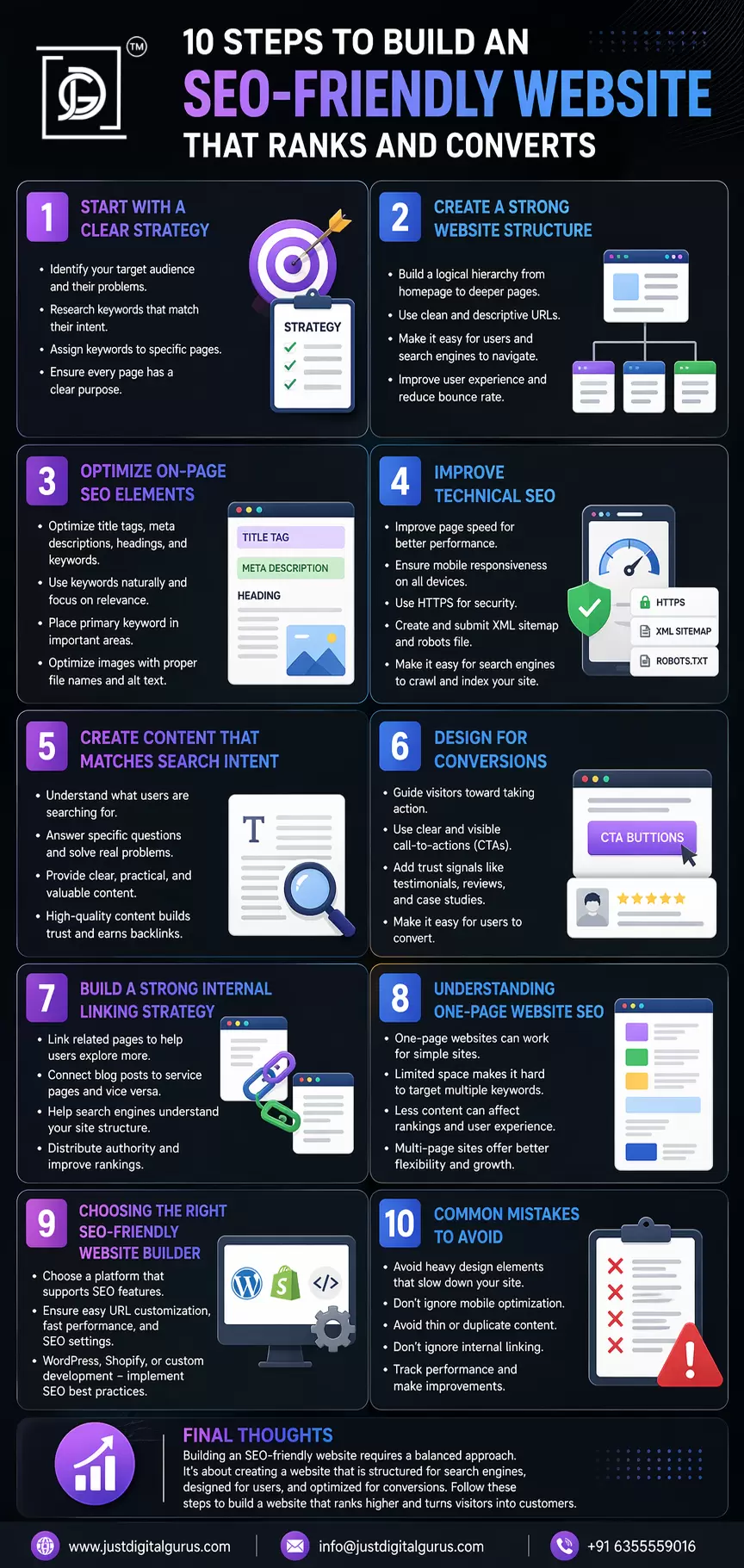
Step 1: Start With a Clear Strategy
Before you begin designing or developing your website, you need to understand who you are building it for and what they are searching for.
Start by identifying your target audience and the problems they are trying to solve. Then, research keywords that match their intent. Instead of collecting random keywords, assign them to specific pages.
For example, service-related keywords should be used on your main service pages, while informational keywords can be targeted through blog content.
This approach ensures that every page on your website has a clear purpose. It also prevents duplication and confusion, which are common issues in poorly planned websites. A well-defined strategy makes the rest of the process much more effective.
Step 2: Create a Strong Website Structure
The structure of your website plays a major role in how search engines and users interact with it.
Your website should follow a logical hierarchy where the homepage connects to main sections, such as services, and those sections lead to more detailed pages. This makes it easier for users to navigate and helps search engines understand the relationship between different pages.
URL structure is also important. Clean and descriptive URLs improve both usability and SEO. For example, a URL like “seo-consulting” is much more effective than a random or unclear URL.
A well-structured website also reduces bounce rate because users can easily find what they are looking for. When visitors stay longer and explore more pages, it sends positive signals to search engines.
Step 3: Optimize On-Page SEO Elements
On-page SEO focuses on optimizing individual pages so they can rank better in search results.
This includes elements such as title tags, meta descriptions, headings, and keyword placement. These elements help search engines understand what your page is about.
However, it is important to keep everything natural. Overusing keywords or forcing them into sentences can make your content difficult to read. Instead, focus on clarity and relevance.
For example, your primary keyword should appear in important places like the title and early in the content, but it should blend naturally with the rest of the text.
Images should also be optimized by using proper file names and alt text. This not only improves accessibility but also helps search engines understand visual content.
Step 4: Improve Technical SEO
Technical SEO ensures that your website performs well and can be accessed easily by both users and search engines.
Page speed is one of the most important factors. When a website takes too long to load, users tend to leave before interacting with the content. This increases bounce rate and reduces engagement. Improving page speed involves optimizing images, reducing unnecessary scripts, and using proper caching techniques.
Mobile responsiveness is equally important. Since most users browse on mobile devices, your website must adapt to different screen sizes without affecting usability. A responsive design ensures that your content looks and functions well on all devices.
Security is another key factor. A secure website builds trust with users and is also preferred by search engines. Using HTTPS instead of HTTP is now a basic requirement.
You should also ensure that search engines can crawl your website properly. This includes having an XML sitemap and a correctly configured robots file. These elements help search engines discover and index your pages efficiently.
Step 5: Create Content That Matches Search Intent
Content is the core of your website. It is what attracts users and keeps them engaged.
Instead of writing general information, focus on answering specific questions and solving real problems. Think about what the user expects when they search for a particular query.
For example, someone searching for how to make SEO friendly website is looking for clear guidance, not vague explanations. Your content should provide practical steps and meaningful insights.
High-quality content builds trust and encourages users to spend more time on your site. It also increases the chances of your content being shared or linked to, which further improves SEO performance.
Step 6: Design for Conversions
Driving traffic to your website is only part of the goal. You also need to convert that traffic into leads or customers.
This requires a clear and user-focused design. Your website should guide visitors toward taking action, whether it is filling out a form, contacting you, or making a purchase.
Call-to-action elements should be visible and easy to understand. Trust signals such as testimonials, reviews, and case studies can also influence user decisions.
A well-designed website makes it easy for users to move from interest to action. This is where website design and SEO work together to deliver real business results.
Step 7: Build a Strong Internal Linking Strategy
Internal linking is one of the most effective ways to improve both user experience and SEO performance, yet it is often ignored.
When you connect related pages within your website, you create a clear path for users to explore more content. For example, a blog post can link to a relevant service page, and that service page can link back to supporting content. This keeps users engaged and encourages them to spend more time on your site.
From an SEO perspective, internal links help search engines understand the structure of your website and the relationship between different pages. They also distribute authority across your site, which can improve the ranking potential of important pages.
A strong internal linking strategy should be planned, not random. Each link should have a purpose and guide the user toward relevant information.
Step 8: Understanding One-Page Website SEO
A one-page website SEO friendly approach can work in certain situations, especially for small businesses or simple services. However, it comes with limitations.
Since all content is placed on a single page, it becomes difficult to target multiple keywords effectively. There is also limited space to provide detailed information, which can affect both ranking and user understanding.
While one-page websites can be useful for specific use cases, a multi-page structure generally offers better flexibility and scalability for long-term SEO growth.
Step 9: Choosing the Right SEO-Friendly Website Builder
Selecting the right platform is an important decision, but it should not be the only focus.
A good SEO friendly website builder should allow you to customize URLs, optimize page speed, and manage SEO settings easily. However, even the best platform cannot compensate for poor strategy or weak content.
Whether you use WordPress, Shopify, or custom development, the key is how you implement SEO principles within that platform.
Step 10: Common Mistakes to Avoid
Many websites struggle because of avoidable mistakes. Overloading the website with heavy design elements can slow down performance and affect user experience.
Ignoring mobile optimization can lead to poor usability for a large portion of users. Publishing thin or duplicate content reduces the overall quality of your website.
Another common issue is a lack of internal linking, which limits both navigation and SEO potential. Not tracking performance is also a mistake, as it prevents you from understanding what is working and what needs improvement.
Avoiding these mistakes can significantly improve the effectiveness of your website.
Final Thoughts
Building an SEO-friendly website requires a balanced approach. It is not just about ranking higher or attracting more visitors. It is about creating a website that delivers value at every stage.
When your website is structured properly, optimized for search engines, and designed for users, it becomes a powerful tool for growth.
If you are planning to build or improve your website, focusing on these fundamentals will help you create something that not only ranks but also converts.
FAQs
What is an SEO-friendly website?
An SEO-friendly website is designed to help search engines understand its content while providing a smooth and useful experience for users.
How to make an SEO friendly website?
You can create an SEO-friendly website by focusing on structure, content quality, technical performance, and user experience.
Can a one-page website rank on Google?
Yes, but it is limited in terms of keyword targeting and scalability compared to multi-page websites.
Do I need professional help to build an SEO-friendly website?
It depends on your experience. Basic websites can be built using tools, but professional guidance can help avoid common mistakes and improve results.

Your comment will appear after approval.