
 Written By :
 ChatGPT
 Perplexity
 Claude
 Gemini
If your dispensary isn't showing up at the top of Google Maps, you're practically invisible to the customers who are ready to buy right now. Someone types "dispensary near me" while sitting in their car, and the first three pins get the visit. Missing that small blue dot means losing a high-intent customer.
That's the harsh reality of local SEO for dispensaries. It's not about vanity rankings. It's about being the obvious choice when someone nearby pulls out their phone. And with cannabis advertising restrictions choking paid channels, organic local visibility is your strongest and most sustainable revenue driver.
I've seen beautifully designed dispensary websites get zero foot traffic because their Google Business Profile was a ghost town. Meanwhile, a competitor with a clunky site but a meticulously optimized GBP and consistent citations cleans up the map pack. Local SEO isn't magic. It's a system.
This guide walks you through every step of that system. We'll cover how to make your dispensary the undeniable local authority on Google Maps. From GBP optimization to citation building, review management to local content, I'll give you the practical, no-fluff advice you need to dominate your local market.
Why Local SEO Matters for Cannabis Dispensaries in 2026
"When I need weed now" is the unspoken truth behind every "cannabis dispensary near me" search. These queries are exploding. They happen on mobile devices, often with maps open, and they carry an urgency that generic informational searches just don't have.
Google Maps has become the modern dispensary storefront. People don't just see your name and address. They see your star rating, your hours, photos of your interior, and real customer feedback. All of that influences the split-second decision of where to go.
The AI-driven local search evolution is raising the stakes. Google's AI now surfaces a three-pack based not just on proximity, but on an intricate blend of relevance and prominence signals. If your local SEO is weak, you won't even be in the conversation.
Competition in local SERPs is getting fiercer. Every dispensary wants those top map spots. The ones who invest in building genuine local trust signals will widen the gap. The ones who don't will keep wondering why their store is empty during peak hours.
How Google Maps Rankings Work for Dispensaries
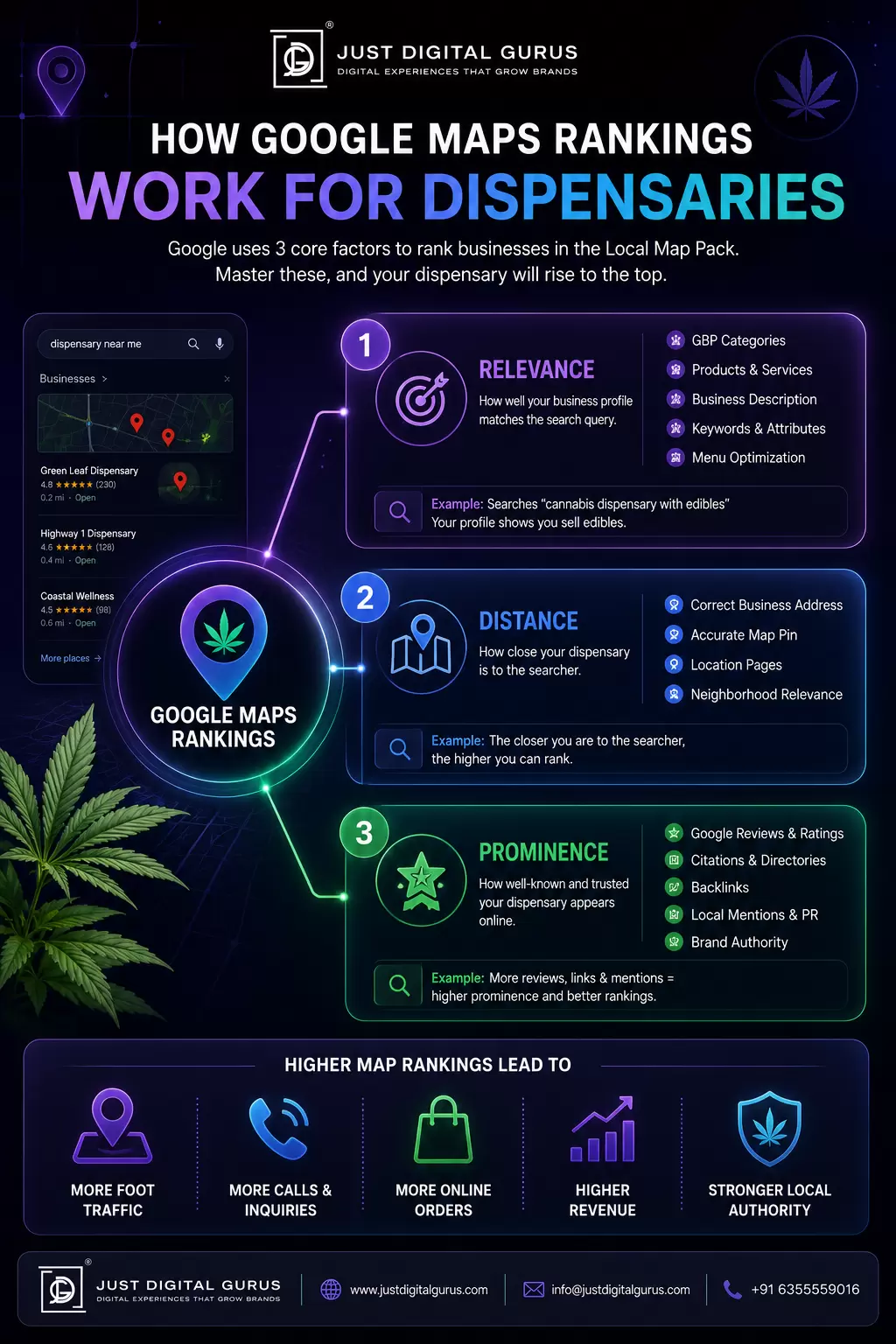
Google uses three main factors to rank businesses in the local map pack: relevance, distance, and prominence. Understanding these is the foundation of any local SEO effort.
Relevance is about how well your business profile matches what someone searched. If someone searches "cannabis dispensary with edibles," your GBP needs to clearly indicate you sell edibles. Your categories, description, and even the services you list all contribute to this match.
Distance is simple. How close is your business to the searcher? You can't fully control this, but you can influence it with location pages and by ensuring your address is correctly pinpointed on the map. The closer you are to the centroid of a search, the better.
Prominence is where the real work happens. It's about how well-known and trusted your business appears online. Reviews, ratings, backlinks, citations, and overall web presence all feed into prominence. A dispensary with 200 genuine reviews and links from local news sites will outrank one with 20 reviews and a thin online footprint.
Dispensary Google Business Profile Optimization
This is the single most important section of this guide. Your Google Business Profile is the control center for your Maps presence. A half-finished profile is a leaky bucket. You need to treat it like a living, breathing asset.
Choosing the correct primary category is step one. "Cannabis store" is the right choice for most dispensaries. Avoid vague categories that don't signal exactly what you are. Secondary categories can add nuance, but your primary must be precise.
Writing an optimized business description matters. Don't stuff it with keywords like a robot. Write naturally about what makes your dispensary special. Mention your location, your product expertise, and the experience customers can expect. Use terms like "cannabis dispensary seo" and "local dispensary" where they fit.
Add your products and services directly within the GBP dashboard. List the types of products you carry — flower, edibles, concentrates, topicals. Link to your online menu. The more information you provide, the more relevant Google considers you for those specific searches.
Business hours must be accurate and updated for holidays. Nothing frustrates a potential customer more than driving to a closed shop. Use the "More hours" section to add special hours for events or pick-up only windows.
Photos and videos bring your store to life. Upload real images of your interior, your team, and your products. Avoid stock photography. A video walkthrough of the store or a quick hello from a budtender builds instant trust. Google favors active profiles, so add new photos regularly.
Google Posts are an underutilized weapon. Share updates about new strains, events, or educational content. Use a call-to-action button. Even a simple "Shop Now" linking to your menu keeps your profile active and engaging. Consistency here signals to Google that your business is alive.
The Q&A section often fills up with common customer questions. Pre-populate it with useful answers. "Do you have a drive-thru?" "Is there parking?" Answer these yourself to prevent inaccurate crowd-sourced info from sticking.
Set up messaging if you can manage it. People want quick answers. If you turn it on, be prepared to respond fast. Add an appointment link if you offer consultations. Link your online ordering system directly. Finally, use UTM tracking on all profile links so you can see exactly how much traffic and revenue your GBP generates.
A quick but crucial warning. Avoid keyword stuffing your business name. Adding city names or product keywords to your actual business name in the dashboard is a quick way to get suspended. Your business name field should reflect your real-world signage, nothing more.
Cannabis NAP Consistency Strategy
NAP stands for name, address, and phone number. It sounds basic, but inconsistent NAP is one of the most common and damaging local SEO mistakes a dispensary can make.
Search engines cross-reference your business information across the web. If your address on Weedmaps says "Suite 100" and your GBP says "#100," that tiny inconsistency erodes trust. Google's confidence in your business data drops, and so do your rankings.
Regularly audit your NAP across every platform. Start with the big ones: your website, GBP, Facebook, Instagram, Leafly, Weedmaps, Yelp, and any local chamber of commerce listings. Use an exact match format for every entry.
Multi-location dispensaries face an even bigger challenge. Each location needs its own distinct NAP, a dedicated page on your website, and a separate GBP. Cross-contamination of phone numbers or addresses between locations confuses search engines and will tank your local prominence.
Cleaning up duplicate listings is essential. Sometimes old addresses or phone numbers spawn ghost listings. Use Google's built-in tools to report and remove duplicates. A clean, consistent NAP footprint tells search engines you're a reliable, established business worth ranking.
Dispensary Citation Building
Citations are online mentions of your business NAP. They don't need to link to you, but they must be accurate. Structured citations appear on directory sites like Yelp. Unstructured citations come from blog posts or news articles.
For dispensaries, industry-specific directories are your first priority. Claim and optimize your profiles on Weedmaps and Leafly. These platforms serve double duty as citation sources and customer discovery channels. A fully filled-out Leafly profile with accurate information is a strong local signal.
Don't neglect general directories. Bing Places, Apple Maps, and Foursquare might feel secondary, but they feed into the broader local search ecosystem. Ensure your NAP is perfect on each one. The consistency across these major data aggregators builds a foundation that's hard for competitors to disrupt.
Building citations isn't a one-time task. As your business details change, you must update them everywhere. Consider a citation management tool if you have multiple locations. Remember, accuracy is more important than volume. A hundred perfect citations beat a thousand messy ones.
Local Keyword Research for Cannabis SEO
Local keyword research is about understanding how your neighbors search for cannabis. The phrasing matters. Someone searching "dispensary in Miami" has different intent than "dispensary near me," though both are local.
Build a keyword list with city modifiers, neighborhood names, product and location combinations, and near-me phrases. Think like someone standing on a street corner. They might search "THC gummies Denver" or "best indica flower Capitol Hill."
Here's a practical breakdown:
| Keyword Type | Example |
|
City Intent |
dispensary in Miami |
|
Neighborhood Intent |
cannabis store Wynwood |
|
Product + Location |
pre-rolls near Venice Beach |
|
Near Me |
dispensary near me open now |
|
Service + Location |
same-day weed delivery Portland |
Long-tail local keywords often signal the highest purchase intent. A search for "cheap ounce of shake near me" is a transaction waiting to happen. Incorporate these terms naturally into your location pages and GBP posts.
On-Page Local SEO for Dispensaries
Your website needs to speak the local language. On-page local SEO bridges the gap between your site and your physical storefront.
Location landing pages are the cornerstone. If you have one store, your homepage might serve this role. Multiple stores require dedicated pages for each, with unique content. Include the city and neighborhood in your H1 tag. "Best Cannabis Dispensary in Austin" is clear and search-friendly.
Meta descriptions should be compelling and location-aware. They're your ad copy in the search results. Tell the searcher why they should choose you in the local area. Internal linking is vital. Link your location page to your menu, to your about page, and to your local guides.
Embed a Google Map directly on the page. It helps users and reinforces the location signal. Implement LocalBusiness schema markup. This structured data tells search engines your exact coordinates, hours, and social profiles in a machine-readable format.
Craft localized content sections. Mention nearby landmarks. "Just a block from the Painted Ladies" or "across from Central Park's west entrance" makes your page feel rooted in the community. Add geo-targeted FAQs answering questions like "Where do I park when visiting your dispensary?"
Google Maps Landing Page Optimization
This is an advanced tactic that many competitors miss entirely. Dedicated city or neighborhood pages, when done correctly, can capture traffic from multiple local areas without spamming.
The key is genuine local relevance. Create a page that serves a specific neighborhood or nearby suburb. Write about the area, its character, and why customers from there love your store. Include driving directions from recognizable landmarks. Mention street names and transit stops.
These pages must not be thin doorway pages. Google penalizes duplicate content with just the city name swapped. Each page needs unique text, unique photos ideally, and specific local information. A page for "Downtown Denver Dispensary" should feel different from one for "Capitol Hill Dispensary."
Add value with parking tips, public transit routes, and even a short note about the neighborhood vibe. This depth signals to Google that the page is a substantive resource, not just a ranking ploy. When done right, these pages rank for hyper-local searches and feed authority back to your main site.
Local Content Marketing Strategy
Local content marketing turns your dispensary into a community resource. You're not just a store. You're a local voice that educates and engages.
Write about local cannabis news and events. Did a new regulation pass? Explain it in simple terms for your customers. Is there a local cannabis farmers market? Cover it. Create area-specific blogs like "Top 5 Trails to Enjoy Responsibly Near Boulder."
Educational guides that answer common local questions are gold. "How to Legally Gift Cannabis in California" or "A Beginner's Guide to Michigan's Recreational Laws." These pieces attract search traffic from people seeking trusted local information.
Seasonal content works surprisingly well. "Best Cannabis Strains for a Michigan Winter" or "Summer Edibles for Chicago Lakefront Picnics" are hyper-relevant and shareable. This approach builds topical authority through consistent, helpful local focus. Your semantic SEO gets stronger as you cover the local cannabis landscape comprehensively.
Review Management and Reputation SEO
Reviews fuel local rankings. The number, velocity, recency, and quality of your Google reviews directly influence your prominence score. It's one of the strongest local SEO signals you can actively influence.
Encourage a steady stream of reviews. Train your budtenders to mention it at checkout. Send a follow-up email with a direct link. Never incentivize reviews with discounts; that violates guidelines and risks penalties.
When customers mention specific products or your staff in reviews, those keywords help. "Best sativa gummies" or "friendly budtender" in organic reviews reinforces your relevance. Don't demand keywords, but celebrate when they appear naturally.
Respond to every review. Thank positive reviewers warmly and personally. For negative reviews, stay calm and professional. Apologize, explain if needed, and offer to make it right offline. This shows potential customers that you care.
Manage reviews across platforms. Weedmaps and Leafly reviews matter to your reputation and can influence your off-site prominence. A healthy, responsive presence across all major cannabis directories sends a unified trust signal.
Local Link Building for Cannabis Dispensaries
Building local links for a dispensary requires creativity because many mainstream sites won't touch cannabis. The focus shifts to genuine community involvement.
Sponsor a local little league team or a charity run. Partner with a neighborhood coffee shop for a cross-promotion. Join your local chamber of commerce and actually attend meetings. These relationships naturally lead to links from trusted local organizations.
Host a cannabis education night or a community cleanup event. Send a press release to the local newspaper. Cannabis PR might seem daunting, but a well-told story about your business's positive local impact is link-worthy.
Get involved in local cannabis policy discussions or sponsor a harm reduction program. These activities generate .org and .gov backlinks that are extremely powerful. Local blogs and neighborhood news sites are also often open to covering a unique local business story, especially one that defies old stigmas.
Technical SEO for Local Cannabis Websites
Local SEO lives on a technical foundation. If your site is slow or broken, all the local signals in the world won't matter.
Mobile optimization is non-negotiable. Almost all "near me" searches happen on phones. Your site must load instantly and look perfect on a small screen. Core Web Vitals, Google's page experience metrics, need to pass with flying colors.
Check your site speed. Compress images, minimize code, and use a content delivery network. Ensure your pages are crawlable and indexed correctly. Implement local business schema, not just on your homepage, but on each location page.
HTTPS security is a trust signal. An SSL certificate is basic but essential. A technically healthy site ensures your local content and GBP efforts are supported, not undermined. Run a quarterly technical audit to catch issues before they sink your rankings.
Multi-Location Dispensary SEO Strategy
Scaling a dispensary to multiple locations multiplies your SEO complexity. You can't just copy and paste one page a few times and call it a day.
Each location needs a completely separate, unique location page. Write original content for each. Feature photos of the actual store and team. Highlight neighborhood-specific details. The goal is to make each page feel like its own local business, not a franchise template.
GBP management at scale requires organization. Keep a spreadsheet tracking every profile, its reviews, and citation status. Encourage localized reviews for each store, not just one aggregated pile. Avoid duplicate content pitfalls by investing in genuine uniqueness. It's more work, but the map pack domination you achieve across a city is worth it.
Common Local SEO Mistakes Dispensaries Make
Steering clear of common pitfalls can save you months of lost progress. One major mistake is keyword stuffing the business name in GBP. This triggers suspensions fast. Your name should match your real-world signage.
Fake reviews are another trap. Don't buy them or have staff post without disclosing, it's transparent and Google penalizes it harshly. Duplicate city pages with thin, spun content are a waste of time and can dilute your site's quality.
Inconsistent NAP we covered, but it bears repeating. It's the silent killer of local credibility. A gorgeous website that's slow on mobile is a conversion disaster. And ignoring local schema markup means leaving easy ranking signals on the table. Fix these before chasing advanced tactics.
AI Search and the Future of Local Cannabis SEO
By 2026, AI is reshaping how people find local businesses. Voice search asks, "Hey Google, find a highly rated edibles dispensary open now." The answer comes from the map pack and AI-generated summaries.
AI Overviews might compile reviews, sentiment, and key business details directly at the top of the search results. To be the business cited, you need impeccable entity-based SEO. Your brand must be understood by Google as a trusted, prominent entity in the local cannabis space.
Conversational local search means optimizing for full questions, not just keywords. "What's the closest dispensary with a first-time patient deal?" Your content and GBP need to address these nuanced queries. Building local brand authority through consistent engagement and solid reviews will be your moat.
Local SEO Checklist for Dispensaries
Use this checklist as a practical reference. It covers the core actions that move the needle.
| Task | Done |
|
GBP claimed, verified, and fully filled out |
|
|
Accurate categories and attributes set |
|
|
New photos uploaded this month |
|
|
A Google Post published in the last week |
|
|
NAP consistent across top directories |
|
|
LocalBusiness schema implemented |
|
|
Location pages unique and optimized |
|
|
At least 10 new reviews this month, all responded to |
|
|
Local backlinks earned from community involvement |
|
|
Core Web Vitals passing on mobile |
Check these off every quarter to stay sharp.
Why Hiring a Cannabis Local SEO Expert Matters
Local SEO for dispensaries isn't just general SEO with a cannabis leaf slapped on it. The compliance landscape is treacherous. A single wrong category or a misunderstood guideline can get your GBP suspended for weeks.
A cannabis local SEO expert knows the specific triggers for Google's filters. They've navigated the peculiarities of getting citations indexed in a stigmatized industry. They understand the local ranking factors that matter most for dispensaries specifically.
Their job is to accelerate your visibility while you run your business. They know which local partnerships yield links, how to speed up review velocity without breaking rules, and how to structure a multi-location strategy that won't collapse. When you're losing money to invisible maps presence, an expert's insight pays for itself.
Conclusion
Dominating Google Maps is the most direct path to foot traffic for a dispensary. It's not about chasing every shiny new SEO trend. It's about the fundamental work of making your business locally prominent, relevant, and undeniably present.
Google Maps rankings compound. Every review, every citation, every local blog post adds a layer of trust. You build a presence so embedded in the community that Google sees you as the default answer.
Start with your GBP. Make it immaculate. Weed out NAP inconsistencies. Build a review generation habit. Craft location content that genuinely helps your neighbors. Do this with patience, and the map pack will reward you.
Ready to see how your dispensary stacks up? We offer a free local SEO audit at Just Digital Gurus. We'll go through your GBP, citations, and local presence with a fine-toothed comb. Let's figure out what's holding you back and get you on the map where you belong.
Frequently Asked Questions
How do dispensaries rank higher on Google Maps?
By optimizing their Google Business Profile completely, building consistent citations across the web, generating frequent genuine reviews, and creating location-specific content that signals relevance and prominence to Google.
What is cannabis local SEO?
It's the specific practice of optimizing a dispensary's online presence to show up for local searches. This includes map pack rankings, localized website content, and managing directory listings so nearby customers can find you easily.
How important are citations for dispensaries?
Extremely important. They validate your business information and contribute to your local prominence. Consistent citations across platforms like Weedmaps, Leafly, and Yelp tell Google you're a legitimate, established business.
Can dispensaries advertise on Google?
Paid advertising for cannabis is heavily restricted. Organic local SEO, therefore, becomes the most critical channel for ensuring your business is visible to customers searching in your area.
How do I optimize my dispensary Google Business Profile?
Use the category "Cannabis store," fill out every field accurately, add real photos and posts weekly, manage and reply to reviews, use the Q&A feature, and avoid keyword stuffing your business name.
What are the best directories for dispensaries?
Start with Weedmaps and Leafly, as they are industry-specific. Then claim your listings on Yelp, Bing Places, Apple Maps, and your local chamber of commerce site.
How long does local SEO take for dispensaries?
You can see ranking improvements within weeks if you correct NAP issues and optimize your GBP. Building enough prominence to sustain top map pack positions against strong competition typically takes three to six months.

Your comment will appear after approval.