
 Written By :
 ChatGPT
 Perplexity
 Claude
 Gemini
The online dating industry is worth billions, and it keeps growing. New platforms launch regularly targeting everything from general audiences to hyper-specific niches like pet owners, professionals, or people with shared dietary preferences. And yet, most of them struggle to gain traction because they underestimate what goes into building a platform people actually trust and want to use.
Dating website development is genuinely more complex than most web projects. You're dealing with sensitive personal data, real-time communication features, identity verification, payment processing, content moderation, and a user experience that needs to feel safe and intuitive all at once. Get any one of those wrong and users leave immediately.
This guide covers the full picture, from what the development process actually looks like, to which technologies make sense, what security really requires, how monetization works, and how to find a development team that can actually pull it off.
What Is Dating Website Development?
Dating website development is the process of designing, building, and launching an online platform that connects people based on compatibility, shared interests, location, or other matching criteria. It covers everything from the database architecture and backend logic that powers matching algorithms, to the frontend experience users interact with daily.
It's not just a website with profiles and a search filter. A properly built dating platform is closer to a social networking application with complex user interactions, real-time messaging, subscription management, moderation systems, and privacy controls running underneath.
The scope of the project depends heavily on your target audience, your monetization model, and the features you want to offer at launch versus features you plan to add later.
Why the Online Dating Industry Continues to Grow
The numbers are hard to ignore. The global online dating market was valued at over $9 billion in 2022 and is projected to keep growing steadily through the decade. Mobile usage, changing social norms around how people meet, and increasing comfort with digital-first relationships have all contributed to that.
A few things are driving continued growth specifically:
Niche platforms are winning. General dating sites face intense competition from established giants like Tinder, Bumble, and Match. But niche platforms targeting specific communities, religions, age groups, or lifestyles are finding loyal audiences that feel underserved by the big players.
Subscription willingness is high. Dating is one of the few categories where users are genuinely willing to pay for premium features. Monetization potential is real if the platform delivers value.
International markets are expanding. Dating platforms targeting regions in Southeast Asia, Latin America, and the Middle East are growing rapidly as internet access improves and social attitudes shift.
If you're considering entering this space, the market opportunity is legitimate. The challenge is execution.
Essential Features of a Modern Dating Website
This is where a lot of projects go wrong. Founders want to build everything at once. The smarter approach is knowing which features are non-negotiable at launch and which ones can come later.
User Registration and Profile Creation
The entry point for every user. Registration should be simple but thorough enough to collect the information your matching logic needs. Profile creation should support photos, bio text, preferences, and any niche-specific attributes your platform focuses on.
Social login options (Google, Facebook, Apple) reduce friction significantly and tend to improve signup completion rates.
AI-Powered Matchmaking
Basic filter-based matching is table stakes now. Users expect the platform to surface relevant profiles intelligently, not just return results based on age range and location. AI-powered matchmaking uses behavioral data, interaction history, and preference signals to improve match quality over time.
This is one area where the difference between a generic platform and a genuinely useful one becomes obvious quickly.
Geolocation-Based Matching
Most users want to meet people within a reasonable distance. Geolocation matching lets users set radius preferences and find profiles near them. This needs to be implemented carefully from a privacy standpoint, displaying approximate location rather than precise coordinates.
Real-Time Messaging and Video Chat
Messaging is the core of what keeps users on the platform. It needs to be fast, reliable, and feel modern. WebSockets are typically used for real-time message delivery. Video chat has become expected since the pandemic and is now a standard feature on most competitive platforms.
Subscription and Membership Management
If your platform uses a freemium or paid membership model, the subscription management system needs to handle plan tiers, billing cycles, upgrades, cancellations, and payment failures gracefully. This connects directly to your payment gateway integration.
Push Notifications
Notifications drive re-engagement. New match alerts, message notifications, profile view alerts, and promotional messages all bring users back. These need to be implemented thoughtfully so they add value rather than become annoying enough that users turn them off entirely.
User Verification Systems
Photo verification, phone number verification, email verification, and ID verification for premium tiers are all worth considering. Fake profiles are one of the fastest ways to destroy user trust on a dating platform. Verification systems reduce that risk.
Admin Dashboard and Analytics
Your team needs visibility into what's happening on the platform. User growth, active sessions, reported profiles, subscription metrics, match rates, message volume. A well-built admin panel makes moderation and business decisions manageable.
How to Build a Dating Website Step by Step
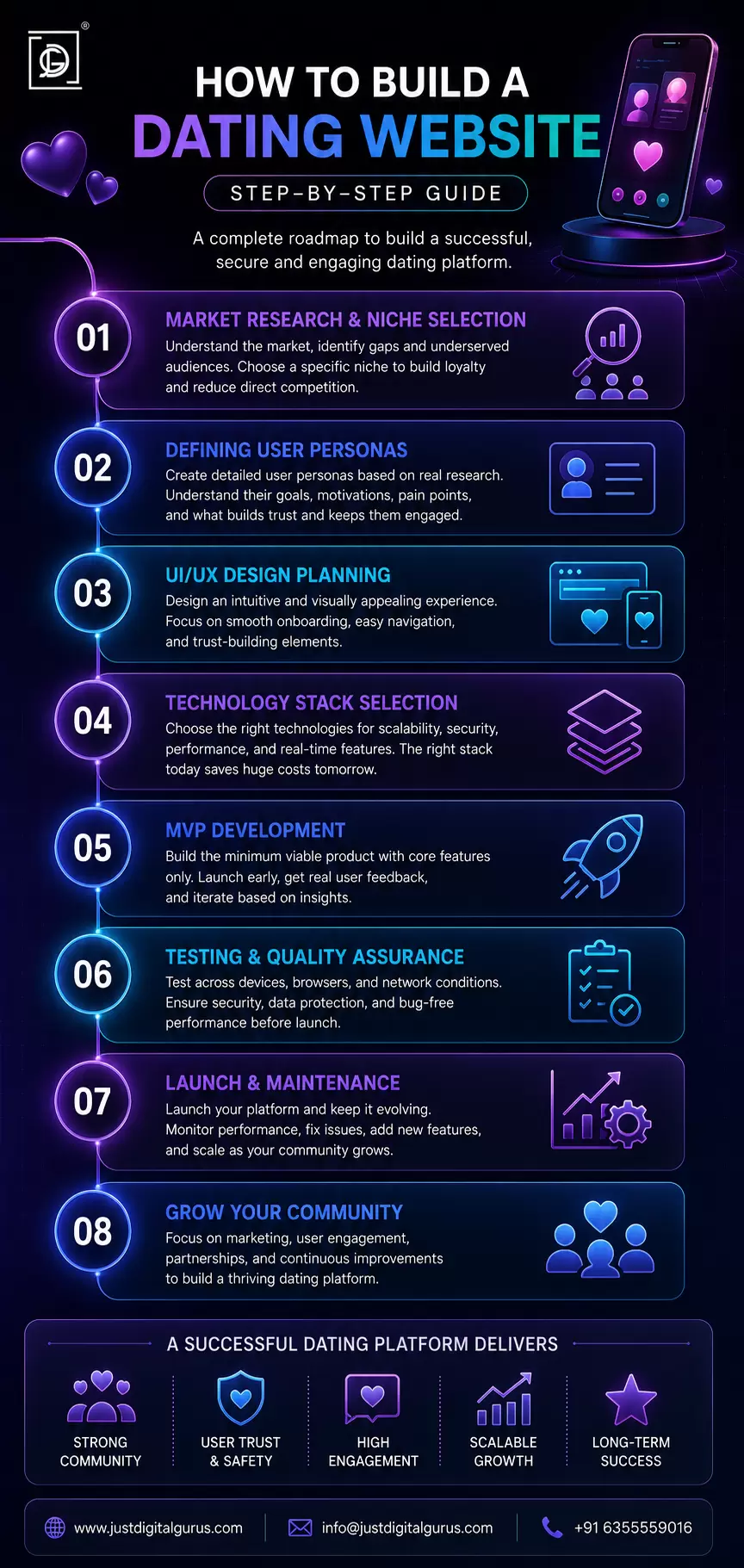
Market Research and Niche Selection
Before writing a single line of code, understand the market you're entering. Who is underserved? What do existing platforms do poorly? What specific community or interest group would benefit from a dedicated platform?
The more specific your niche, the easier it is to build an audience and the less directly you compete with established giants.
Defining User Personas
Who are your users? What do they want from the platform? What would make them trust it? What would make them leave? Building user personas based on real research shapes every decision that follows, from feature prioritization to UI design to tone of the platform.
UI/UX Design Planning
Dating platforms live and die by user experience. If the onboarding is confusing, the profile setup is tedious, or the matching interface feels clunky, users leave before they've even seen whether the platform works.
Design should prioritize clarity, trust signals, and ease of use. It also needs to feel appropriate for your specific audience. A dating platform for professionals over 40 should look and feel very different from one targeting college students.
Technology Stack Selection
More on this below, but technology decisions made early have long-term consequences. Choosing the wrong stack for your scale requirements or security needs creates expensive rework later.
MVP Development
Build the minimum version that actually works. Core features only. Get it in front of real users as quickly as possible, collect feedback, and iterate. This approach is more honest about what you know and don't know at the start of a project.
Testing and Quality Assurance
Dating platforms need thorough testing across devices, browsers, and network conditions. Security testing is especially critical given the sensitivity of the data involved. QA should be ongoing, not a single phase before launch.
Launch and Maintenance
Launch is not the finish line. Post-launch maintenance covers bug fixes, performance monitoring, security updates, feature additions based on user feedback, and scaling infrastructure as your user base grows.
Choosing the Right Dating Website Development Software
The software and framework decisions you make early shape what's possible later. There's no single right answer, but here's how the main options stack up:
| Technology | Best For | Considerations |
|---|---|---|
| PHP (Laravel) | Cost-effective custom builds | Widely supported, large developer pool |
| Node.js | Real-time features, high concurrency | Strong for messaging and live features |
| Python (Django) | AI/ML matchmaking features | Excellent for data processing and algorithms |
| React / Next.js | Frontend / full-stack modern platforms | Fast rendering, strong SEO support |
| React Native / Flutter | Cross-platform mobile apps | Reduces mobile development cost |
| MySQL / PostgreSQL | Relational data storage | Standard for user and profile data |
| MongoDB | Flexible content storage | Good for varied profile attributes |
| Redis | Caching, session management | Improves real-time performance |
| WebSockets | Real-time messaging | Industry standard for chat features |
| AWS / Google Cloud | Scalable hosting infrastructure | Handles traffic growth reliably |
Most production dating platforms use a combination of these rather than a single technology. The specific combination depends on your feature set, expected user volume, and development team expertise.
Dating Website Development Using PHP: Benefits and Considerations
PHP remains one of the most widely used languages for web application development, and it's a legitimate option for dating platform development, particularly when using a modern framework like Laravel.
Why PHP Still Makes Sense
| Benefit | Detail |
|---|---|
| Large developer pool | Easy to find experienced PHP developers at competitive rates |
| Mature ecosystem | Extensive libraries, packages, and community support |
| Laravel framework | Clean architecture, built-in security features, authentication systems |
| Cost efficiency | Generally lower development cost compared to some alternatives |
| Proven at scale | Many large platforms run on PHP successfully |
| CMS integration | Easy integration with content management and admin tools |
Where PHP Has Limitations
Real-time features like live messaging and video chat are not PHP's strongest territory. You'd typically handle WebSocket connections through a separate Node.js service alongside a PHP backend, rather than trying to force real-time functionality through PHP alone.
For AI-powered matchmaking logic, Python tends to be a more natural fit. Many PHP-based dating platforms use a hybrid approach where PHP handles the application layer and other services handle specific feature requirements.
If you're working with a budget that makes PHP development attractive, it's a solid foundation. Just be aware of where it works best and where you might need complementary services.
Security Requirements for Dating Platforms
This section deserves serious attention. Dating platforms collect some of the most personal information people share online: photos, location, relationship preferences, private conversations, and payment details. A security breach on a dating platform isn't just a technical problem. It's a trust-destroying event that often kills platforms permanently.
End-to-End Data Encryption
All sensitive data should be encrypted both in transit (TLS/SSL) and at rest. Private messages, in particular, should use end-to-end encryption so that even your own systems can't read conversation content.
GDPR and Privacy Compliance
| Compliance Requirement | What It Means in Practice |
|---|---|
| Data minimization | Only collect what you actually need |
| Right to erasure | Users can delete their account and all associated data |
| Consent management | Clear opt-in for data processing and marketing |
| Data portability | Users can export their data |
| Privacy policy | Clear, readable explanation of data handling |
| Cookie consent | Proper consent management for tracking |
If your platform serves users in the European Union, GDPR compliance is not optional. US-based platforms serving California residents also need to consider CCPA requirements.
Secure Payment Processing
Never store raw payment card data. Use established payment processors like Stripe or Braintree that handle PCI DSS compliance on their end. Your role is ensuring the integration is implemented correctly and that the connection between your platform and the payment processor is secure.
Profile Verification
Verification systems reduce fake profiles, catfishing, and scam accounts. Options range from email and phone verification at the basic level to photo verification (comparing a selfie to profile photos) and ID verification for premium tiers.
Fraud Detection Systems
| Fraud Type | Detection Approach |
|---|---|
| Fake profiles | AI-based image analysis, behavioral pattern detection |
| Scam accounts | Message pattern analysis, report aggregation |
| Payment fraud | Velocity checks, address verification, 3D Secure |
| Spam behavior | Rate limiting, CAPTCHA, behavioral analysis |
Content Moderation Tools
User-reported content, automated inappropriate image detection, and human moderation workflows are all necessary. A dating platform without active content moderation becomes unsafe quickly, and unsafe platforms lose users.
Building a Scalable Dating Website Architecture
Cloud Infrastructure
Build on cloud infrastructure from the start. AWS, Google Cloud, or Azure all provide the tools needed to scale horizontally as your user base grows. Starting with scalable infrastructure is far cheaper than migrating to it after you've already outgrown a fixed server setup.
Microservices Architecture
| Service | Function |
|---|---|
| User service | Registration, authentication, profile management |
| Matching service | Algorithm logic, compatibility scoring |
| Messaging service | Real-time chat, message storage |
| Notification service | Push notifications, email alerts |
| Payment service | Subscription management, billing |
| Moderation service | Content review, report handling |
| Analytics service | Usage tracking, business metrics |
Breaking the application into independent services means individual components can be scaled or updated without affecting the entire platform.
Database Optimization
As user counts grow, database performance becomes critical. Indexing, query optimization, read replicas for heavy read workloads, and caching layers with Redis all contribute to keeping the platform responsive under load.
Load Balancing
Traffic to a dating platform is rarely consistent. Weekday evenings and Sunday afternoons tend to be peak periods. Load balancers distribute traffic across multiple server instances automatically, preventing any single server from becoming a bottleneck.
CDN Integration
Profile photos, videos, and other media assets should be served through a Content Delivery Network. This reduces load on your origin servers and dramatically improves load times for users in different geographic locations.
Monetization Strategies for Dating Websites
Getting monetization right is what separates sustainable platforms from ones that burn through launch momentum and run out of runway.
| Monetization Model | How It Works | Best For |
|---|---|---|
| Premium Membership Plans | Users pay monthly or annually for full access | Serious dating platforms |
| Freemium with Upgrades | Free basic access, paid features unlocked | Broad audience platforms |
| Featured Profiles | Users pay to appear more prominently in search | Supplementary revenue |
| In-App Purchases | Credits, boosts, super likes | High-engagement platforms |
| Virtual Gifts | Send digital gifts to other users | Niche and social-leaning platforms |
| Advertising Revenue | Display ads to free-tier users | High-volume platforms |
| Verification Badges | Paid identity verification | Trust-focused platforms |
| Event Features | Virtual or in-person event listings | Community-oriented platforms |
Most successful platforms use a combination of freemium subscriptions and in-app purchases rather than relying on a single revenue stream. The specific mix depends on your audience and the value your platform delivers.
Dating Website Development Cost Breakdown
Costs vary significantly based on feature scope, development team location, and technology choices. Here's a realistic range:
| Project Scope | Estimated Cost | Timeline |
|---|---|---|
| Basic MVP (core features only) | $15,000 - $35,000 | 2 - 4 months |
| Standard platform with messaging + subscriptions | $35,000 - $75,000 | 4 - 7 months |
| Full-featured platform with AI matching + video | $75,000 - $150,000 | 7 - 12 months |
| Enterprise / white-label platform | $150,000+ | 12+ months |
| Ongoing maintenance (monthly) | $2,000 - $8,000 | Ongoing |
| Cost Factor | Impact on Budget |
|---|---|
| Development team location | US/UK teams cost more; offshore reduces cost with quality tradeoffs |
| Feature complexity | Real-time features, AI, video chat add significant cost |
| Design complexity | Custom UI/UX vs adapted templates |
| Security requirements | Verification systems, compliance work adds cost |
| Third-party integrations | Payment gateways, video providers, verification APIs |
| Platform type | Web only vs web + mobile apps |
These are directional estimates. A proper scoping exercise with a development team will give you more accurate numbers based on your specific requirements.
How to Choose a Dating Website Development Company
Industry Experience
Has the team built dating platforms or social networking applications before? Experience with this specific category matters more than general web development experience. The challenges around real-time features, user safety, and sensitive data handling are specific enough that prior exposure makes a real difference.
Technical Expertise
| What to Evaluate | Why It Matters |
|---|---|
| Backend architecture experience | Determines how well the platform scales |
| Real-time technology knowledge | Critical for messaging and matching features |
| Security implementation | Non-negotiable given data sensitivity |
| Mobile development capability | Most dating usage happens on mobile |
| AI/ML experience | Required for intelligent matchmaking |
| Cloud infrastructure knowledge | Affects performance and cost efficiency |
Security Standards
Ask specifically how they approach data encryption, GDPR compliance, and payment security. A team that can't give clear answers to these questions is a team that hasn't built platforms where these things mattered.
Portfolio Evaluation
Look at real platforms they've built. How do they perform? How do they feel to use on mobile? Are there obvious design or performance problems? A strong portfolio of relevant work is more meaningful than any sales conversation.
Support and Maintenance Services
Post-launch support matters. A dating platform needs ongoing updates, security patches, performance monitoring, and feature additions based on user feedback. Ask how they handle maintenance and what the post-launch relationship looks like.
Pricing Transparency
Be cautious of teams that are vague about cost structure or give estimates without understanding your requirements. A reliable development partner will ask enough questions before quoting to give you a number that's actually meaningful.
Why Businesses Choose Dating Website Development Services in the USA
US-based development teams offer a few specific advantages that are worth understanding rather than just assuming one approach is better than another.
| Advantage | Detail |
|---|---|
| Timezone alignment | Real-time communication without significant delays |
| Legal familiarity | Understanding of US privacy law (CCPA, state regulations) |
| Quality consistency | Established quality standards and accountability |
| Communication clarity | No language barrier in requirements and feedback cycles |
| IP protection | Stronger legal protections for intellectual property |
| Cultural context | Better understanding of US dating culture and user expectations |
That said, US-based development typically costs more. The decision comes down to project complexity, budget, and how much risk you're comfortable carrying. For a dating platform handling sensitive user data, the risk reduction that comes with a trusted, accountable development partner often justifies the higher cost.
Common Challenges in Dating Website Development
| Challenge | Why It Happens | How to Address It |
|---|---|---|
| Fake profile management | Open registration attracts bad actors | Multi-layer verification, AI detection, active moderation |
| User retention | People leave when they find a match or get frustrated | Engagement features, notifications, community elements |
| Cold start problem | New platforms have no users for new users to match with | Geographic or niche launch strategy, seeded content |
| Real-time performance | Messaging under load is technically demanding | WebSockets, horizontal scaling, Redis caching |
| Payment integration complexity | Multiple currencies, subscription states, refunds | Established payment processor, tested billing logic |
| Privacy and data leaks | Sensitive data is a high-value target | Encryption at rest and in transit, security audits |
| Content moderation at scale | Human review doesn't scale with user growth | Automated detection + human review workflows |
| Mobile optimization | Most users are on mobile devices | Mobile-first design, optimized assets, app consideration |
Future Trends in Dating Platforms
AI-driven compatibility is getting more sophisticated. Platforms are moving beyond basic preference matching toward systems that learn from user behavior and improve match quality continuously.
Video-first interactions are becoming standard. Short-form video profiles, video prompts, and live video features reduce the gap between online interaction and meeting in person.
Safety features are becoming competitive differentiators. Background check integrations, real-time location sharing for first dates, and in-app emergency features are features users increasingly expect, not just appreciate.
Niche platforms continue to grow. The market for broadly targeted dating apps is largely saturated. Platforms serving specific communities, values, or lifestyles are finding audiences that feel genuinely understood by the product.
Social elements are increasing. Group events, community forums, and interest-based group matching are being added to platforms to keep users engaged beyond the core matching experience.
Final Thoughts
Dating website development is a legitimate business opportunity, but it's also a genuinely complex technical undertaking. The platforms that succeed are the ones built with real attention to user safety, performance, and experience from day one, not the ones that launch quickly with the intention of fixing problems later.
If you're planning to build a dating platform, the technology decisions, security architecture, and team you choose early will define what's possible for years. Getting those right from the start is worth the investment.
At Just Digital Gurus, we build web platforms that are designed to perform, scale, and hold up under real-world conditions. If you're exploring what your project would require, book a call with our team for a straightforward conversation about scope, timeline, and what makes sense for your goals. You can also explore our web design and development services or get in touch directly if you have specific questions.
Frequently Asked Questions
What is dating website development?
Dating website development is the process of designing and building an online platform that connects users based on compatibility, location, shared interests, or other matching criteria. It includes frontend and backend development, database architecture, real-time messaging systems, payment integration, security implementation, and content moderation infrastructure.
How much does dating website development cost?
A basic MVP typically costs between $15,000 and $35,000. A full-featured platform with real-time messaging, AI matchmaking, video chat, and subscription management can run $75,000 to $150,000 or more. Ongoing maintenance adds $2,000 to $8,000 per month depending on platform complexity and traffic volume.
Which technologies are best for dating website development?
There's no single answer, but commonly used combinations include Laravel (PHP) or Node.js for the backend, React or Next.js for the frontend, PostgreSQL or MongoDB for databases, WebSockets for real-time messaging, and AWS or Google Cloud for hosting. Python is often added for AI matchmaking components.
Is PHP a good choice for dating website development?
Yes, particularly with the Laravel framework. PHP handles the application layer well and offers a large developer pool and cost efficiency. For real-time features like live messaging, you'd typically use a Node.js service alongside the PHP backend rather than handling everything in PHP alone.
How do I choose the best dating website development company?
Look for a team with experience building social or dating platforms specifically, not just general web development. Ask about their security implementation practices, review their portfolio critically, and ask clear questions about post-launch support. Transparency around cost structure and timeline is also a good signal of how they operate. You can contact our team or book a call to discuss your project directly.

Your comment will appear after approval.