
 Written By :
 ChatGPT
 Perplexity
 Claude
 Gemini
If you run a dispensary, you already know the feeling. You have an incredible product lineup, a welcoming store, and a team that actually cares. But when someone in your city pulls out their phone and types “dispensary near me,” your business isn’t showing up.
Worse, some out-of-state directory with zero local presence ranks above you. That quiet frustration is exactly why cannabis SEO strategy has become the single most reliable way to build a dispensary brand that owns the top of the search results.
I’m going to walk you through how dispensaries can rank number one in their market. Not with generic advice. With a framework that accounts for all the weird quirks cannabis businesses deal with, paid ads are heavily restricted. Social media throttles your reach.
The legal landscape changes depending on which side of a state line you stand. Organic search, done right, gives you a consistent stream of local customers. No constant anxiety of algorithm bans. No skyrocketing ad costs.
This guide covers the full picture. You will learn how to structure your website so search engines trust it. How to build a local presence that dominates Google Maps. How to create content that answers real questions. And how to future-proof your strategy as AI-generated search results evolve.
Whether you run a single storefront or a multi-location chain, the principles stay the same. We’ll talk about the parts most SEO articles skip. Entity SEO. Conversion rate optimization for cannabis sites. How to build topical authority in a space where compliance always looms.
Why Cannabis SEO Matters More Than Ever in 2026
Cannabis businesses live in a strange digital purgatory. Google refuses to run standard cannabis ads. Meta platforms limit what you can promote and frequently flag compliant content. TikTok and other emerging channels outright ban paid promotion of cannabis products.
That leaves you with organic traffic as the backbone of your online acquisition. And that organic traffic is more competitive than ever. Search demand for dispensary-related terms keeps growing. People aren’t just looking for “weed delivery” anymore.
They search for “best indica gummies for sleep near me” or “what terpenes help with anxiety.” Each of those searches is a chance to earn a click, a store visit, or an online order. If your site isn’t optimized, someone else is grabbing that customer.
AI-powered search is also reshaping the game. Google’s AI Overviews now answer questions directly at the top of the results page. They pull information from sources they trust. If your dispensary website isn’t seen as a trusted entity with strong E-E-A-T signals, you won’t be cited.
You lose visibility even when you technically rank. This isn’t a future problem. It’s happening now. Cannabis SEO has to go beyond stuffing “dispensary near me” into a title tag. It demands a holistic approach that merges technical health, local relevance, content depth, and brand authority.
What Is Cannabis SEO Strategy?
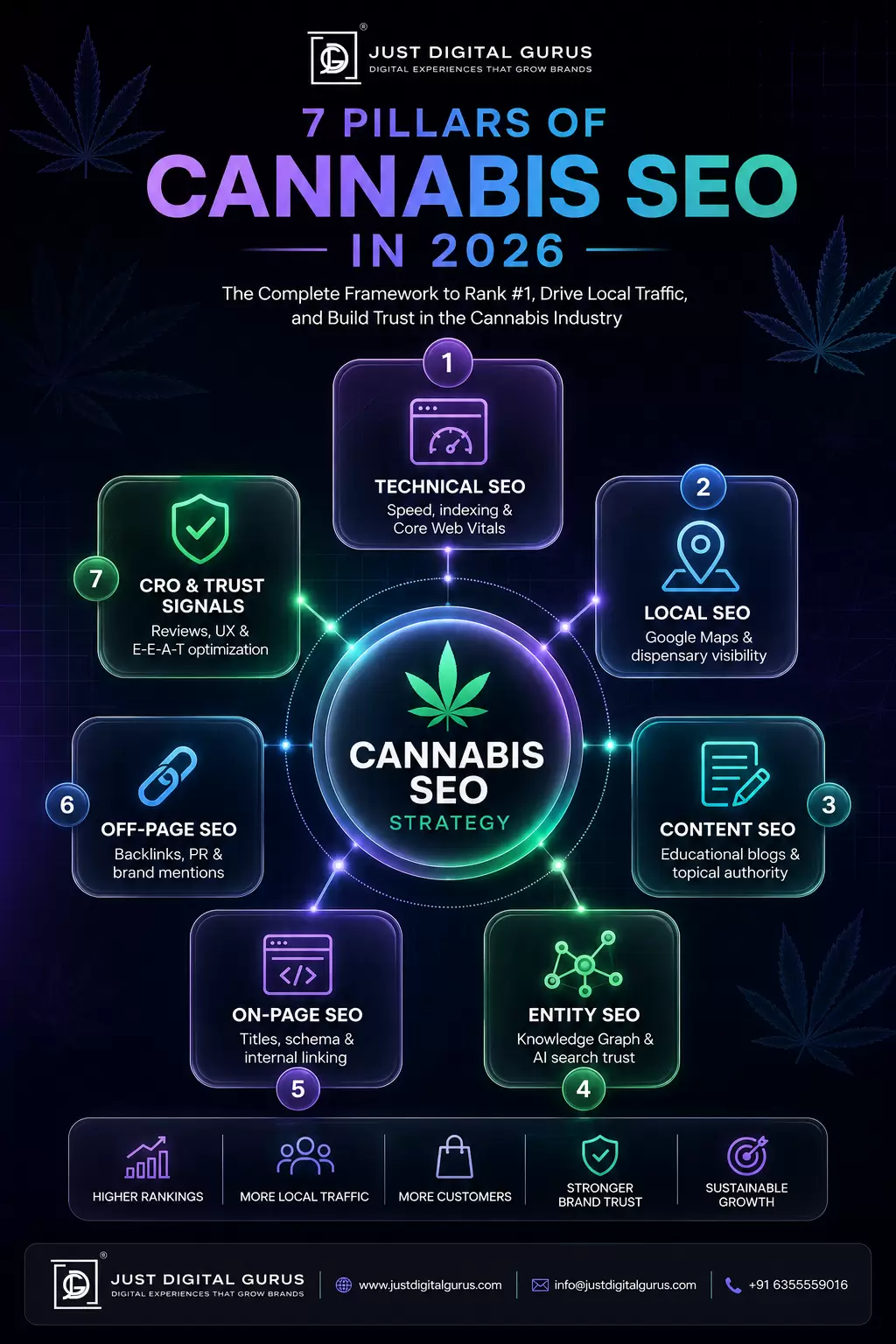
A complete cannabis SEO strategy isn’t a single tactic. It’s a system built from several interconnected layers. You need your site’s foundation to be crawlable and fast. You need your local footprint to be consistent and verified across every platform that matters.
You need content that educates, captures intent, and keeps people on the page. You need structured data that helps search engines understand what your business does and where. And you need trust signals that tell both Google and a first-time visitor that your dispensary is legitimate.
I break it down into seven core pillars. Technical SEO covers site speed, Core Web Vitals, mobile experience, and indexing. Local SEO includes your Google Business Profile, citations, location pages, and review management. Content SEO is your blog, strain guides, educational material, and commercial pages.
Entity SEO builds your brand’s identity in Google’s Knowledge Graph. On-page SEO handles title tags, headings, internal linking, and product descriptions. Off-page SEO encompasses link building and digital PR. Conversion optimization makes sure the traffic you earn actually turns into revenue.
A dispensary SEO guide that ignores any one of these pillars leaves money on the table. You might rank for a while, but the foundation will crack.
Local SEO for Cannabis Dispensaries: The Section That Will Actually Move Your Needle
When I audit dispensary websites, the most common gap isn’t a lack of content. It’s a messy local SEO foundation. You can’t rank in the map pack if Google isn’t absolutely certain about your name, address, phone number, and business category.
Your Google Business Profile needs to be claimed, verified, and fully completed. Add your hours and services. Include attributes like “women-owned” or “veteran-led” if they apply. Upload photos of your interior and products. Post updates regularly.
Businesses that respond to reviews and keep their profiles active consistently outrank those that set it and forget it. The “weed dispensary seo” conversation starts and ends with a top-notch GBP. Get this right first.
Beyond GBP, your NAP consistency across the web is non-negotiable. Every citation, from Leafly and Weedmaps to Yelp and your local chamber of commerce, must feature the exact same business name, address, and phone number. Discrepancies confuse the search algorithms and dilute your local authority.
Creating dedicated location landing pages for each storefront tells Google you are deeply relevant to each area you serve. Include unique directions, staff bios, neighborhood-specific content, and local schema markup. Don’t just swap the city name. That’s duplicate content and Google ignores it.
Then there’s local schema markup itself. Adding LocalBusiness schema with your geo-coordinates, payment methods, and social profiles gives search engines a structured data layer. It feeds directly into local ranking signals. This is one of those elements that takes a developer an hour and pays dividends for years.
Review management is equally critical. A steady flow of recent, positive reviews strengthens your local search presence. Reply naturally, but mention your city and product category. “Thanks for visiting our cannabis dispensary in Springfield” works far better than a generic “Thanks!”
These details collectively create a map pack ranking engine. Most dispensaries severely underutilize it.
Keyword Research for Cannabis SEO: Going Beyond the Obvious
Too many dispensaries target nothing but “cannabis dispensary seo” and “weed shop near me.” Those terms are important, but they represent only a tiny fraction of the search demand. The real opportunity lies in understanding how people search at different stages of the buying journey.
You want to create a keyword map that includes local intent, product-specific, informational, and commercial investigation queries. Someone early in their research might search “how to microdose THC.” Those informational queries build trust and introduce your brand well before a purchase decision.
Someone further along might search “best indica gummies for pain in Denver.” That’s a high-intent query with a clear local and product modifier. You want to be there for both moments.
Here’s a quick example of how I categorize keywords for a dispensary client:
| Keyword Type | Example |
| Local intent | dispensary near me open now |
| Product specific | gummies with 1:1 CBD:THC |
| Informational | how long does a cannabis edible take to kick in |
| Commercial investigation | best dispensary for concentrates in Portland |
| Strain specific | Blue Dream vape cartridge review |
| Compliance/guide | legal THC limit for edibles in California |
Long-tail keywords often convert better because they capture intent when a person is closer to a decision. When you build content around these terms and support it with strong on-page SEO, you create a funnel.
It guides someone from a curiosity search to a store visit. This is real cannabis search engine optimization, not just throwing words on a page.
On-Page SEO for Cannabis Websites: Making Every Element Count
A lot of dispensary websites are built on templates that leave SEO fundamentals behind. Missing title tags. Duplicate meta descriptions. Product pages that say “item description pending.” Heading structures that jump from H1 to H4. These small things add up fast.
Your title tag should include the primary keyword and your location naturally. It should read like something a human would click. “Buy Indica Edibles | Denver Dispensary | [Brand Name]” works better than a robotic string. Meta descriptions need to summarize the page promise and include a reason to click.
Header tags must follow a logical order and reinforce the page’s topical hierarchy. Internal linking is where many cannabis sites stumble. If you write a fantastic guide on terpenes, link to your product pages that feature high-terpene extracts. That internal link web helps Google crawl your site more intelligently.
Product page SEO for cannabis is its own beast. Each product needs a unique description that blends compliance language with persuasive copy. Include lab testing details, cannabinoid percentages, suggested uses, and strain background. Optimize image alt text with descriptive, non-spammy phrases.
Clean up your URL structure so it’s readable, not a string of numbers and parameters. Cannabis product page optimization also means implementing product schema with THC and CBD attributes. This can trigger rich results in search and help your products stand out visually.
Every category page should have a well-written introduction above the product grid. Filters must be crawlable without generating infinite duplicate URLs. This is the on-page seo cannabis competitors often skip because it’s tedious. That’s exactly why it works.
Technical SEO for Cannabis Websites: The Hidden Engine
You can write the best cannabis content in the world. But if your site takes eight seconds to load on mobile, Google isn’t going to reward you. Technical SEO covers everything from site speed and Core Web Vitals to crawlability and indexing.
Start with a thorough audit. Check if your pages pass the Core Web Vitals assessment in Search Console. Compress images without losing quality. Implement lazy loading for media. Switch to a fast, reliable host. Make sure your mobile experience isn’t just functional but delightful.
The majority of dispensary searches happen on phones. Your XML sitemap needs to be clean and submitted. Your robots.txt file shouldn’t accidentally block important resource files. Canonical tags are crucial for e-commerce sites. Faceted navigation can create duplicate content, and you need to consolidate authority.
Schema markup goes beyond local. Article schema for blog posts. FAQ schema for common questions. Product schema for inventory. Breadcrumb schema for navigation. All of these help search engines understand the relationships on your pages.
I also see indexing issues when age gates aren’t implemented correctly. If your age verification pop-up blocks Googlebot, you’re invisible. Make sure the gate allows search crawlers while still protecting compliance. Fixing these technical foundations makes every other SEO effort exponentially more effective.
Cannabis Content Marketing Strategy: Building Topical Authority the Right Way
Content isn’t about publishing a random blog post once a month and hoping for the best. It’s about creating a web of interconnected topics that signal to Google you are an expert source on cannabis. Layer educational articles, location-specific content, strain guides, and FAQ pages.
The informational angle is huge. “How to store edibles for summer.” “Why does weed give you the munchies.” “Understanding terpene profiles for pain relief.” These topics attract visitors at the top of the funnel. Pair that with location content like “best parks near our dispensary.”
Strain guides are a goldmine for long-tail traffic, especially if you optimize for strain names plus effects or flavors. But the real shift happens when you move from isolated articles to a topical cluster model. Pick a pillar topic, like “cannabis tincture guide.”
Surround it with cluster content on dosage, effects, comparisons, and recipes. Interlink them. Google sees that you’ve covered a subject comprehensively, which boosts your authority for all related queries. This directly feeds into E-E-A-T. You’re demonstrating expertise through your content architecture.
Entity SEO and Topical Authority: What Most Cannabis Blogs Get Wrong
Here’s where your blog can truly separate itself. Most SEOs in this space still focus only on keywords. They haven’t embraced entity SEO. This is how Google understands that a business, a person, a product type, a location, and a topic are all connected in a knowledge graph.
When Google recognizes your dispensary as a distinct entity, your chances of appearing in AI summaries and Knowledge Panels skyrocket. Build that recognition through consistent branding across the web. Get mentioned in reputable cannabis publications. Create a Wikidata entry. Use proper schema.
Topical authority means you go deep, not just broad. Cover cannabis for insomnia from multiple angles: scientific studies, strain recommendations, dosage timing, and patient experiences. Create a hub of content that proves you’re the definitive source.
Semantic SEO supplements this by covering related terms and entities naturally. Instead of awkwardly repeating “cannabis dispensary seo,” you talk about dispensary marketing and local search for weed shops. The language is organic, but the entity web you weave is precise.
This is the layer that prepares your site for AI-driven search and voice queries. Context matters more than exact match keywords now.
Link Building for Cannabis Websites: Earning Trust at Scale
Link building in cannabis is hard. Many mainstream sites won’t link to you. That’s why your strategy needs to lean heavily on relevance and relationships. Cannabis directories like Weedmaps and Leafly contribute to your brand graph, but you need follow links from respected sources.
Local backlinks are your lifeline. Sponsor local events. Partner with nearby businesses. Join the chamber of commerce. Speak at community panels. Each connection often yields a link from a local organization that tells Google you’re embedded in your community.
Digital PR plays a massive role. Release data-driven stories about cannabis trends or consumer behavior. Pitch them to industry publications and local news. Guest post on legitimate cannabis publications, not link farms. Provide genuinely valuable content.
You don’t need hundreds of low-quality links. A handful of links from real publications, .edu research mentions, and trusted local domains will outweigh spammy blog comments every time. Focus on earning mentions that align with your E-E-A-T goals.
Ecommerce SEO for Weed Dispensaries: Converting Searchers Into Customers
Many dispensary sites run on platforms like Dutchie, WooCommerce, or custom storefronts. E-commerce SEO for cannabis requires extra detail because product inventories change fast and compliance limits what you can say. Category pages need unique titles, descriptive headings, and introductory text.
Avoid thin category pages that are just grids of products. Add content that helps Google understand the page’s purpose. Filter navigation must be handled carefully. You don’t want every combination of “Indica + THC + 100mg” generating a separate indexable URL.
Use canonical tags, noindex parameter handling, or AJAX filtering. Product descriptions should never be copy-pasted across strains. Write unique copy that blends strain lineage, effects, testing data, and compliant language. Implement Product schema with THC and CBD properties.
Rich snippets for products with star ratings increase click-through rates dramatically. Inventory indexing is tricky because products go in and out of stock. Use accurate availability markup. Consider keeping a page live with a “currently unavailable” message and similar suggestions.
Product reviews collected directly on your site add fresh, user-generated content. Search engines love this. Your online menu becomes a search-optimized revenue engine rather than a digital brochure.
A Trust Layer Most Dispensaries Ignore: E-E-A-T for Regulated Businesses
Most cannabis SEO guides talk about E-E-A-T as an abstract concept. Let’s make it tangible. In a regulated industry, Google needs clear signals that you are legitimate and safe. This goes beyond an SSL certificate and privacy policy.
Your About page should feature bios of founders, growers, and budtenders with real expertise. Link to their LinkedIn profiles or industry certifications. Show your licenses and lab testing partnerships. Highlight community involvement. Publish content written by people with verifiable credentials.
Cite sources for any scientific claims. Link to studies or government databases. When Google sees that your content stems from real experience and is fact-checked, your site earns a trust score. This directly affects rankings, especially for health-related queries.
Offline trust translates online. Sponsor local harm reduction programs. Partner with universities on research. Get mentioned on government health pages. These signals create a digital trust footprint that no amount of keyword optimization can replicate.
This trust layer protects your rankings when Google rolls out core updates. You’re building a brand that algorithms deem worthy.
Common Cannabis SEO Mistakes That Keep You Stuck
You can fast-track your results by avoiding the errors I see repeated across the industry. First, thin location pages that change only the city name. Google treats those as duplicate content and they rarely rank. Make each page unique with local team stories and area-specific products.
Duplicate product descriptions are another silent killer. If every strain has the same generic blurb, search engines have no reason to choose your page. Invest in unique copy, even a few sentences per product.
Ignoring local SEO entirely is devastating. You can have a beautiful website, but an unclaimed GBP or inconsistent citations will keep you out of the map pack. Slow mobile sites are conversion killers. If your menu takes forever to load, bounce rates climb.
Loading up on AI-generated content without human oversight is risky. Google spots thin, auto-generated material. Use AI as a tool, not a replacement for genuine expertise. Weak internal linking structures hide your best pages from crawlers. Each mistake is fixable, and fixing them leads to outsized ranking improvements.
AI Search and the Future of Cannabis SEO
By 2026, the way people search has shifted. Voice queries like “find a dispensary with high CBD edibles near me” are common. Conversational search means users expect direct answers. Google’s AI Overviews aggregate information without requiring a click.
To remain visible, your site needs to be the source those AIs pull from. Create entity-rich content that answers questions in a structured, authoritative way. Use FAQ schema with clear, concise answers. Write in natural language that mirrors how people speak.
Brand authority becomes the ultimate moat. When someone asks their device “What’s the best cannabis dispensary in Phoenix?” the AI considers aggregate reviews, brand mentions, and location data. Investing in brand-driven SEO now ensures you are the entity being recommended.
This shift makes genuine expertise and community connection a ranking factor. Old-school tricks can’t fake it.
Cannabis SEO Checklist: A Practical Implementation Framework
Here’s a checklist you can use to audit your own website. It isn’t exhaustive, but it covers the high-impact items.
| Task | Status |
|
Google Business Profile verified and fully optimized |
|
|
NAP consistent across top 50 citations |
|
|
LocalBusiness schema added to homepage and location pages |
|
|
Core Web Vitals passing for both mobile and desktop |
|
|
XML sitemap submitted and clean |
|
|
Robots.txt not blocking important resources |
|
|
All product pages have unique descriptions and product schema |
|
|
Category pages have at least 300 words of unique content above product grid |
|
|
Internal linking between blog posts and commercial pages established |
|
|
FAQ schema implemented on relevant pages |
|
|
Regular review generation process in place |
|
|
At least one new piece of authoritative content published monthly |
|
|
Entity connections established via Wikidata, social profiles, and consistent branding |
|
|
Age gate allows search engine crawling |
|
|
E-E-A-T signals visible on About and author pages |
Run through this list quarterly. It keeps the fundamentals from slipping while you build more advanced strategies.
Why Hiring a Cannabis SEO Expert Is Worth the Investment
You can implement a lot of this yourself, especially with time and curiosity. But the competitive edge often comes from experience with the nuances. A cannabis SEO expert understands the legal constraints and stigma-driven link challenges.
They know the intricacies of local ranking algorithms in this niche. They navigate compliance while still optimizing aggressively. A dedicated professional has seen what works across dozens of markets. They know how to avoid algorithm penalties that hit cannabis sites.
They have relationships with cannabis-friendly publishers for link building. They bring a strategic lens that turns a collection of tactics into a revenue-generating system. When you compete against well-funded multi-state operators, having an expert can be the difference between page one and page three.
Conclusion: Own Your Market Through Authority, Not Tricks
Cannabis SEO isn’t about gaming the system. It’s about building a digital presence so thorough, so trustworthy, and so locally entrenched that Google has no choice but to put you at the top. Dispensaries winning right now treat their website as a hub of education and community.
Start with local SEO. Nail your GBP and citations. Layer in content that answers the exact questions your customers type into their phones at 10 p.m. Build your technical foundation so nothing holds you back. Establish your brand as an entity with real-world authority.
Consistent effort compounds. Shortcuts fade with the next algorithm update. If you want a personalized audit of your dispensary’s SEO, our team at Just Digital Gurus offers free initial consultations. We’ve lived in this niche long enough to know what moves the needle without the fluff.
Frequently Asked Questions
What is cannabis SEO?
Cannabis SEO is the practice of optimizing dispensary websites to rank higher for cannabis-related queries. It combines technical optimization, local search tactics, content strategy, and trust building.
How do dispensaries rank on Google?
They rank by maintaining a strong Google Business Profile, consistent citations, locally relevant content, authoritative backlinks, and a technically sound website. E-E-A-T signals like licenses and reviews are crucial.
Is cannabis advertising allowed on Google?
Google largely restricts paid ads for cannabis products, except for limited CBD topicals. That’s why organic SEO and local map optimization are essential.
How long does cannabis SEO take?
Local improvements can appear within a few months. Competitive markets may take six to twelve months for top rankings. SEO is a long game that compounds.
What is the best SEO strategy for dispensaries?
Integrate local GBP optimization, unique product content, technical health, topical clusters, and deliberate entity building. No single tactic works alone.
How important is local SEO for weed dispensaries?
It’s critical. Most dispensary searches have local intent. A well-optimized local presence drives foot traffic, map pack visibility, and branded trust.
Can dispensaries rank without paid ads?
Absolutely. Top-performing dispensaries generate the bulk of their traffic from organic and local search. Consistent effort delivers sustainable growth that paid ads can’t match in this industry.

Your comment will appear after approval.