
 Written By :
 ChatGPT
 Perplexity
 Claude
 Gemini
You have a beautiful dispensary website. The design is clean. The menu looks great. But when someone in your city searches "best indica edibles near me," your site is buried on page three. The problem usually isn't the design. It's the on-page SEO foundation. If search engines can't understand your content, they won't show it to anyone.
Dispensary website SEO is about making every page on your site crystal clear to Google. It means optimizing titles, headings, images, schema markup, and menu pages so search engines know exactly what you sell and where you're located. Unlike paid ads, which are heavily restricted for cannabis, organic search traffic is free, consistent, and full of high-intent buyers.
I once heard a colleague say, “A website without on-page SEO is like a store with the lights off. People walk by, but nobody comes in.” That stuck with me. When your on-page signals are wrong, Google struggles to connect your business with customer searches. Fix the fundamentals, and your traffic story changes.
Let’s walk through every on-page element that matters for cannabis websites. I'll sprinkle in practical diagrams you can reference while auditing your own site, plus bite-sized checkpoints to keep things actionable.
The Age Gate Trap: Don't Make Your Site Invisible
Most dispensary websites use an age verification pop-up. It’s a compliance requirement in many states. The hidden danger? Many age gates block search engine bots entirely. If Googlebot can’t see past the verification screen, your content doesn’t exist.
Picture how this looks. On the left, a bot hits a solid wall. On the right, a properly configured gate lets crawlers through while still asking real users for age confirmation.
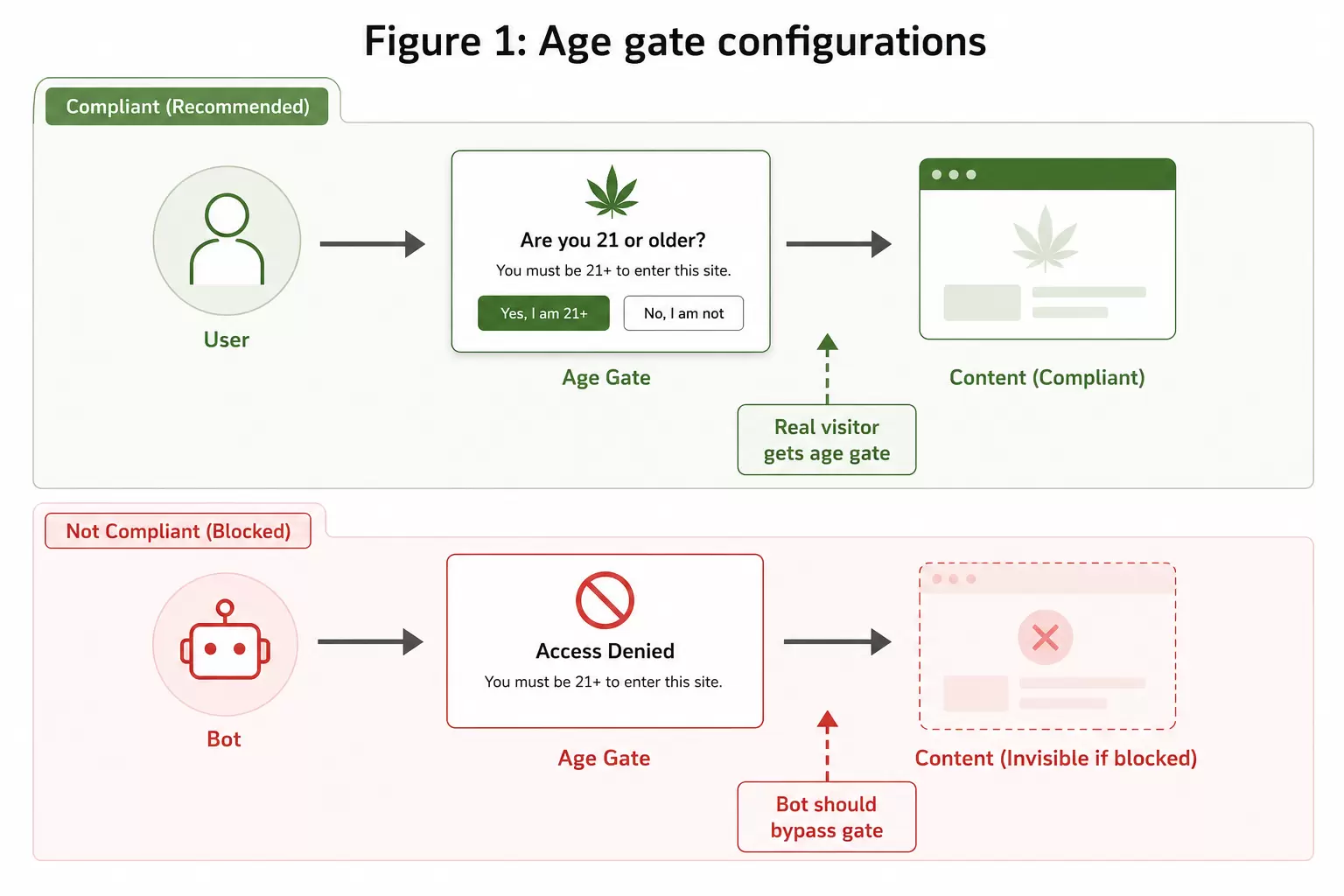
A tiny technical fix, usually a user agent check on your server, solves this. If you notice pages stuck in Google Search Console under “Crawled - currently not indexed,” suspect the gate. Resolving this alone can cause a sudden spike in indexed pages and impressions.
- Check if your age gate uses a simple overlay or a hard redirect.
- Work with your developer to whitelist Googlebot and Bingbot user agents.
- Test with the URL Inspection tool in Search Console after the change.
Quick fix, massive impact. Don’t skip this
Mobile-First Cannabis Site: Speed and Experience Win
The majority of dispensary searches happen on phones. Google uses mobile-first indexing. That means your mobile site’s performance directly shapes your rankings. A slow, clunky experience and your visitors bounce.
Site speed is a ranking factor. Huge, unoptimized product photos are the prime culprit. But several other elements weigh you down too.
Common mobile performance drains:
- Uncompressed images
- Render-blocking JavaScript
- Poor server response time
- Too many third-party scripts
Run your site through PageSpeed Insights. The tool gives you a punch list of fixes, often starting with properly sized images and caching. Also test your menu navigation on an actual phone. Buttons should be large enough to tap. Text should be readable without pinching and zooming.
Core Web Vitals measure loading, interactivity, and visual stability. A conceptual diagram of these three pillars makes the scoring easy to remember.
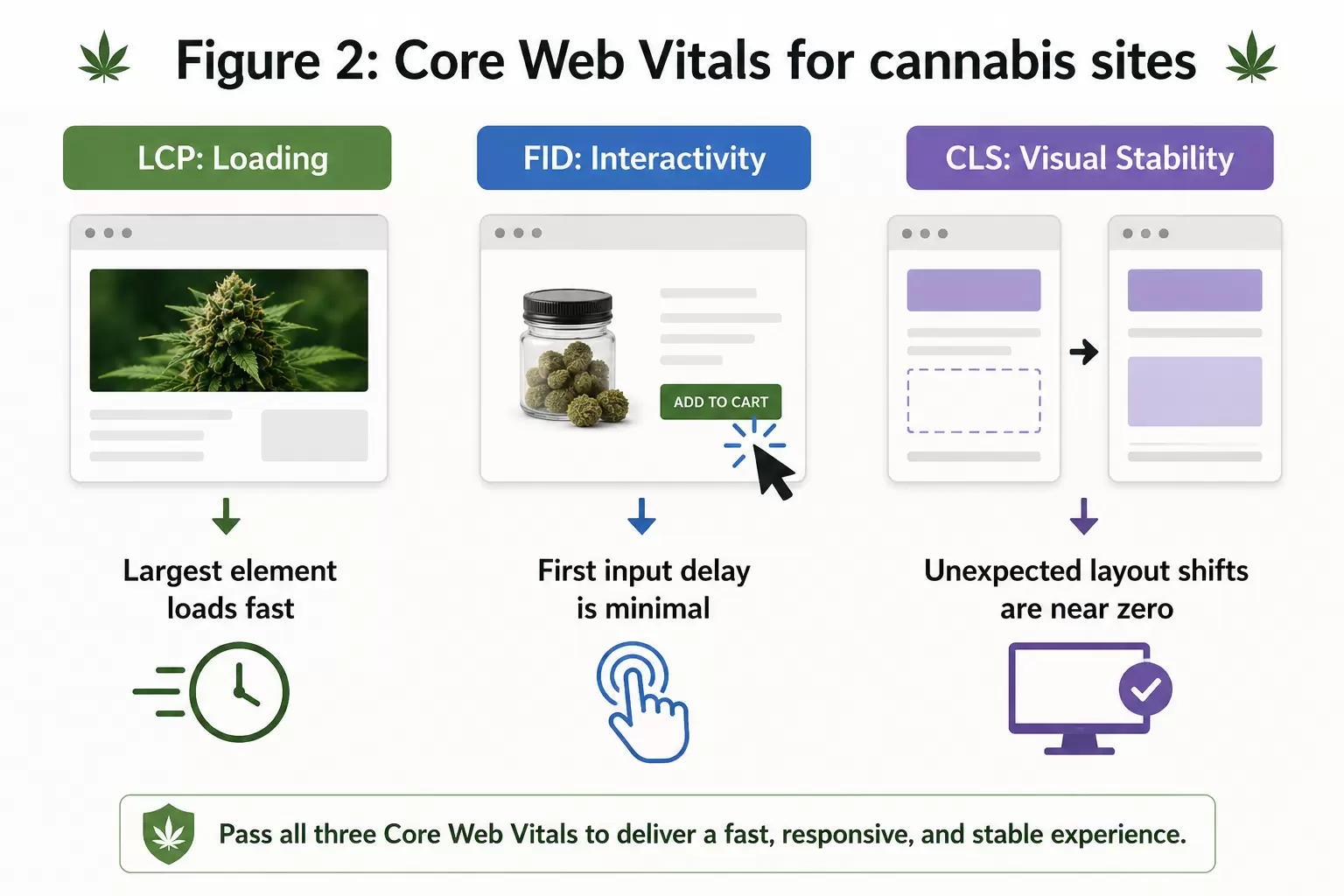
Passing all three tells Google your site is pleasant to use. That contributes directly to better rankings and higher conversion rates. After all, a mobile-first cannabis site that loads in two seconds will keep a customer far longer than one that takes eight.
Title Tags and Meta Descriptions That Get Clicks
Title tags are the blue clickable headlines in search results. They must quickly answer “what is this page about?” and “why should I care?” For a dispensary, include the primary product or service and your location naturally.
Real-world examples:
- Buy Indica Edibles | Denver Cannabis Dispensary | Green Haven
- CBD:THC Gummies for Sleep | Portland Dispensary | Evergreen Apothecary
Meta descriptions don’t directly affect rankings, but they influence click-through rate. Write them like a mini advertisement. Mention a key benefit, a bit about your store, or a specific local detail.
Keep these rules in mind:
- Every page gets a unique title and meta description.
- Avoid stuffing the same keyword multiple times.
- Keep titles under 60 characters and descriptions around 155.
When a dozen dispensaries all show up for the same query, the snippet that reads like a helpful human crafted it will win the click.
Headings and Content Structure That Guide Readers and Crawlers
Headings create a hierarchy that helps both users and search engines understand a page. Visualize it like a table of contents. The H1 is the main topic. H2s are major sections. H3s are sub-points.
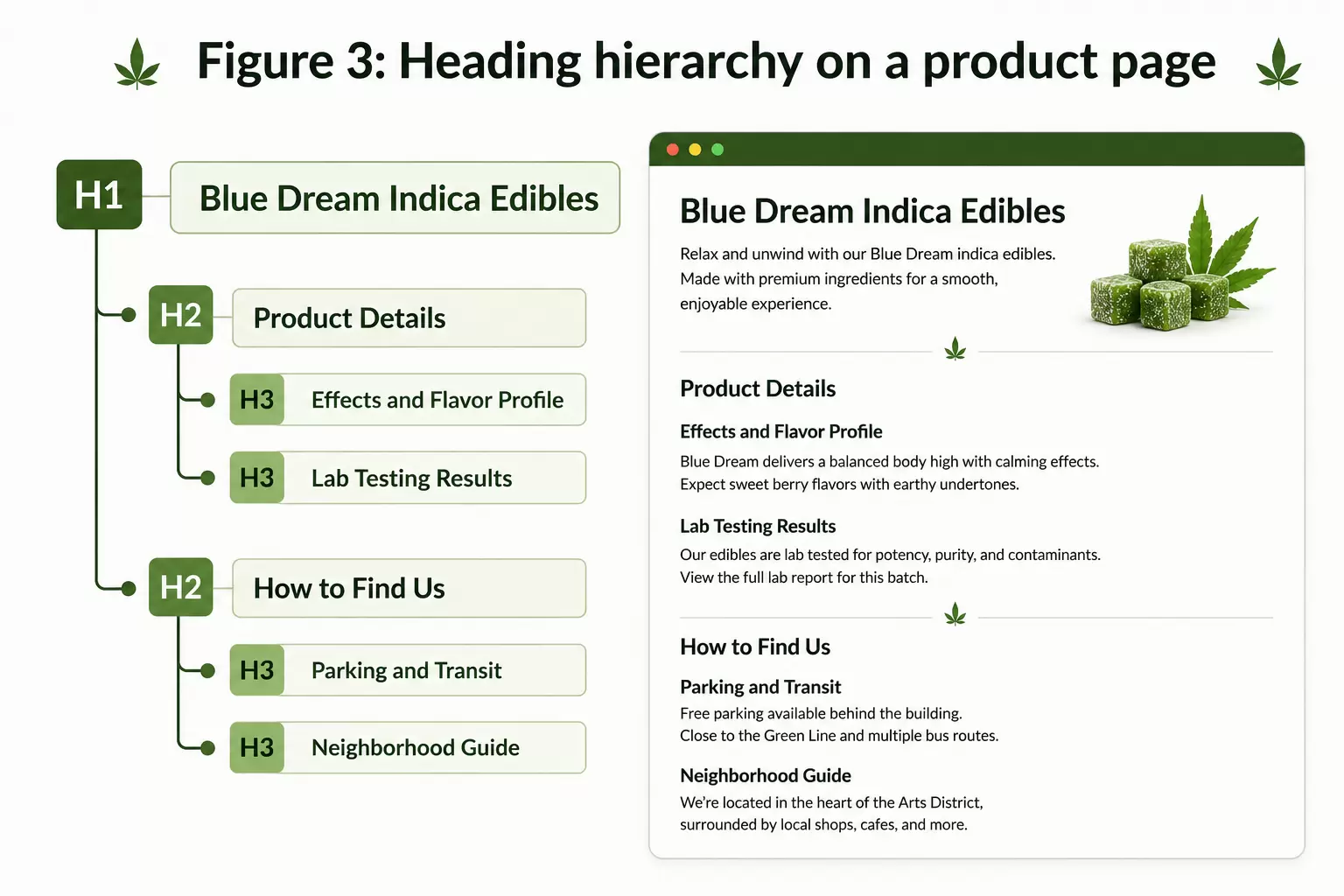
A page with a missing H1, or an H1 followed directly by an H4, confuses Google. The content body below the headings needs substance. Thin pages with two lines of text have almost no chance of ranking.
For a dispensary menu category page, add a unique introductory paragraph above the product grid. Explain what makes your selection special, mention the neighborhood you serve, and outline your testing standards. That copy gives Google meaningful text to associate with the category.
Cannabis Schema Markup: Speak Google's Language
Schema markup is structured data. It doesn't appear on your page visually. It sits in the code and tells search engines exactly what your business is, what you sell, and where you are.
For dispensaries, there are a few must-have schema types. I'll list them with what each one does:
- LocalBusiness schema: Your business name, address, phone, geo-coordinates, hours, and social profiles. Place it on the homepage and location pages.
- Product schema: Product name, description, price, availability, and even cannabinoid content. This can trigger rich results with star ratings and pricing.
- FAQ schema: Add questions and answers directly in search results. Ideal for pages that answer common customer queries.
- Article schema: For blog posts, helping them stand out with images and publish dates.
- Breadcrumb schema: Shows the navigation path in search results, improving click-through.
A simplified view of how schema enriches a search listing:
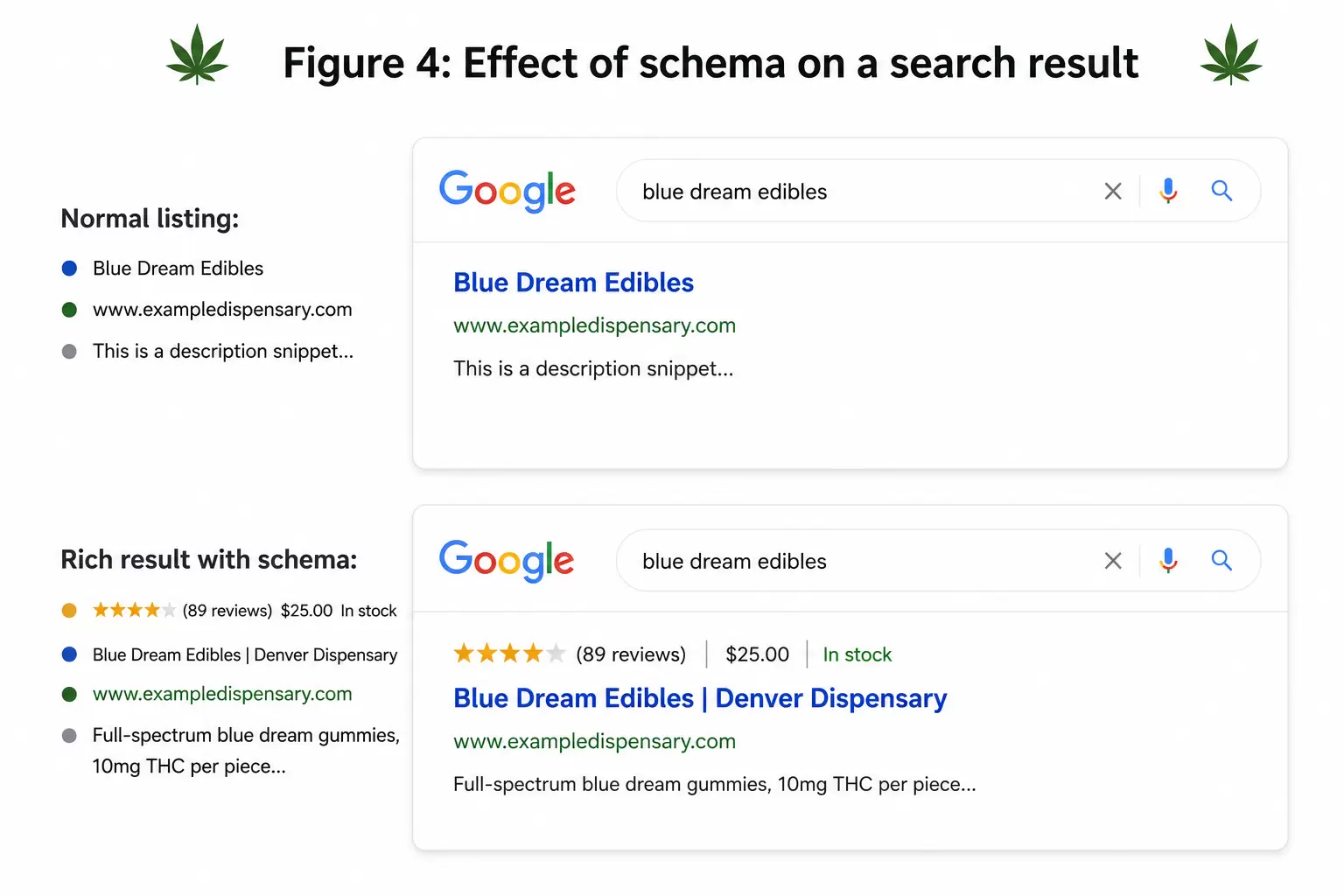
Implementing schema requires a developer or a plugin. The SEO upside makes it one of the highest-return investments on your site.
Dispensary Menu SEO: Turning Your Online Menu Into a Traffic Engine
Your menu is where people decide whether to drive over or place an order. Each product page is also a chance to rank for strain and product-specific searches.
Unique product descriptions are the foundation. Copy-pasting the grower's generic strain summary across twenty products signals laziness to Google. Instead, write something original. Describe the aroma, the experience, and what makes your batch unique.
Use bullet points to break out key product details:
- Strain lineage: Blue Dream (Blueberry x Haze)
- THC: 24%, CBD: <1%
- Terpenes: Myrcene, Pinene, Caryophyllene
- Effects: Relaxed, euphoric, creative
- Best for: Evening use, stress relief
Images should have descriptive file names and alt text. "blue-dream-indica-gummies-10mg.jpg" and alt "Blue Dream indica gummies in a silver tin" are far better than "IMG_4953.jpg" and empty alt. Product URLs should be clean and human-readable: /menu/edibles/blue-dream-gummies.
Category pages need introductory text as well. Link from menu items to related educational blog posts. If you have a blog about sleep and cannabis, link to the heavy indica products from within that article. This internal link web distributes page authority and shows Google the relationships between topics.
Image Optimization for Cannabis Sites
High-quality product photos sell. But unoptimized images crush your page speed. The fix is straightforward, and you can treat it as a checklist.
Image optimization steps:
- Resize images to the maximum display dimensions. No 4000px wide files for a 600px container.
- Compress with lossless or near-lossless tools like TinyPNG or ShortPixel.
- Use WebP format for modern browsers to reduce file size further.
- Always add descriptive, natural alt text.
- Rename files before uploading; include the product name.
A well-optimized image might go from 2MB to 80KB with no visible quality loss. Multiply that across thirty products and you've shaved seconds off load time. Google notices speed improvements quickly, often within a week or two of a recrawl.
Internal Linking That Distributes Authority
Internal links are the roads connecting your site's pages. They pass ranking strength and define topic clusters. When you write a new blog post, link to 2-3 relevant product or category pages. On product pages, link back to educational guides.
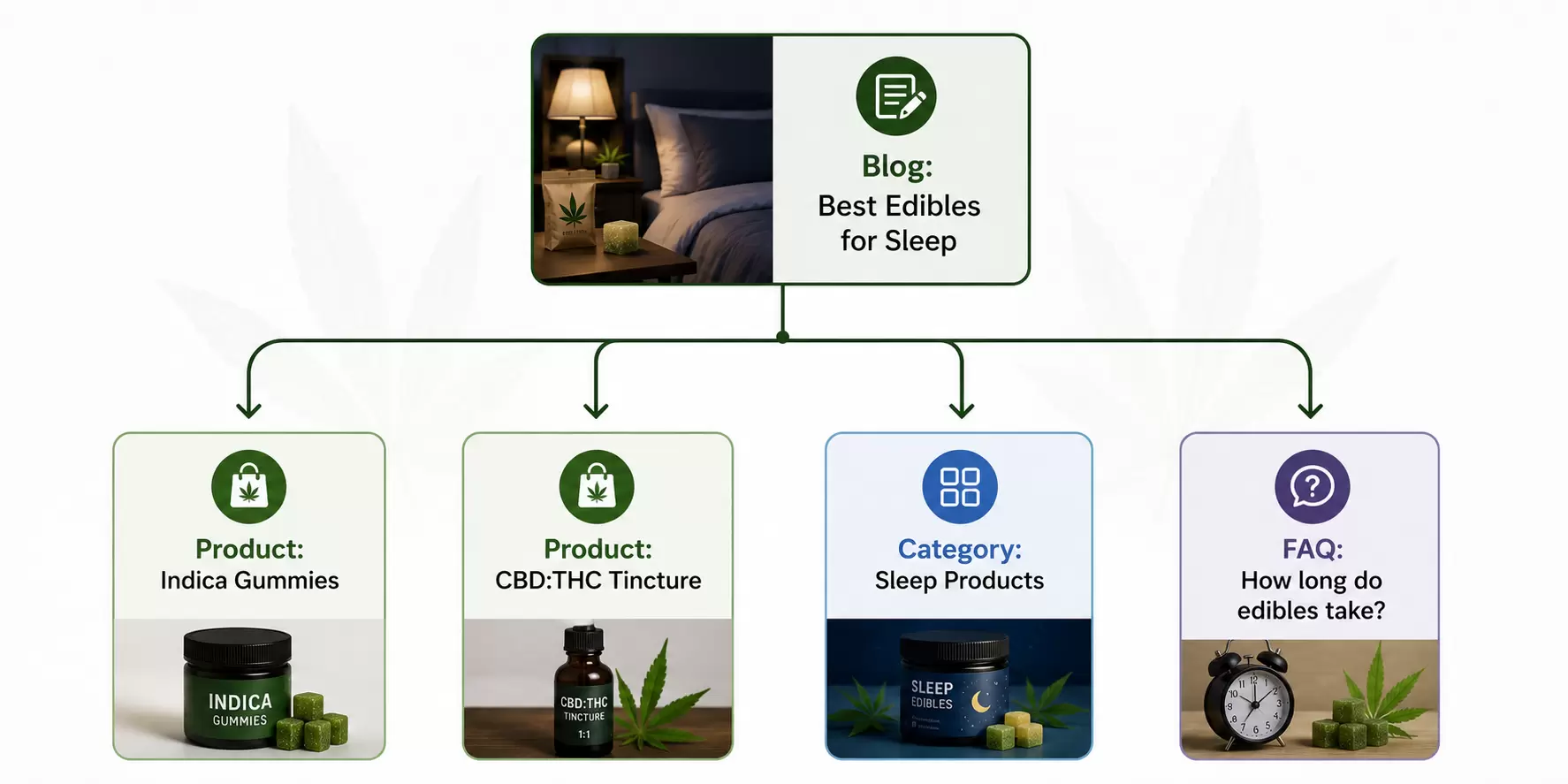
Descriptive anchor text makes these connections clear to both users and crawlers. Instead of "click here," use "see our full sleep edibles selection." Vary anchor text naturally and avoid over-optimizing with exact match keywords on every link.
URL Structure Best Practices
Clean URLs are readable by humans and bots. A sloppy URL string packed with numbers and symbols conveys nothing. A simple, keyword-aware URL builds instant context.
Preferred structure:
- /menu/edibles/blue-dream-gummies (good)
- /products?id=487&cat=3 (bad)
Aim for short, hyphen-separated phrases. Include a primary keyword when it fits. If you ever change a URL, implement a 301 redirect from the old address so no authority disappears. Consistency across the entire site makes future audits and migrations far easier.
On-Page SEO Checklist for Cannabis Websites
Here’s a quick audit table. Run through it every quarter to keep your on-page foundation strong.
| On-Page Element | Best Practice |
|
Age Gate |
Allows Googlebot and other crawlers through |
|
Title Tags |
Unique, includes keyword and location |
|
Meta Descriptions |
Unique, compelling, 150-160 characters |
|
H1 Tag |
One per page, clear and descriptive |
|
Heading Structure |
Logical hierarchy (H1 > H2 > H3) |
|
Body Content |
Unique, substantial, answers search intent |
|
Product Descriptions |
Original per product, includes effects and details |
|
Image Alt Text |
Descriptive, keyword-aware, not stuffed |
|
Image File Names |
Clean, descriptive, hyphenated |
|
URL Structure |
Short, readable, includes target keywords |
|
Internal Links |
Contextual links between relevant pages |
|
LocalBusiness Schema |
Present on homepage and location pages |
|
Product Schema |
Implemented on menu items with price and availability |
|
FAQ Schema |
Added to pages with common customer questions |
|
Breadcrumb Schema |
Present for navigation paths |
|
Core Web Vitals |
Passing on mobile and desktop |
|
Mobile Responsiveness |
Site functions perfectly on all device sizes |
|
Canonical Tags |
Set correctly to avoid duplicate content |
|
SSL Certificate |
HTTPS active site-wide |
Print this out or keep it in a shared doc. The small, consistent improvements add up faster than one giant overhaul every two years.
Common On-Page Mistakes Dispensaries Make
Addressing these common errors often delivers the fastest ranking gains:
- Duplicate product descriptions across different strains. Search engines see 50 near-identical pages and can't decide which to rank.
- Missing title tags, often left as "Home" or "Product," wasting prime vocabulary real estate.
- Thin location pages with only an address and map embed, offering no unique text about the neighborhood.
- Keyword-stuffed headings and alt text that read spammy and trigger algorithms.
- Slow mobile load times that cause visitors to abandon the page before even seeing the menu.
- Age gates that inadvertently block crawlers, as covered earlier.
- Broken or missing schema markup that passes up rich result opportunities.
If you audit your site and find any of these, fix them immediately. These are the low-hanging fruit that can reset your SEO trajectory.
The Future of On-Page Cannabis SEO
As AI-powered search grows, on-page clarity becomes everything. Google’s AI Overviews pull content from well-structured pages with clear headings and embedded FAQs. Voice search means people ask full conversational questions, and your content must answer them in kind.
Imagine a search like “what’s the strongest indica gummy available right now near me.” The site that will be pulled into an AI-generated answer has:
- A recent, unique product description mentioning potency.
- Product schema with stock availability.
- Location schema confirming the dispensary's proximity.
Entity-based SEO, where your business is recognized as a distinct entity connected to specific products and topics, is the next frontier. By keeping your on-page signals clean today, you position yourself as a trusted source for the algorithms of tomorrow.
“The best time to lay a strong SEO foundation was when you launched your site. The second best time is now. Every day you delay, your competitors pull further ahead.” - A hard-earned truth in cannabis digital marketing.
Conclusion
On-page SEO is the completely controllable side of your dispensary's online presence. You can't force backlinks overnight, but you can write a unique product description today. You can't move your store closer to every customer, but you can make your title tags irresistible and your mobile menu blazing fast.
Start with the age gate check. Then move through the checklist. Build the habit of adding schema to new pages and writing original descriptions. Over months, these efforts compound into higher rankings, more traffic, and more customers walking through your door.
If the technical pieces feel like more than you want to handle alone, Just Digital Gurus does this work daily for dispensaries across the country. From schema to speed, we make sure your website earns its place at the top. Reach out for a free on-page audit and let's see exactly where your site stands right now.
Frequently Asked Questions
What is dispensary website SEO?
It's the practice of optimizing a cannabis dispensary's website to rank higher in search results. This includes on-page elements like titles, content, schema markup, site speed, and mobile experience.
Why is on-page SEO important for cannabis sites?
Because paid advertising is heavily restricted in the cannabis industry, organic search traffic is the most reliable way to attract customers. On-page SEO makes it possible for search engines to find, understand, and rank your content.
How do I fix my age gate blocking Google?
Work with a developer to allow known search engine crawlers through the age verification screen. This is done by checking the user agent and letting Googlebot access the content without interaction.
What is cannabis schema markup?
Schema markup is structured data added to your website's code that helps search engines understand your business type, products, prices, and THC/CBD content. It can trigger rich results and improve visibility.
How can I improve my dispensary menu SEO?
Write unique product descriptions for every item. Use descriptive image alt text. Build clean URLs. Add Product schema. Link from menu pages to educational blog content, and vice versa.
Does site speed really affect dispensary rankings?
Absolutely. Google uses mobile-first indexing and considers Core Web Vitals a ranking factor. A slow site leads to higher bounce rates and lower organic visibility, especially for mobile users.
What are common on-page mistakes on cannabis sites?
Duplicate product descriptions, missing title tags, thin location pages, keyword stuffing, slow mobile load times, and age gates that block crawlers are the most frequent issues.

Quick question: What’s the first SEO change a new dispensary website should focus on?
Your comment will appear after approval.