
 Written By :
 ChatGPT
 Perplexity
 Claude
 Gemini
Most businesses hit a wall at some point. The website that worked fine when you had 500 visitors a day starts breaking at 50,000. The simple CMS that handled ten product pages can not manage ten thousand. The checkout flow that felt smooth for a small catalog turns into a nightmare when you scale to enterprise-level operations.
That is exactly where enterprise website development comes into the picture. It is not just about building a bigger website. It is about building a smarter, more resilient, and deeply integrated digital platform that can handle the complexity of a large-scale business without falling apart.
If you are at the stage where your current website feels like it is holding your business back rather than pushing it forward, this guide will walk you through everything you need to know. From planning and features to costs and choosing the right partner, we are going to cover it all in real depth.
Let us get into it.
What Is Enterprise Website Development?
Enterprise website development is the process of designing, building, and maintaining large-scale websites and web platforms that serve the complex needs of medium to large-sized organizations. Unlike a standard business website that might have a handful of pages and a contact form, an enterprise website is built to support thousands (sometimes millions) of users, integrate with internal business systems, handle massive amounts of data, and deliver personalized experiences at scale.
Think about companies like Salesforce, FedEx, or even a large hospital network. Their websites are not just digital brochures. They are operational hubs. They connect to CRMs, ERPs, inventory management systems, customer portals, payment gateways, analytics dashboards, and much more. Everything has to work together seamlessly, and everything has to stay fast and secure while doing it.
When we talk about what enterprise web development really involves, we are talking about a fundamentally different approach to how a website is architected. Standard websites are often built on off-the-shelf templates with minimal customization. Enterprise websites, on the other hand, are typically custom-built from the ground up or built on enterprise-grade platforms like Adobe Experience Manager, Sitecore, or custom frameworks using technologies like React, Angular, Node.js, or .NET.
The key distinction is complexity. Enterprise website development accounts for things that smaller websites never have to worry about. Role-based access control for hundreds of internal users. Multi-language and multi-currency support for global operations. Content workflows that require multiple levels of approval before anything goes live. APIs that connect the website to dozens of third-party services in real time.
It is not just about having a website. It is about having a digital infrastructure that grows with the organization and serves as the backbone of how the business operates online.
Enterprise Web Development vs Regular Website Development
A lot of people assume that enterprise web development is just regular web development with a bigger budget. That is a misunderstanding that leads to a lot of failed projects. The differences between the two go far beyond size and cost. They touch every aspect of how a project is planned, built, and maintained.
Let us break this down clearly.
A regular website, the kind most small and mid-size businesses run, is typically built with straightforward goals. It needs to look good, load fast, provide information, and maybe capture leads or sell a handful of products. The tech stack is usually simple. WordPress, Shopify, Squarespace, or a similar platform. A small team of one to three developers can handle the entire build in a few weeks. Maintenance is minimal. Updates are infrequent. And if something breaks, the impact is limited.
Enterprise web development operates in a completely different universe. The goals are multifaceted. The website might need to serve customers, partners, employees, and vendors all at the same time, each with different access levels and different experiences. The tech stack involves multiple technologies working in concert. The development team often includes specialists in frontend, backend, DevOps, security, database architecture, QA, and UX. The project timeline is measured in months, not weeks. And if something breaks, it can affect thousands of users and potentially cost the business significant revenue every hour it stays down.
Here is a comparison table that lays out the differences more concretely:
| Aspect | Regular Website Development | Enterprise Web Development |
| Scale | Hundreds to thousands of visitors | Tens of thousands to millions of visitors |
| Complexity | Simple structure, limited integrations | Complex architecture, deep system integrations |
| Tech Stack | WordPress, Shopify, basic frameworks | Custom frameworks, enterprise CMS, microservices |
| Team Size | 1 to 5 people | 10 to 50+ specialists |
| Timeline | 2 to 8 weeks | 3 to 12+ months |
| Security | Basic SSL and plugin-based security | Multi-layered security, compliance (HIPAA, GDPR, SOC 2) |
| Content Management | Single admin, simple publishing | Multi-role workflows, approval chains, localization |
| Maintenance | Occasional updates | Ongoing monitoring, optimization, and scaling |
| Cost | $2,000 to $25,000 | $50,000 to $500,000+ |
| Downtime Impact | Minor inconvenience | Major revenue and reputation loss |
The takeaway here is straightforward. If your organization has outgrown the capabilities of a standard website and you are dealing with the kind of complexity described in the right column, you are firmly in enterprise territory. Trying to solve enterprise problems with regular website solutions is like trying to run a logistics company off a spreadsheet. It works until it does not, and when it stops working, everything falls apart fast.
Key Features of Enterprise Websites
Enterprise websites are not defined by how they look on the surface. They are defined by what they do underneath. The features that separate an enterprise web platform from a regular website are the ones that handle complexity, scale, security, and integration without compromising the user experience.
Let us go through the features that matter most.
Scalable Architecture
This is the foundation of everything. An enterprise website must be built on architecture that can handle traffic spikes, growing data volumes, and expanding functionality without requiring a complete rebuild. This usually means cloud-based infrastructure (AWS, Azure, or Google Cloud), microservices architecture that allows different parts of the system to scale independently, and load balancing that distributes traffic across multiple servers. When Black Friday hits and your traffic triples overnight, scalable architecture is what keeps your site running while your competitors crash.
Advanced Content Management
Enterprise web app development almost always involves building or configuring a content management system that goes far beyond basic publishing. We are talking about multi-site management from a single dashboard, content personalization based on user behavior and demographics, multilingual content support, version control, and workflow management where content goes through writers, editors, legal reviewers, and approvers before it ever reaches the public. Platforms like Sitecore, Adobe Experience Manager, and Contentful are popular choices for this level of content management.
Deep System Integrations
Enterprise websites do not operate in isolation. They connect to CRM systems like Salesforce or HubSpot, ERP systems like SAP or Oracle, marketing automation platforms, payment processing systems, inventory management tools, HR platforms, and custom internal applications. Enterprise web portal development requires building robust APIs and middleware that allow all of these systems to communicate with the website in real time. When a customer places an order on the website, that order might need to simultaneously update the inventory system, trigger a fulfillment workflow, send a confirmation through the marketing platform, and log the transaction in the ERP. All of this has to happen instantly and reliably.
Enterprise-Grade Security
Security at the enterprise level is not just about having an SSL certificate and a firewall. It involves multi-factor authentication, role-based access controls, data encryption at rest and in transit, regular penetration testing, compliance with industry regulations like GDPR, HIPAA, PCI-DSS, or SOC 2, and real-time threat monitoring. A security breach at an enterprise scale can expose millions of customer records, result in massive regulatory fines, and destroy the trust that took years to build.
Personalization and User Experience
Large organizations serve diverse audiences, and a one-size-fits-all website experience does not cut it. Enterprise websites use data-driven personalization to serve different content, products, and experiences to different user segments. A returning customer sees different homepage content than a first-time visitor. A user from Germany sees the site in German with prices in euros. A logged-in partner sees a completely different portal than a public visitor. This level of personalization requires sophisticated frontend development, data analytics, and machine learning in some cases.
Analytics and Reporting
Decision-makers at large organizations need data, and they need it in real time. Enterprise websites are built with comprehensive analytics and reporting capabilities that go beyond Google Analytics. Custom dashboards track KPIs specific to the business. A/B testing frameworks allow continuous optimization. Data pipelines feed website performance data into business intelligence tools. Everything is measurable, and everything feeds back into the strategy.
Performance Optimization
Enterprise websites must load fast despite their complexity. This involves CDN (Content Delivery Network) implementation to serve content from servers closest to the user, image and asset optimization, lazy loading, server-side rendering, database query optimization, and caching strategies. Google has made it abundantly clear that page speed affects rankings, and for enterprise sites with thousands of pages, even small performance improvements can have massive SEO and conversion impact.
These features do not exist as nice-to-haves. For enterprise organizations, they are operational requirements. Missing any one of them can create bottlenecks that limit growth, frustrate users, and expose the business to risk.
Enterprise Web Application Development: When Do You Need It?
There is an important distinction between an enterprise website and an enterprise web application, and understanding it can save you from building the wrong thing.
An enterprise website is primarily an information and marketing platform. It presents content, captures leads, showcases products, and serves as the public face of the organization. An enterprise web application, on the other hand, is a functional tool. It lets users do things. Place orders, manage accounts, track shipments, collaborate with team members, generate reports, configure products, submit claims, and perform workflows that are core to how the business operates.
Enterprise web application development becomes necessary when your business needs are transactional and interactive, not just informational. Here are the scenarios where you need a web application, not just a website.
Your customers need self-service capabilities. If your support team is drowning in calls and emails because customers can not check their order status, update their account information, or download invoices on their own, you need a customer-facing web application. Companies like FedEx and UPS have built entire web applications around self-service tracking and shipping management, reducing support costs by millions while improving the customer experience.
Your internal teams rely on manual processes. If your sales team is copying data between spreadsheets and your CRM, or your operations team is managing workflows through email chains, an internal web application can automate those processes. Custom-built dashboards, workflow automation tools, and data management interfaces can replace hours of manual work with a few clicks.
You need real-time data processing. If your business depends on processing and displaying data in real time, such as financial transactions, inventory levels, booking availability, or logistics tracking, you need a web application that can handle real-time data streams and present them to users instantly.
You operate in a regulated industry. Healthcare, finance, insurance, and government organizations often need web applications that enforce compliance at every step. Patient portals, claims processing systems, and secure document management platforms all fall into the category of enterprise web application development.
Your existing software is outdated. Many enterprises still run critical operations on legacy desktop applications that were built fifteen or twenty years ago. Migrating these to modern web applications makes them accessible from anywhere, easier to maintain, and more secure.
The bottom line is this: if your users need to interact with your systems in ways that go beyond reading content and filling out contact forms, you need enterprise web application development. And that requires a team with deep expertise in both frontend and backend development, database design, API architecture, and security.
Planning an Enterprise Website Development Project
The planning phase is where enterprise website projects are won or lost. Building without a thorough plan is the fastest way to blow through your budget, miss your deadlines, and end up with a platform that does not actually solve your problems.
Here is how to approach planning properly.
Start with Business Objectives, Not Features
The biggest mistake organizations make is starting the planning process with a list of features they want. Features are a means to an end. You need to start with the end. What business problems are you trying to solve? What outcomes do you need this platform to deliver?
Maybe the objective is to reduce customer support costs by 40% through self-service capabilities. Maybe it is to increase online revenue by expanding into three new international markets. Maybe it is to consolidate five separate internal tools into one unified platform. Whatever it is, every decision that follows, from technology selection to design to feature prioritization, should map back to these objectives.
Conduct a Thorough Discovery Phase
Enterprise web development solutions always begin with discovery. This is the phase where the development team works closely with stakeholders from across the organization to understand current systems, pain points, user needs, technical constraints, and business processes.
Discovery typically includes stakeholder interviews, user research, competitive analysis, technology audits, content audits, and documentation of existing integrations. The output is a detailed requirements document and a project roadmap that everyone agrees on before a single line of code is written.
Skipping discovery is like building a skyscraper without surveying the land first. You might get lucky, but you probably will not.
Define Your Technology Stack
The technology choices you make will affect everything: performance, scalability, security, maintenance costs, and your ability to find developers to work on the project in the future. This decision should be made by experienced technical architects who understand the trade-offs between different options.
For the frontend, choices often include React, Angular, Vue.js, or Next.js. For the backend, options range from Node.js and Python to Java, .NET, and PHP (specifically Laravel for more structured applications). For the CMS layer, enterprise options include Adobe Experience Manager, Sitecore, Contentful, Strapi, or custom-built solutions. For infrastructure, most enterprise projects run on AWS, Azure, or Google Cloud with containerization through Docker and orchestration through Kubernetes.
The right stack depends on your specific needs, existing infrastructure, and long-term goals. There is no universal best answer.
Create a Realistic Timeline and Budget
Enterprise website projects take time. A project that would take six weeks for a regular website might take six months or longer at the enterprise level. The timeline needs to account for discovery, design, development, integrations, testing, content migration, training, and a phased rollout.
Budget planning should include not just the initial build but also ongoing costs for hosting, maintenance, security monitoring, updates, and optimization. Many organizations budget for the build and then are surprised by the ongoing costs. Building the platform is typically 40% to 60% of the total cost of ownership over the first three years. The rest goes to maintenance, optimization, and scaling.
Plan for Testing and Quality Assurance
Enterprise websites require rigorous testing that goes far beyond clicking through a few pages. Load testing ensures the site can handle peak traffic. Security testing identifies vulnerabilities before hackers do. Integration testing verifies that all connected systems work together correctly. Accessibility testing ensures compliance with WCAG standards. Cross-browser and cross-device testing confirms that the site works properly everywhere. And user acceptance testing brings real stakeholders into the process to validate that the platform meets their needs.
Cutting corners on testing is one of the most common reasons enterprise web projects fail after launch. It is always cheaper to find and fix problems before they reach production than after.
Enterprise Website Development Cost: What Affects Pricing?
Let us talk about money, because this is the question every decision-maker asks first, and the answer is never as simple as anyone wants it to be.
Enterprise web development cost varies enormously based on a range of factors, and anyone who gives you a flat number without understanding your requirements is either guessing or misleading you. That said, we can break down the factors that influence pricing so you can develop a realistic budget.
Scope and Complexity
This is the single biggest cost driver. A corporate website with 200 pages, a blog, and a contact form is a different project than a multi-portal platform with e-commerce, customer self-service, partner management, and real-time analytics dashboards. More features, more integrations, and more user types all add to the scope, and scope directly translates to hours of work.
Custom Development vs Platform-Based Development
Building everything from scratch using custom code gives you maximum flexibility but costs more. Using an enterprise platform like Adobe Experience Manager or Sitecore as a foundation can reduce development time but comes with significant licensing fees and requires developers who specialize in those platforms. There is no right answer here. It depends on your needs and your long-term plans.
Design Complexity
Enterprise websites need professional, on-brand design. But the level of design work can vary. A straightforward corporate design with clean layouts and consistent components is less expensive than a highly interactive design with custom animations, video backgrounds, and unique layouts for every page type. If you need design systems that ensure consistency across multiple sub-brands or product lines, that adds complexity and cost as well.
Number and Depth of Integrations
Connecting the website to your CRM, ERP, payment gateway, and marketing automation platform is standard for enterprise projects. But each integration has its own complexity. Some systems have well-documented, modern APIs that make integration relatively straightforward. Others, especially legacy systems, have limited or outdated APIs that require custom middleware to bridge the gap. The more integrations you need, and the more complex they are, the higher the cost.
Compliance and Security Requirements
If you operate in healthcare, finance, government, or any other regulated industry, your website needs to meet specific compliance standards. Achieving HIPAA compliance, PCI-DSS compliance, or SOC 2 certification requires additional security measures, documentation, and often third-party audits. These add to both the initial development cost and the ongoing maintenance cost.
Team Location
Development rates vary significantly by geography. Agencies in the United States and Western Europe typically charge $150 to $300+ per hour for enterprise work. Agencies in Eastern Europe, South Asia, and Latin America often charge $50 to $120 per hour. The rate difference does not automatically mean a difference in quality, but it does mean you need to evaluate potential partners carefully regardless of where they are based.
Ongoing Maintenance and Optimization
As mentioned earlier, the launch is not the end of the investment. Enterprise websites require continuous monitoring, security patching, performance optimization, content updates, and feature enhancements. Budgeting 15% to 25% of the initial development cost per year for ongoing maintenance is a reasonable starting point.
To give you a rough framework for enterprise web development cost, here is what typical ranges look like:
A mid-complexity enterprise website with moderate integrations and a standard CMS typically falls in the $75,000 to $200,000 range. A high-complexity platform with deep integrations, custom applications, multi-site management, and advanced personalization can range from $200,000 to $500,000 or more. And the largest enterprise projects involving multiple web applications, global rollouts, and extensive custom development can exceed $1 million.
These are broad ranges, and your specific project could fall anywhere within them depending on the factors above. The most reliable way to get an accurate estimate is to go through a proper discovery process with an experienced enterprise web development company that can scope the project based on your actual requirements.
When to Hire an Enterprise Web Development Company
Not every project needs an outside partner. Some organizations have strong internal development teams that can handle enterprise-scale projects. But there are clear situations where hiring an enterprise web development company is the smarter move.
You lack specialized expertise internally. Enterprise projects require skills that most in-house teams do not have in-house. Enterprise-grade security architecture, microservices design, performance optimization at scale, and complex integration work are specialized disciplines. If your internal team consists of generalist developers who primarily maintain your current website, they are likely not equipped to lead an enterprise rebuild.
You need to move faster than your internal team allows. Internal teams have existing responsibilities. They are maintaining current systems, handling support requests, and working on ongoing projects. Pulling them off those responsibilities to focus on a major development project creates problems elsewhere. An external enterprise website development agency brings dedicated resources that focus exclusively on your project without disrupting your existing operations.
You need an outside perspective. Internal teams often develop blind spots. They are so close to the existing systems and processes that they can not see the bigger picture or challenge assumptions that need to be challenged. An experienced enterprise web development company brings perspective from working with multiple organizations across different industries. They have seen what works, what does not, and where the common pitfalls are.
The project is mission-critical and failure is not an option. When the project directly impacts revenue, customer experience, or operational efficiency, the stakes are too high for experimentation. An enterprise website development agency with a proven track record and established processes significantly reduces the risk of failure. They bring project management discipline, quality assurance practices, and accountability that are hard to replicate with an ad-hoc internal effort.
You need ongoing support and optimization after launch. Building the platform is only the beginning. You need a partner who will be there to monitor performance, fix issues, implement updates, and continuously optimize the platform after it goes live. Most reputable enterprise web development companies offer ongoing support retainers that ensure your platform stays healthy and evolves with your business.
If any of these situations resonate with you, it is worth having conversations with potential partners sooner rather than later. The best agencies book up months in advance, and the discovery and planning process itself takes time.
Choosing the Right Enterprise Web Development Services
Selecting the right partner for your enterprise web project is one of the most consequential decisions you will make. The wrong choice leads to missed deadlines, budget overruns, technical debt, and a platform that does not meet your needs. The right choice gives you a platform that drives real business results for years to come.
Here is how to evaluate enterprise web development services and enterprise web application development services effectively.
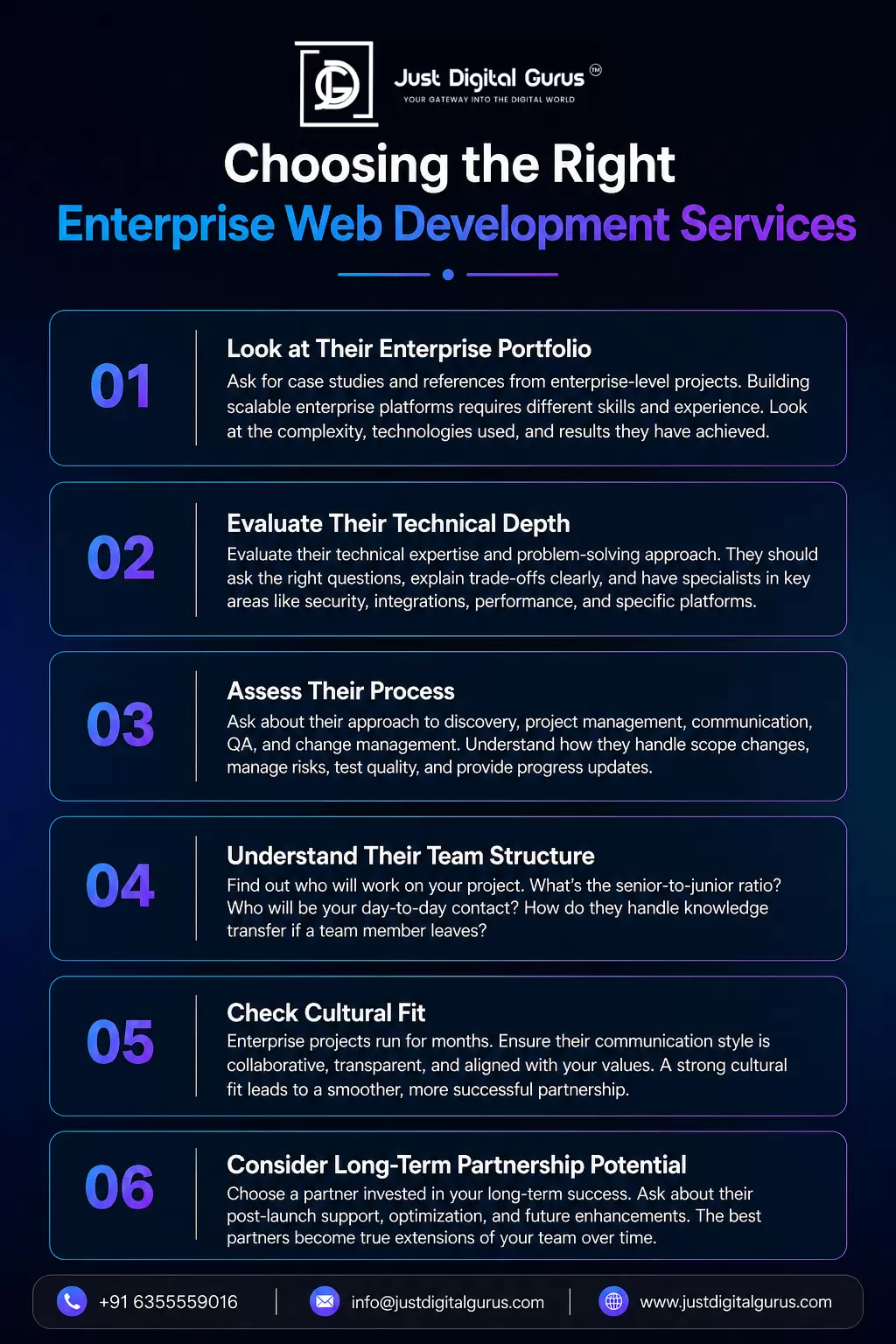
Look at Their Enterprise Portfolio
Ask for case studies and references specifically from enterprise-level projects. Building a beautiful small business website and building a scalable enterprise platform are completely different disciplines. You want a partner who has done what you need them to do, ideally in your industry or a closely related one. Look at the complexity of the projects they have delivered, the technologies they have used, and the results they have achieved.
Evaluate Their Technical Depth
During initial conversations, pay attention to how they talk about technology. Do they ask thoughtful questions about your existing systems and technical requirements? Do they explain trade-offs between different approaches clearly? Do they have specialists in the areas that matter most to your project, whether that is security, integrations, performance, or specific platforms? A partner that throws around buzzwords without substance is a red flag. A partner that asks hard questions and gives honest answers is a green flag.
Assess Their Process
Enterprise projects require structured processes. Ask about their approach to discovery, project management, communication, quality assurance, and change management. How do they handle scope changes? How do they manage risks? What does their testing process look like? How often will you receive progress updates? A mature enterprise web development services provider will have clear, documented answers to all of these questions.
Understand Their Team Structure
Find out who will actually be working on your project. Will it be the senior people you met during the sales process, or will the work be handed off to junior developers? What is the ratio of senior to junior team members? Who will be your day-to-day point of contact? How do they handle knowledge transfer if a team member leaves the project?
Check Cultural Fit
This might sound soft, but it matters enormously for long-term partnerships. Enterprise web projects run for months, and the relationship between your team and the development partner needs to be collaborative, transparent, and built on mutual respect. If the communication style does not feel right during the sales process, it will not get better during the project.
Consider Long-Term Partnership Potential
Your needs will not end at launch. You want a partner who is invested in the long-term success of your platform, not just in delivering the initial project and moving on. Ask about their approach to post-launch support, optimization, and future enhancements. The best enterprise web application development services providers become true extensions of your team over time.
Why Enterprise Website Projects Fail (and How to Avoid It)
This is the section most guides do not include, but it might be the most valuable one. Understanding why enterprise web projects fail is the best way to make sure yours does not.
Failure reason number one: unclear requirements. When stakeholders can not agree on what the platform needs to do, the development team ends up building a moving target. Every sprint brings new requirements. The scope expands continuously. The budget and timeline blow up. The solution is simple in concept but difficult in practice: invest the time upfront to align all stakeholders on clear, documented, prioritized requirements before development begins.
Failure reason number two: choosing technology before understanding the problem. Too many organizations decide they want to build on a specific platform or use a specific technology before they even understand what they need. Technology should serve strategy, not the other way around. Start with the problem, then find the technology that solves it best.
Failure reason number three: underestimating integration complexity. Connecting an enterprise website to legacy systems is almost always harder than anyone expects. APIs are undocumented. Data formats are inconsistent. Systems that were never designed to communicate with each other need to exchange information in real time. Budget extra time and resources for integration work, because it will take longer than you think.
Failure reason number four: insufficient testing. When deadlines get tight, testing is usually the first thing that gets cut. This is a catastrophic mistake for enterprise projects. Bugs that reach production affect thousands of users and can take days to fix. A rigorous testing process is not optional. It is insurance.
Failure reason number five: lack of executive sponsorship. Enterprise web projects touch multiple departments and require decisions that cross organizational boundaries. Without a senior executive who champions the project, provides air cover, and breaks through internal politics, projects stall and die. Make sure you have a strong executive sponsor before you start.
Failure reason number six: treating launch as the finish line. The launch is the starting line, not the finish line. Enterprise websites need continuous optimization based on real user data. They need regular security updates. They need performance monitoring. They need content refreshes. Organizations that launch and then shift all resources elsewhere end up with a platform that degrades rapidly.
Being aware of these pitfalls will not make them disappear, but it will help you build the processes and safeguards that prevent them from derailing your project.
Final Thoughts
Enterprise website development is one of the most significant investments a large organization can make in its digital future. Done well, it creates a platform that drives revenue, reduces costs, improves customer satisfaction, and gives the organization a competitive edge that lasts for years. Done poorly, it wastes millions of dollars and sets the business back.
The difference between success and failure comes down to planning, partnership, and patience. Plan thoroughly before you build. Partner with people who have genuine enterprise experience and a track record to prove it. And give the project the time and resources it needs to be done right.
If you are exploring enterprise web development solutions for your organization and want to talk through your specific situation, the team at Just Digital Gurus works with organizations at this exact stage. We help you figure out what you actually need, plan a realistic path to get there, and build a platform that delivers measurable business results.
The first step is always a conversation. Not a sales pitch. A real conversation about your challenges and goals. That is how the best enterprise projects begin.

Your comment will appear after approval.