
 Written By :
 ChatGPT
 Perplexity
 Claude
 Gemini
You can sell it. You just cannot talk about it.
That is the paradox facing every dispensary owner and cannabis brand in 2026. Despite a projected $40+ billion U.S. market, cannabis advertising operates in a regulatory minefield where one poorly worded headline or unverified image can trigger account bans, fines, or license scrutiny.
The rules are not uniform. They are a patchwork of federal restrictions, state-by-state variances, and platform-specific AI moderation systems that change quarterly. What works in California will get you banned in Florida. What passes Facebook’s algorithm today might trigger a shadowban tomorrow.
This guide is not a vague warning about "following the rules." It is a tactical blueprint for compliant revenue growth. We will cover the precise requirements for the 70% adult audience rule, platform-specific policies for Google and Meta, programmatic cannabis ad buying, and the emerging landscape under Schedule III classification.
If you are a dispensary owner, MSO marketing director, or cannabis startup founder, this is your 2026 survival manual.
The Compliance Foundation: Federal vs. State Reality
The 70% Adult Audience Rule
Before you place any weed advertising, you must verify that at least 70% of the audience is reasonably expected to be 21 or older. This is not a suggestion. It is the baseline standard adopted by most states and enforced by major ad platforms.
How to calculate it:
Media vendors should provide audience demographic data. For digital campaigns, platforms like Meta and Google use age gating. For outdoor advertising, you use census data and traffic patterns within a specific radius. If a billboard is within 500 feet of a school, your audience demographic calculation fails automatically.
Platform-specific note: Google Ads requires advertisers to self-certify that their campaigns meet local age requirements. Meta uses birthday data but also scans for "youthful creative elements" that might attract underage users regardless of age targeting.
What "No Youth Appeal" Actually Means
Regulators and AI moderation systems look for specific visual and linguistic triggers:
Prohibited elements:
- Cartoon characters, mascots, or illustrations that appeal to children
- Candy-like product names (e.g., "Gummy Bears," "Skittles Kush")
- Bright neon packaging that mimics snack foods
- Slang like "dank," "fire," or "loud" in headline copy
- Imagery of excessive consumption or intoxication
Safe alternatives:
- Lifestyle photography featuring adults 25+
- Minimalist, pharmaceutical-grade packaging shots
- Terms like "wellness," "relief," or "balance"
- Educational content about cannabinoid profiles
Medical Claims and THC Promotion Limitations
You cannot claim cannabis cures, treats, or prevents disease. The FDA has issued warning letters to brands using terms like "anti-inflammatory," "pain relief," or "anxiety treatment" in dispensary advertising. For the latest enforcement actions, review the FDA’s cannabis regulation updates. Meanwhile, the DEA’s controlled substance scheduling page confirms that Schedule III status does not relax recreational marketing rules.”
2026 Update: Even with Schedule III classification for cannabis, medical claims remain restricted to FDA-approved drugs. Epidiolex can advertise therapeutic benefits. Your dispensary cannot.
THC promotion restrictions: Many states prohibit advertising specific THC percentages or potency contests. Avoid "highest THC content in [State]" messaging. Focus on terpene profiles, cultivation methods, or experience descriptors ("relaxing," "energizing").
Platform War Rooms: Google, Meta, and Beyond
Google Cannabis Ad Policy
Google does not completely ban cannabis advertising. However, you must comply with the Google Ads policy on healthcare and medicines and obtain LegitScript certification. Meta operates differently — review Meta’s advertising standards before launching any Facebook campaign.
What is allowed:
- CBD and hemp-derived products (with certification and THC <0.3%)
- Cannabis education and advocacy (no product sales)
- Cannabis addiction treatment services
- Verified dispensaries in specific jurisdictions (via Google's restricted certification program)
The Landing Page Loophole:
Google allows ads for "cannabis-related business services" if the landing page does not sell cannabis directly. You can advertise your dispensary's educational blog, loyalty program signup, or event calendar. You cannot advertise a "Buy Now" product page.
Requirements for CBD/Cannabis certification:
- LegitScript certification (for CBD)
- State-issued license documentation
- Age-gated landing pages (18+ or 21+ depending on state)
- No health claims or testimonials
What triggers rejection:
Images of cannabis leaves, product consumption, price promotions ("20% off carts"), or terms like "marijuana," "weed," or "THC" in display URLs.
Meta Cannabis Ad Policy
Meta (Facebook and Instagram) operates on an AI-first moderation system. Their algorithms scan images for cannabis leaves, vapor clouds, or packaging that resembles regulated substances.
The Shadowban Reality:
Even if your ad is approved, Meta's AI may suppress organic reach if your account frequently posts cannabis content. This is "shadowbanning." Your content exists, but the algorithm stops distributing it.
Safe posting strategy:
- Use lifestyle imagery over product photography
- Avoid showing the plant itself; focus on the lifestyle outcome (yoga, social gathering, wellness routine)
- Use terms like "plant medicine" or "herbal wellness" instead of "cannabis" in ad copy
- Link to age-gated landing pages with prominent disclaimers
The appeal process:
If rejected, appeal immediately. Meta's human review team overturns approximately 40% of AI cannabis rejections. Document your state license in the appeal notes.
TikTok Cannabis Restrictions
TikTok explicitly bans cannabis advertising in its Branded Content Policy. However, organic influencer marketing operates in a gray area.
Compliant approach:
- Educational content without direct sales links
- Age-restricted accounts (18+ content setting)
- No product tags or shopping features
- Influencers must use #Ad or #Sponsored disclosures
Risk: TikTok's moderation AI is aggressive. Accounts showing consumption methods (dabbing, rolling) face permanent bans without warning.
YouTube Cannabis Ad Restrictions
YouTube follows Google's ad policies but adds content-level restrictions. You cannot monetize videos featuring cannabis consumption with Google AdSense. However, you can run TrueView ads for your dispensary if you meet Google's restricted certification requirements.
Content strategy:
Create "edutainment" content about terpenes, cultivation science, or industry news. Run ads against this content to build retargeting pools, then use compliant email marketing to convert viewers.
Reddit Cannabis Advertising
Reddit is the most underutilized platform for dispensary PPC in 2026. They allow cannabis advertising in legal states through their "Restricted Vertical" program.
Requirements:
- Target only states where cannabis is legal for adult use
- Exclude subreddits with high youth demographics
- Use text-heavy creative; avoid product images
- Link to age-gated domains
Advantage: Reddit's audience is inherently age-verified through community norms, and CPMs are 60-70% lower than Meta or Google.
Programmatic Cannabis Ads & Data Clean Rooms
Programmatic PMP Ad Buying
Programmatic cannabis ads are possible through Private Marketplace (PMP) deals. Unlike open exchange buying, PMPs allow you to purchase inventory from cannabis-friendly publishers (High Times, Leafly, Weedmaps) without platform restrictions.
How it works:
- Use a cannabis-compliant DSP (Demand Side Platform) like Mantis, Traffic Roots, or Advocado
- Negotiate direct deals with cannabis-adjacent publishers
- Use contextual targeting (cannabis content categories) rather than behavioral targeting
- Serve ads on cannabis news sites, lifestyle blogs, and regulatory information portals
The Clean Room Strategy:
Major brands use data clean rooms (LiveRamp, InfoSum, Google Ads Data Hub) to match first-party customer data with publisher audiences without exposing personal information. This allows you to retarget your dispensary's loyalty members across legal cannabis sites without violating privacy laws or platform policies.
First-Party Data Goldmine
Because you cannot rely on pixel-based retargeting on Meta or Google, first-party data strategies are essential.
Tactics:
- Loyalty audience targeting: Upload hashed email lists to compliant programmatic platforms
- SMS opt-in campaigns: Use text message marketing (TCPA-compliant) with explicit written consent
- WiFi capture: Collect emails in-store with age-verified guest WiFi systems
- Event-based leads: Host educational seminars (cannabis and cooking, wellness workshops) to build compliant email lists
Outdoor, Print, and Traditional Media
Cannabis Outdoor Advertising
Billboard buffer zones vary significantly by state. The NCIA state-by-state laws resource provides an updated map of where outdoor cannabis advertising is permitted.
- California: No advertising within 1,000 feet of schools, daycares, or youth centers
- Colorado: No outdoor advertising unless the audience is at least 70% adult (21+)
- New York: Prohibits billboards entirely for cannabis (as of 2026)
- Michigan: Allows billboards but requires static images only (no video/digital motion)
Compliance tip: Use geo-fencing technology to turn off digital billboards when school dismissal times occur in nearby zones.
Print and Radio
Print media must include government warning labels (e.g., "For use by adults 21 and older"). Radio ads face timing restrictions; many states prohibit cannabis ads between 6 AM and 10 PM (when children are likely listening).
Cannabis SEO vs. PPC: The Owned Media Advantage
Why SEO Is Your Insurance Policy
Dispensary PPC restrictions make paid acquisition volatile. One algorithm update can destroy your traffic. Cannabis SEO provides sustainable, compliant traffic.
2026 SEO priorities:
- Local SEO: Google Business Profile optimization with menu integration (via Dutchie, Leafly, or Jane)
- Entity building: Create content clusters around "cannabis education," "terpene guides," and "consumption methods"
- E-E-A-T signals: Publish physician-reviewed content, cite peer-reviewed studies, display state licenses prominently
Technical requirement: Implement age-gating on the homepage that does not block search engine crawlers (use JavaScript-based gates, not server-level blocks).
Email and SMS Compliance
Cannabis email marketing must comply with CAN-SPAM and state-specific regulations.
Requirements:
- Explicit opt-in (no pre-checked boxes)
- Physical business address in footer
- Clear "21+" or "18+ for medical" disclaimers
- Easy unsubscribe (honored within 10 business days)
SMS considerations: The TCPA requires written consent for text marketing. Use double opt-in ("Text JOIN to 55555, then reply YES to confirm"). Avoid terms like "weed deals" or "pot specials" in message content; carriers filter these aggressively.
Copy That Converts: Compliant Wording Examples
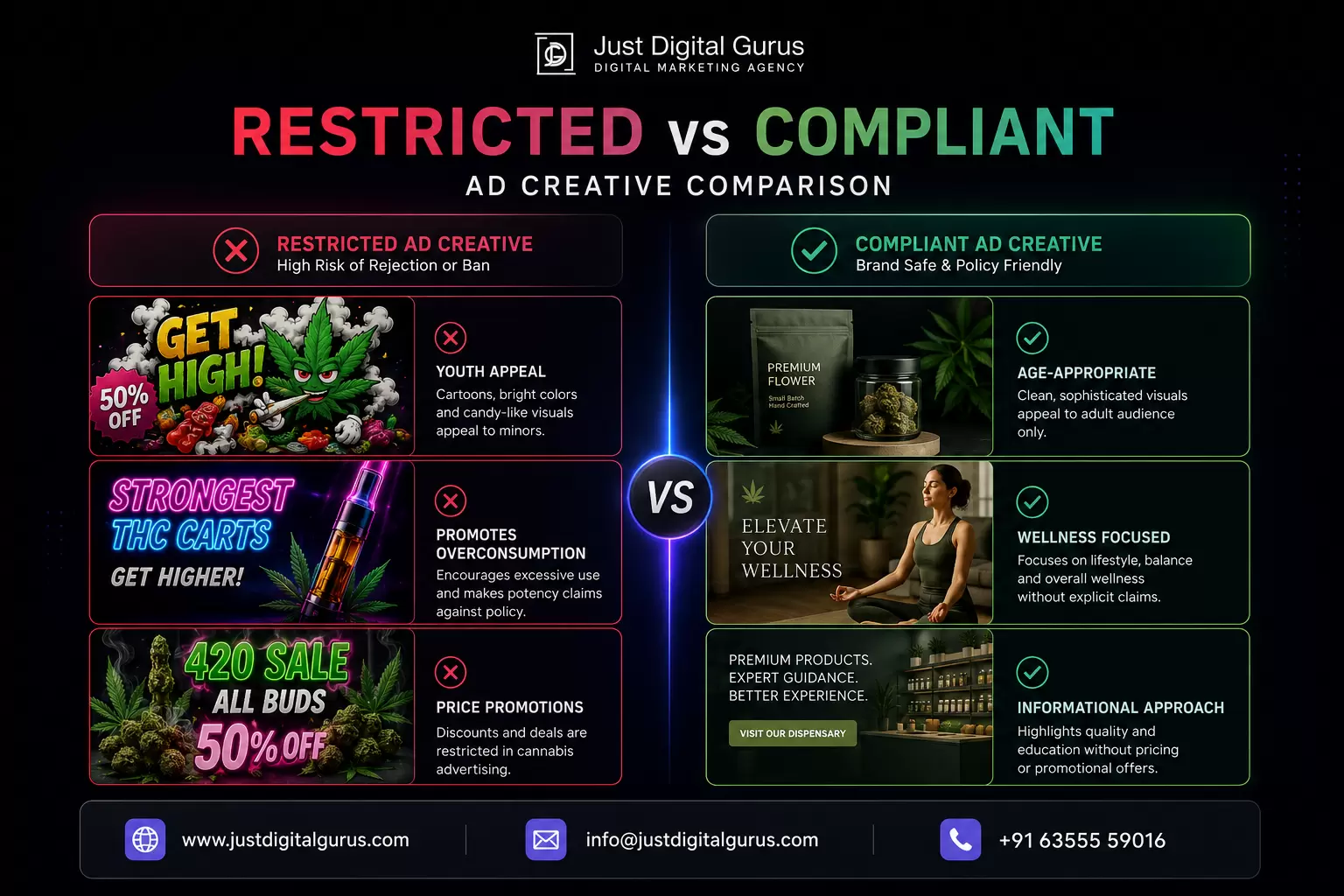
Good vs. Bad Ad Copy
| Restricted (Triggers Bans) | Compliant (Passes Review) |
| Best weed for pain relief | Explore natural wellness options |
| Get high with our strongest THC carts | Discover our premium vapor collection |
| Cure your anxiety with CBD | Learn about cannabinoids and calm |
| 420 Sale: 50% off all buds | Spring Wellness Event: Member Exclusive |
| Medical marijuana for cancer patients | Consult our certified cannabis advisors |
Landing Page Compliance Examples
Non-compliant elements to remove:
- "Add to Cart" buttons without age verification
- Testimonials claiming health benefits ("This cured my fibromyalgia")
- Images of pregnant women or children near products
- Cross-border shipping options (violates interstate commerce laws)
Compliant structure:
- Age gate (21+ or 18+ with medical card)
- Location verification (zip code checker)
- Educational content above the fold
- "View Menu" CTA (not "Buy Now")
- State license number in footer
Safe CTA Phrases
- "Explore the Menu"
- "Visit Our Dispensary"
- "Learn More"
- "Join the Community"
- "Speak with a Consultant"
Avoid: "Buy Weed Online," "Get Stoned," "High Potency Deals," "Medical Marijuana Delivery"
The 2026 Landscape: Schedule III and AI Moderation
Schedule III Implications
In 2024-2025, the DEA rescheduled cannabis from Schedule I to Schedule III. This changes research advertising but not recreational marketing.
What changed:
- Medical research institutions can now advertise clinical trials and FDA studies
- Pharmaceutical companies can promote FDA-approved cannabinoid drugs (Epidiolex, Marinol, Cesamet)
- Tax benefits (280E relief) allow more marketing budget allocation
What stayed the same:
- State-licensed recreational dispensaries still cannot advertise on most federal platforms
- Interstate advertising remains restricted
- Health claims are still prohibited for non-FDA-approved products
Hemp Loophole Enforcement Changes
The FDA and DEA are cracking down on "intoxicating hemp" products (Delta-8, Delta-10, THCP) in 2026. Many states have banned these substances or restricted their advertising to the same standards as marijuana.
Strategy shift: If you previously relied on hemp-derived cannabinoid advertising to bypass restrictions, pivot to compliant marijuana marketing in legal states or pivot to CBD-only (non-intoxicating) wellness positioning.
AI Moderation Evolution
Ad platforms now use multimodal AI (Google's Gemini, Meta's Llama) to review ads. These systems analyze:
- Image backgrounds (detecting cannabis leaves in wallpaper)
- Optical Character Recognition (OCR) on packaging in photos
- Voice transcription in video ads for restricted terms
Bypass strategy:
- Use flat-lay photography with neutral backgrounds
- Remove text from product packaging in ad creative
- Add background music to video ads to confuse voice-to-text analysis (while remaining accessible)
Compliance Checklist for Dispensary Marketing
Pre-Campaign Verification:
- Verify state-specific advertising regulations (check for recent 2026 updates)
- Confirm 70%+ adult audience demographic for chosen media
- Review creative for prohibited imagery (cartoons, candy, consumption)
- Audit landing pages for age gates and license display
- Check distance from schools/daycares (outdoor ads)
- Submit to LegitScript (if advertising CBD on Google)
- Obtain platform certifications (Meta Business Manager verification, Google Restricted Certification)
Ongoing Monitoring:
- Weekly audit of approved ads (platforms retroactively reject)
- Monitor comment sections for underage engagement
- Review SMS opt-in consent records quarterly
- Update privacy policy to reflect data collection practices
Documentation:
- Maintain records of audience demographic data for 7 years
- Archive all creative assets with approval timestamps
- Document compliance training for marketing staff
Common Mistakes That Trigger Bans
1. The "Organic Only" Trap
Posting cannabis content on Meta without paid promotion still violates Community Standards if the content promotes sales. Organic reach is not a safe harbor.
2. Retargeting Pixel Violations
Installing the Meta Pixel or Google Analytics on pages where users view THC products creates a compliance violation. Use server-side tracking or consent-mode analytics only.
3. Influencer Disclosure Failures
Having influencers post about your products without #Ad or #Sponsored triggers FTC violations. Reference the FTC endorsement guides to draft a compliant influencer contract template.
4. Cross-State Geo-Targeting Errors
Accidentally showing ads to users in prohibition states (even border towns) results in license scrutiny. Use hyper-local geo-fencing with 10-mile buffer zones from state lines.
5. Medical Reviews and Testimonials
Sharing customer reviews that mention medical conditions ("helped my PTSD") on your website or social media constitutes an impermissible health claim.
Frequently Asked Questions
Can dispensaries advertise on Google in 2026?
Yes, but with restrictions. Google allows certified advertisers to promote CBD products (under 0.3% THC) and cannabis business services. Direct cannabis sales ads are only permitted in specific jurisdictions through Google's restricted certification program. Most dispensaries succeed by advertising educational content and loyalty programs rather than product pages.
What is the 70% rule in cannabis advertising?
The 70% rule requires that at least 70% of the expected audience for any advertisement be adults aged 21 or older (or 18+ for medical-only states). This applies to digital, print, outdoor, and broadcast media. Advertisers must obtain demographic data from publishers or platforms to verify compliance.
Is cannabis advertising illegal federally?
Cannabis advertising is not federally illegal, but it is heavily restricted. The FDA prohibits therapeutic claims. The FCC restricts broadcast advertising. Major platforms (Google, Meta) enforce policies stricter than federal law. State laws vary significantly, with some states allowing billboards and others prohibiting all outdoor advertising.
Can I use billboards for my dispensary?
It depends on your state. California, Colorado, and Michigan allow cannabis billboards with buffer zones from schools. New York and Massachusetts prohibit outdoor cannabis advertising entirely. You must also verify that 70% of traffic viewers are adults.
Why does Meta keep rejecting my cannabis ads even though cannabis is legal in my state?
Meta's advertising policies follow federal law (Controlled Substances Act), not state law. Additionally, Meta's AI moderation system frequently generates false positives for cannabis-related imagery. You must appeal rejections and avoid visual triggers like cannabis leaves or consumption imagery in your creative.
What are programmatic cannabis ads?
Programmatic cannabis advertising uses automated buying platforms (DSPs) to purchase ad space on cannabis-friendly websites through Private Marketplaces (PMPs). This bypasses restrictions on major platforms like Google and Meta by placing ads on niche publishers (cannabis news sites, lifestyle blogs) where the audience is verified adult and contextually relevant.
How do I market my dispensary without paid ads?
Focus on local SEO (Google Business Profile optimization), content marketing (educational blogs about terpenes and consumption methods), email marketing to loyalty members, community events (educational seminars), and SMS marketing with proper TCPA consent. These owned media channels are not subject to platform advertising restrictions.
Conclusion
Cannabis advertising in 2026 requires precision. The brands winning market share are not those finding "loopholes." They are the ones building robust first-party data ecosystems, leveraging compliant programmatic channels, and dominating local SEO while their competitors fight algorithmic bans.
The landscape will continue evolving. Schedule III may eventually open pharmaceutical advertising pathways. AI moderation will become more sophisticated. But the fundamentals remain: verify your audience, avoid health claims, respect platform policies, and never rely on a single channel.
Your dispensary can scale profitably within these constraints. It requires strategic discipline, legal awareness, and creative agility.
Need help with compliant cannabis marketing?
Contact our team to audit your current advertising strategy, implement programmatic PMP campaigns, or build an SEO foundation that drives revenue without risking your licenses.
Disclaimer: This article provides marketing guidance based on publicly available platform policies and state regulations as of 2026. It does not constitute legal advice. Cannabis advertising laws vary by jurisdiction and change frequently. Consult qualified cannabis legal counsel before implementing advertising strategies.

Your comment will appear after approval.