
 Written By :
 ChatGPT
 Perplexity
 Claude
 Gemini
The wedding industry is personal, meaningful, and surprisingly accessible to break into. If you've ever stood at a ceremony and thought "I could do this," you're probably right. Knowing how to become a wedding officiant is less about jumping through endless hoops and more about understanding a few key legal requirements, building genuine skills, and then setting yourself up professionally so couples can actually find you.
This guide covers the whole picture: legal steps, business setup, branding, website, and marketing. Whether you want to officiate as a side income or build it into a full-time career, the process is the same. You just decide how far you want to take it.
What Does a Wedding Officiant Do?
Before jumping into requirements and business names, it helps to be honest about what the job actually involves day to day. Being a wedding officiant is more than showing up and saying "you may kiss the bride."
Responsibilities Before the Ceremony
Most of your work as an officiant happens before the wedding day. You'll:
- Meet with the couple (sometimes multiple times) to understand their story, tone preferences, and ceremony vision
- Help plan the ceremony structure and order of events
- Write or co-write a personalized ceremony script
- Clarify marriage license requirements for the couple
- Attend the rehearsal and guide the wedding party through the run-of-show
- Coordinate with photographers, planners, and venue staff on logistics
The couples who rave about their officiant are almost always talking about someone who invested real time before the day itself. The ceremony script and personal touches come from that preparation.
Duties During the Wedding Ceremony
On the day, your role is to hold the room with confidence and guide everyone through the ceremony without it feeling like you're running a drill. That includes:
- Welcoming guests and setting the emotional tone
- Delivering personalized remarks about the couple
- Prompting the declaration of intent, vows, and ring exchange
- Pronouncing the couple married
- Signing the marriage license immediately after the ceremony with the required witnesses
Legal Responsibilities After the Ceremony
This part often gets overlooked by new officiants. Once the ceremony is done and the champagne is flowing, someone still needs to make sure the marriage license gets filed correctly.
Depending on the state, either you or the couple returns the signed license to the county clerk's office within a specified window (often 30 days, though this varies). If the license doesn't get filed, the marriage isn't legally recorded regardless of how beautiful the ceremony was.
Know the requirements in your state before you sign anything.
How to Become a Wedding Officiant
Understand Your State's Laws
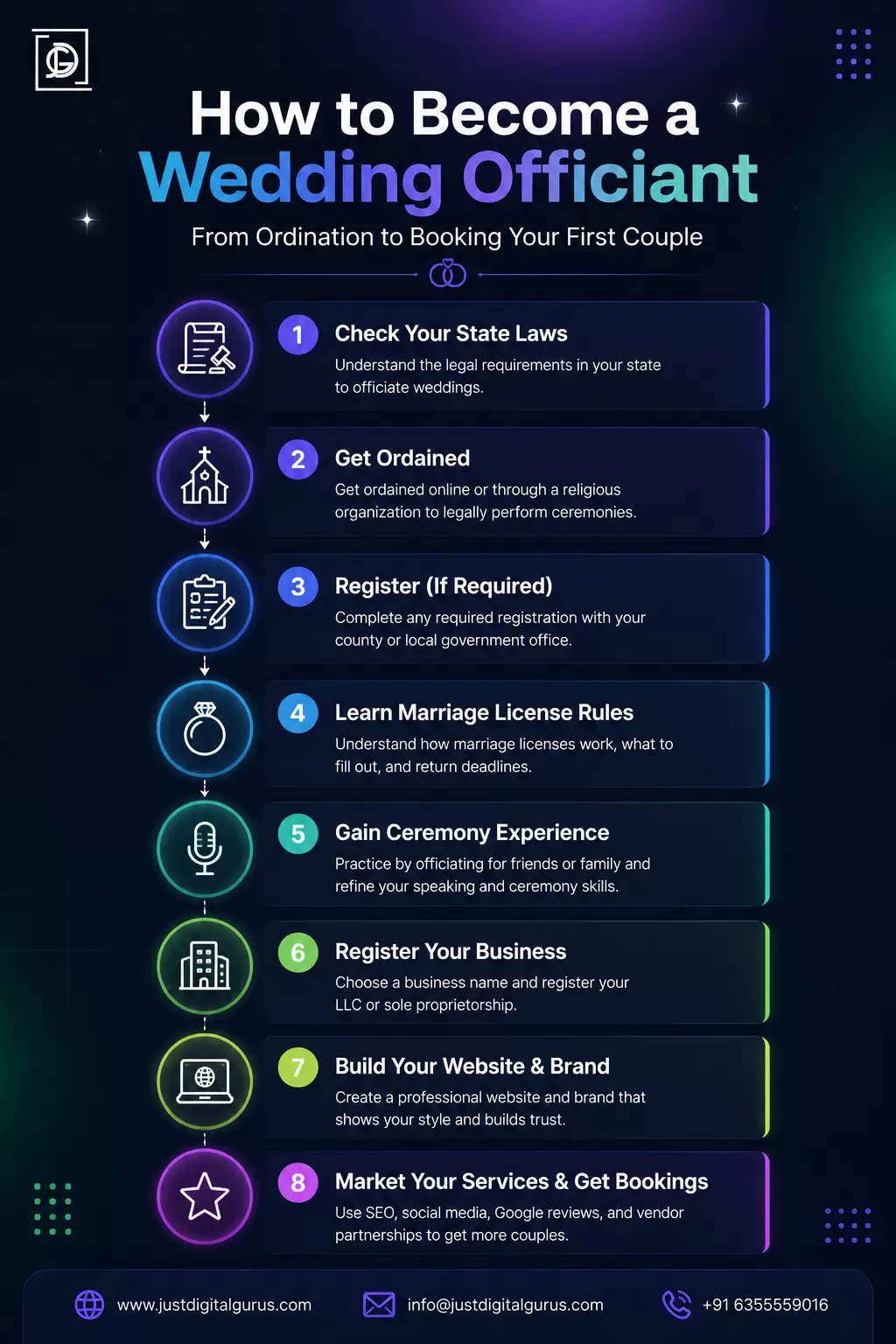
This is where everything starts. Wedding officiant requirements are set at the state level in the US, and they vary more than most people expect.
Some states are very open. California, New York, Florida, and Texas generally recognize ordinations from established online organizations and have minimal registration requirements. Other states are stricter. Virginia, for example, has historically had more specific requirements about who qualifies as a recognized officiant.
A few questions to research for your specific state:
- Is online ordination legally recognized?
- Do you need to register with a county clerk or court before officiating?
- Are there restrictions on who can legally solemnize a marriage?
- How long does the couple have to file the signed marriage license?
The safest approach is to contact the county clerk's office in the county where the wedding will take place. Don't rely entirely on what you read online (including here) because requirements change and can vary even within the same state at the county level.
If you plan to be a wedding officiant in multiple states, you'll need to check requirements for each one separately.
Get Ordained Online or Through a Religious Organization
For most people pursuing how to become a wedding officiant outside of a religious context, online ordination through a recognized organization is the standard route.
The most widely used options include:
- Universal Life Church (ULC): Free, widely recognized, offers ordination certificates for purchase
- American Marriage Ministries (AMM): Free ordination, strong legal documentation support
- Open Ministry: Free, similar to the above
The process takes about five minutes. You fill in your name, email, and a few basic details. You're ordained. Some states and counties require you to have a printed ordination certificate as proof, which you can usually order from these organizations for a small fee.
If you're coming from a religious background and already have ministerial credentials, those may be accepted directly. Check your specific state's requirements.
Complete Any Required Registration
Some states and counties require officiants to register with a government office before they can legally perform a marriage. New York City, for example, has historically required officiants to register with the city clerk before officiating within the five boroughs, even if they're already ordained.
This registration is usually straightforward and low-cost, but it needs to happen before the ceremony, not after.
Learn Marriage License Procedures
Part of how to be a wedding officiant professionally is guiding couples through the marriage license process. You won't obtain the license for them (that's their job), but you should understand:
- Where and how couples apply for a marriage license in your area
- Whether there's a waiting period between application and issuance
- What information you need to fill in on the license as the officiant
- The deadline for returning the signed license after the ceremony
Being knowledgeable about this builds trust with couples and prevents legal headaches down the line.
Gain Practical Experience
If you're brand new, your first few ceremonies might be for friends or family. That's completely fine and a natural starting point. Treat those ceremonies with the same level of preparation you'd give a paying client.
Attend other ceremonies when you can. Notice what works and what doesn't. Pay attention to pacing, tone, how officiants handle unexpected moments, and how they connect with both the couple and the crowd.
The more ceremonies you observe and conduct, the more your own style develops.
Wedding Officiant Requirements by State
Since this varies so much, here's a general overview of how states tend to fall:
States That Require Registration
A handful of states or specific counties require officiants to register before performing a marriage. Notable examples include parts of New York, Virginia (which has had ongoing legislative discussions about online ordinations), and a few others.
Always verify at the county level. A state might broadly accept online ordinations while a specific county requires additional paperwork.
States with Minimal Requirements
Most US states simply require that the officiant be ordained by a recognized religious organization or hold a civil office that grants authority to solemnize marriages. In these states, online ordination from organizations like ULC or AMM is generally sufficient.
California, Florida, Texas, Colorado, Illinois, and many others fall into this category, though again, verify locally.
Important Legal Considerations
A few things that apply broadly regardless of state:
- You typically must be at least 18 years old
- You cannot officiate your own marriage (obviously)
- The marriage license must be signed correctly and filed within the required timeframe
- Errors on the marriage license can create legal complications for the couple
Take the legal side seriously. The ceremony is memorable, but the paperwork is what makes the marriage legally real.
How to Start a Wedding Officiant Business
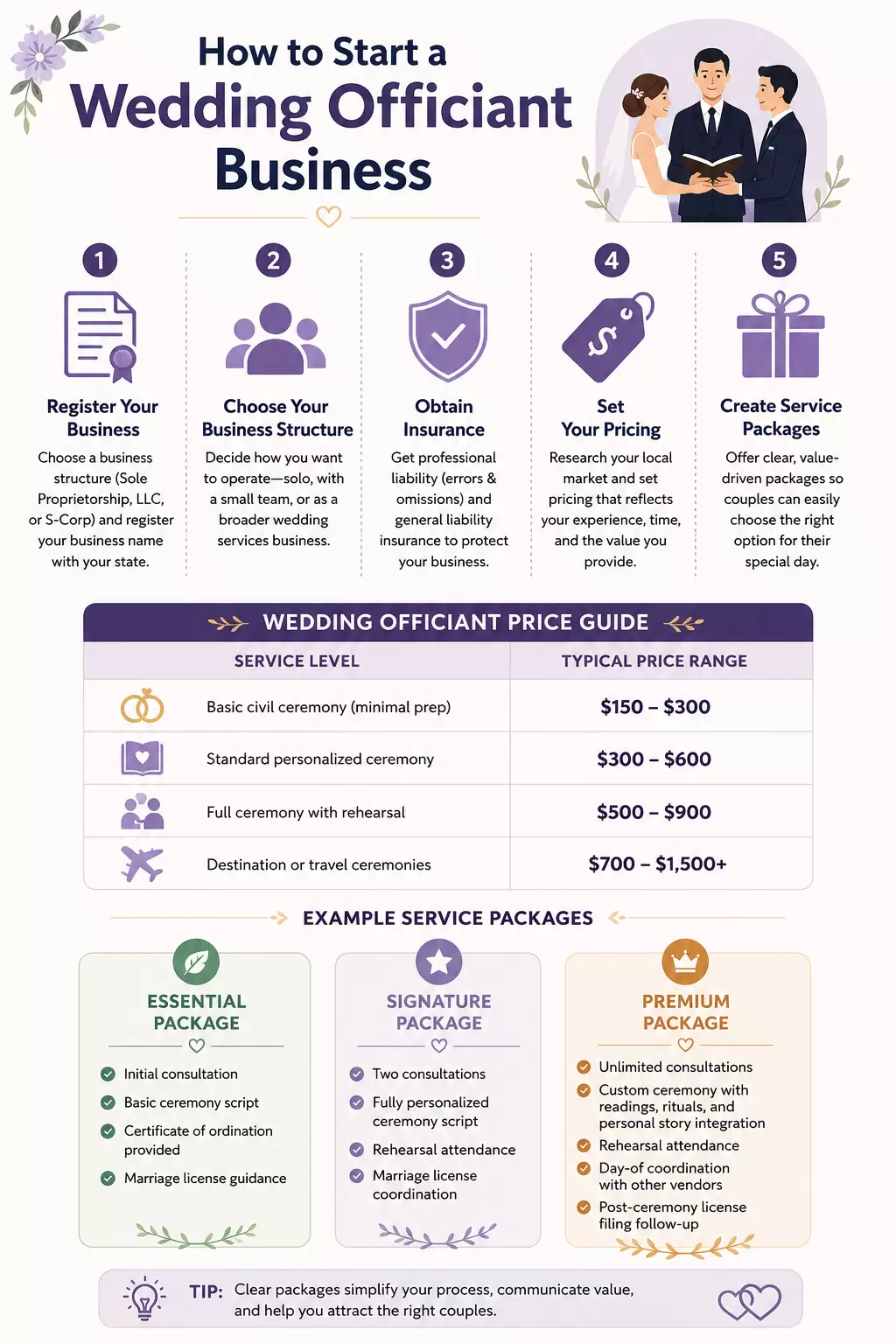
Getting ordained handles the legal side. Actually building a business is a separate project. Here's how to approach how to start a wedding officiant business systematically.
Register Your Business
Once you're ready to work professionally, you need a legitimate business structure. Your options typically include:
- Sole Proprietorship: Simplest setup, no formal registration in most states, but you're personally liable for everything
- LLC (Limited Liability Company): Separates your personal assets from business liabilities, more professional, modest setup cost (varies by state, usually $50-500)
- S-Corp: Generally overkill for a solo officiant starting out, but worth knowing about for later
For most solo wedding officiants just starting out, an LLC is a reasonable choice. It's not dramatically expensive to set up and it gives you some liability protection if anything goes sideways.
Register your business name with your state's secretary of state office. The fee and process vary by state.
Choose Your Business Structure
Beyond the legal entity, think about how you want to operate:
- Solo, handling everything yourself?
- A small team where you might eventually bring in associate officiants?
- A broader wedding services company that offers officiating alongside other services?
Your structure affects your pricing, branding, and how you present yourself to couples. Most people starting out go solo and expand later if the demand warrants it.
Obtain Insurance
Professional liability insurance (also called errors and omissions insurance) is worth considering for wedding officiants. If something goes wrong legally, such as an error on a marriage license or a dispute over services, having coverage matters.
General liability insurance is also common in the wedding industry, and some venues actually require vendors to carry it. Shop around for policies designed for wedding professionals or solo service providers.
Set Your Pricing
Pricing a wedding officiant business depends on your location, experience, and what's included in your services. As a rough guide:
| Service Level | Typical Price Range |
|---|---|
| Basic civil ceremony (minimal prep) | $150 - $300 |
| Standard personalized ceremony | $300 - $600 |
| Full ceremony with rehearsal | $500 - $900 |
| Destination or travel ceremonies | $700 - $1,500+ |
These are general ranges and market rates vary significantly by region. Urban markets with high demand and cost of living typically support higher rates. Research what officiants in your specific area charge.
Don't underprice yourself significantly just to book clients early. It devalues your work and attracts clients who may not value the effort you put in. Price based on the real time and skill involved.
Create Service Packages
Rather than an à la carte menu, most officiants do better with defined packages. Something like:
Essential Package
- Initial consultation
- Basic ceremony script
- Certificate of ordination provided
- Marriage license guidance
Signature Package
- Two consultations
- Fully personalized ceremony script
- Rehearsal attendance
- Marriage license coordination
Premium Package
- Unlimited consultations
- Custom ceremony with readings, rituals, and personal story integration
- Rehearsal attendance
- Day-of coordination with other vendors
- Post-ceremony license filing follow-up
Clear packages make it easier for couples to compare and choose. They also reduce the "can you just do X for a little less?" conversations.
Choosing Wedding Officiant Business Names
Your business name is often the first impression couples get. It needs to work across your website, social media, business cards, and word-of-mouth.
Branding Tips
A good wedding officiant business name should:
- Be easy to remember and spell
- Reflect your style or personality (traditional, modern, fun, spiritual, non-religious)
- Not be so specific that it limits your scope (avoid naming it after a single venue or season)
- Work as a domain name
Name Ideas That Inspire Trust
A few directions that tend to work well:
Name-Based:
- [Your Name] Ceremonies
- [Your Name] Wedding Officiant
- [Your Name] Celebrates
Location-Based:
- [City] Wedding Officiant
- [Region] Ceremonies
- [State] Celebrant Co.
Feeling or Style-Based:
- Forever Forward Ceremonies
- Heartfelt Vows
- The Ceremony Studio
- Words & Rings
- United Ceremonies
- Simply Married
Avoid overly generic names like "Perfect Day Officiant" that blend into the background. And avoid names that make legal claims (like "Licensed" or "Certified") unless you're in a state that has actual certification programs.
Domain Name Availability
Before falling in love with a name, check if the domain is available. Tools like Namecheap, GoDaddy, or Google Domains let you search instantly. Aim for a .com if possible.
Also check:
- Is the name available on Instagram?
- Is it available on Facebook?
- Does a Google search for the name return any confusing or conflicting results?
If your ideal name is taken as a domain, try variations like adding your city, "ceremonies," or "co" to the end.
Build a Professional Wedding Officiant Website
This is where most new officiants underinvest, and it costs them bookings. If you're serious about how to start a wedding officiant business, a professional website isn't optional. It's the foundation of how couples find and evaluate you.
Why Every Officiant Needs a Website
Couples planning a wedding search Google. They type things like "wedding officiant near me," "non-religious wedding officiant [city]," or "affordable wedding officiant [area]." If you don't have a website, you don't show up. If you're only on wedding directories like The Knot or WeddingWire, you're competing directly with every other officiant in your market on their platform, on their terms.
A website gives you control. It's where your personality, style, and story come through in a way that a directory listing simply can't.
Essential Website Pages
A solid wedding officiant website should include at minimum:
Homepage
Clear statement of who you are, what you offer, and where you serve. A warm photo of you at a ceremony or consultation. A clear call to action (book a call, check availability, contact me).
About Page
This is where couples decide if they like you. Be genuine. Tell your story. Why do you officiate? What's your style? What do you believe about love and marriage? Don't make it a resume. Make it human.
Services/Packages Page
List your packages clearly with what's included and pricing (or at least a starting price). Couples who have to ask for pricing often don't bother.
Testimonials/Reviews Page
Social proof is enormous in the wedding industry. One page of real reviews from past couples does more for your credibility than any marketing copy you write about yourself.
FAQ Page
Answer the questions couples ask most. Are you ordained? Do you travel? How do you personalize the ceremony? What happens if you get sick? Getting ahead of these questions reduces friction in the booking process.
Contact Page
A simple contact form, your email, and ideally a booking calendar or availability check tool.
Wedding Officiant Website Template Features
When choosing a wedding officiant website template, look for:
- Clean, elegant design that suits the wedding industry aesthetic
- Mobile-responsive layout (most couples browse on phones)
- Fast loading speed
- Easy-to-edit sections for your text and photos
- Contact form integration
- Testimonial display options
- Clear calls to action on every page
Platforms like Squarespace, Showit, and WordPress with an appropriate theme all work well for officiant websites. Squarespace in particular is popular in the wedding industry because of its design quality and ease of use.
If you want something more custom and specifically optimized for search, a professionally designed website built around your target keywords will outperform a template in the long run. Our web design and development services build websites for service professionals that are designed to convert visitors into inquiries.
SEO Tips for Getting Found Online
Building a beautiful website is step one. Getting couples to actually find it is step two. Here's the basics of how to be a wedding officiant who shows up in search results:
Target local keywords. "Wedding officiant [your city]" is your most important keyword phrase. Use it naturally in your page titles, headings, and content. Don't stuff it, but don't avoid it either.
Create location-specific content. If you serve multiple cities, consider creating separate pages for each major area. "Wedding Officiant in Austin" and "Wedding Officiant in San Antonio" can each rank for their respective searches.
Write a blog. Regular content about wedding ceremony topics builds topical authority and brings in organic traffic. Our guide on how to officiate a wedding is a good example of the type of content that attracts couples doing research online.
Optimize your meta titles and descriptions. Every page on your site should have a unique, keyword-informed meta title and description that makes someone want to click.
Get your site indexed. Submit your site to Google Search Console after launch so Google starts crawling it promptly.
For a deeper dive on making your website findable, our SEO-friendly website guide covers the fundamentals in plain language.
Marketing Your Wedding Officiant Business
A website is the foundation. Marketing is what drives people to it. Here's how to start a wedding officiant business that actually generates consistent inquiries.
Optimize Your Google Business Profile
If you haven't already, create and fully complete your Google Business Profile (formerly Google My Business). This is what shows up in the map pack when someone searches "wedding officiant near me."
A well-optimized profile includes:
- Accurate business name, address, and service area
- Your primary business category (Wedding Officiant)
- High-quality photos (at least 5 to 10)
- A detailed business description with your key services and city
- Regular posts about recent ceremonies or upcoming availability
- Consistent review collection from past couples
The map pack is prime real estate in local searches. Getting into it requires both a complete profile and positive reviews.
Collect Client Reviews
In the wedding industry, reviews are everything. Couples trust other couples. A genuine five-star review with a specific story about how you made someone's ceremony special is worth more than any advertising.
After each ceremony, follow up with a brief, warm email thanking the couple and asking if they'd be willing to share a review on Google or The Knot. Make it easy by including a direct link.
Don't be shy about asking. Most happy couples are glad to do it. They just need the nudge and the link.
Social Media Marketing
Instagram and Pinterest are the primary visual platforms for wedding professionals. Instagram in particular is where couples discover vendors organically through hashtags, location tags, and recommendations.
Post consistently. Share photos from ceremonies (with permission), behind-the-scenes moments from rehearsals, quotes about love and commitment, and short ceremony script excerpts. Engage with local wedding photographers, planners, and florists in your comment sections.
You don't need to go viral. You need to be consistently visible to local couples and other wedding vendors who might refer you.
Our social media management services can handle this side of things if you'd rather focus on the ceremonies themselves.
Local SEO Strategies
Local SEO for a wedding officiant business means showing up when people search for officiants in your specific area. Beyond your Google Business Profile, this includes:
- Getting listed in local wedding vendor directories (The Knot, WeddingWire, Zola, Thumbtack)
- Building citations (consistent name, address, phone number) across the web
- Earning backlinks from local wedding blogs, venue partner pages, and wedding planner websites
- Creating locally targeted content on your blog
Our local SEO services are specifically designed for service businesses that need to rank in specific geographic areas, which is exactly what an officiant business needs.
Wedding Vendor Partnerships
One of the most underrated marketing strategies for new officiants is building relationships with other wedding vendors: photographers, planners, florists, venue coordinators. These people are constantly in contact with engaged couples who need officiants.
Reach out. Introduce yourself. Attend local wedding industry networking events. Be genuinely helpful and easy to work with, and referrals will follow naturally.
When photographers love working with you because you help their couples feel relaxed and run the ceremony smoothly, they'll recommend you without being asked.
For broader marketing strategy support, our wedding business marketing services and wedding officiant advertising and marketing services are specifically built for wedding professionals looking to grow their client base.
Common Mistakes New Wedding Officiants Make
Ignoring Local Legal Requirements
The most consequential mistake. Getting ordained online takes five minutes, but skipping the step of verifying local wedding officiant requirements can result in a marriage that isn't legally recognized. Always check with the county clerk before officiating anywhere new.
Underpricing Services
New officiants often charge too little out of insecurity or a desire to book quickly. The problem is that underpricing attracts clients who don't value the work and makes it hard to raise rates later without pushback. Research your market, price fairly, and trust that the right couples will book you.
Not Having a Professional Website
Relying entirely on wedding directories, Facebook, or word of mouth leaves you dependent on platforms and algorithms you don't control. A professional website with strong local SEO is the only marketing asset you truly own.
Forgetting Contracts and Policies
Always use a written contract. It should cover:
- Date, time, and location of the ceremony
- Services included
- Payment terms and deposit
- Cancellation and rescheduling policy
- What happens if you (the officiant) have an emergency
A contract protects both you and the couple. Without one, disputes about expectations are nearly impossible to resolve fairly.
Winging the Ceremony
Even experienced public speakers don't wing a wedding ceremony well. The script should be written in full and rehearsed out loud. The ceremony is the couple's most important moment. It deserves your full preparation.
Neglecting the Marriage License
Forgetting to follow up on the license filing is a surprisingly common oversight. Put a reminder in your calendar for a few days after the wedding to confirm the license was filed. A couple discovering their marriage isn't legally recorded weeks later because the license was never filed is a nightmare situation.
Frequently Asked Questions
How do you become a wedding officiant?
Get ordained through a recognized organization (online or religious), verify wedding officiant requirements in your state and county, complete any required registration, and build a professional presence to attract couples. This guide covers the full how to become a wedding officiant process from start to finish.
What are the wedding officiant requirements in my state?
Requirements vary by state and county. Most states accept online ordination from recognized organizations, but some require additional registration. Always verify with the county clerk's office where the wedding will take place.
How do I start a wedding officiant business?
Register your business entity (LLC is a solid choice for most), set your pricing and packages, build a professional website, optimize for local search, and start collecting reviews. Our full section on how to start a wedding officiant business above covers each step in detail.
What should a wedding officiant website include?
At minimum: a homepage with a clear value proposition, an about page, a services and pricing page, a testimonials page, an FAQ page, and a contact form. A well-designed wedding officiant website template should be mobile-responsive, fast, and locally optimized for search.
How much can a wedding officiant earn?
It varies significantly by location, experience, and how many ceremonies you perform. Part-time officiants in smaller markets might earn $10,000 to $30,000 per year. Experienced officiants in major metro areas performing 50 to 100 ceremonies annually can earn $50,000 to $100,000 or more. The ceiling depends largely on your market, pricing, and how aggressively you market yourself.
Do I need insurance as a wedding officiant?
It's not legally required in most places, but it's worth having. Professional liability insurance protects you if a legal dispute arises, and some venues require vendors to carry general liability coverage. Shop around for policies designed for wedding professionals.
Can I officiate weddings in multiple states?
Yes, but you need to verify requirements in each state separately. Your ordination typically travels with you, but registration requirements and license procedures differ by location. If you regularly officiate in multiple states, build a checklist for each one.
Final Thoughts
How to become a wedding officiant is a question with a genuinely accessible answer. The legal path is manageable, the skills are learnable, and the demand for personalized, thoughtful ceremony experiences is consistent. Couples want someone who will make their ceremony feel like them, and that's a skill you can develop with intentional practice and preparation.
The business side is where most officiants either invest or underinvest. A professional website, strong local SEO, consistent marketing, and good vendor relationships are what separate officiants who struggle to fill their calendar from those who have a waitlist.
If you're ready to take the business side seriously, Just Digital Gurus works specifically with wedding professionals on exactly this. Our wedding officiant advertising and marketing services and wedding SEO services are built to help officiants get found by the right couples at the right time.
We also offer wedding celebrant marketing services, local SEO, web design and development, and digital marketing support tailored to service professionals in the wedding industry.
Get in touch or book a call to talk through what growing your officiant business actually looks like.

Your comment will appear after approval.