
 Written By :
 ChatGPT
 Perplexity
 Claude
 Gemini
Most wedding photographers are genuinely talented behind the camera. Where things tend to fall apart is everything that happens before someone actually books them. Unclear wedding photography packages, inconsistent pricing, no proper contract, and a website that makes it hard to take the next step, these are the things that quietly kill bookings.
If you've ever had a couple reach out, go quiet after you sent your pricing, and then disappear, there's a good chance the problem wasn't your photography. It was your packaging.
This guide is about fixing that. How to structure wedding photography packages that communicate value clearly, price them in a way that's profitable and competitive, build the booking process that converts inquiries into signed contracts, and make sure your website is actually working for you.
Why Well-Designed Wedding Photography Packages Matter
How Packages Influence Buying Decisions
Couples planning a wedding are making dozens of decisions under emotional and financial pressure. When they land on your website or receive your pricing guide, they're not just comparing numbers. They're trying to figure out if you're the right fit, if the investment makes sense, and what the process of working with you will feel like.
Well-designed wedding photography packages do three things immediately:
- They make it easy to understand what's included
- They anchor the couple's expectations around value, not just price
- They give couples a clear path to saying yes
When packages are confusing, incomplete, or feel like a menu of random line items, couples don't ask for clarification. They move on to the next photographer whose pricing they could actually understand.
Common Mistakes Wedding Photographers Make
Before getting into what works, it's worth naming what doesn't:
- Too many options. Five or six package tiers overwhelm people. Three is almost always enough.
- Vague descriptions. "Full day coverage" means nothing if you don't specify how many hours.
- À la carte only. Forcing couples to build their own package from scratch creates friction and tends to produce price anchoring on the cheapest possible combination.
- No visible pricing. Hiding your rates entirely frustrates serious inquiries and wastes time for both parties.
- Generic package names. Bronze, Silver, Gold means nothing. Names that reflect the experience (Intimate, Signature, Legacy) work better.
Benefits of Value-Based Pricing
Most photographers starting out price based on what they think they can charge rather than what their services are genuinely worth. Value-based pricing flips that logic.
Instead of starting with your costs and adding a margin, you start with what the outcome is worth to the client. A couple's wedding photographs are the primary lasting record of one of the most significant days of their lives. That's not a commodity. Pricing it like one devalues your work and attracts clients who may not respect the investment they've made.
How to Build Wedding Photography Packages That Sell
Define Your Ideal Client
Before you write a single package, get clear on who you're building it for. A photographer targeting intimate elopements and one targeting 300-guest luxury ballroom weddings should have completely different wedding photography packages, pricing structures, and marketing approaches.
Ask yourself:
- What's my typical client's budget range?
- What style of wedding do I shoot best and enjoy most?
- Do I prefer smaller, more intimate celebrations or large-scale productions?
- Am I targeting local couples or destination weddings?
Your packages should be designed to attract more of the clients you actually want, not just anyone willing to pay.
Choose the Right Package Tiers
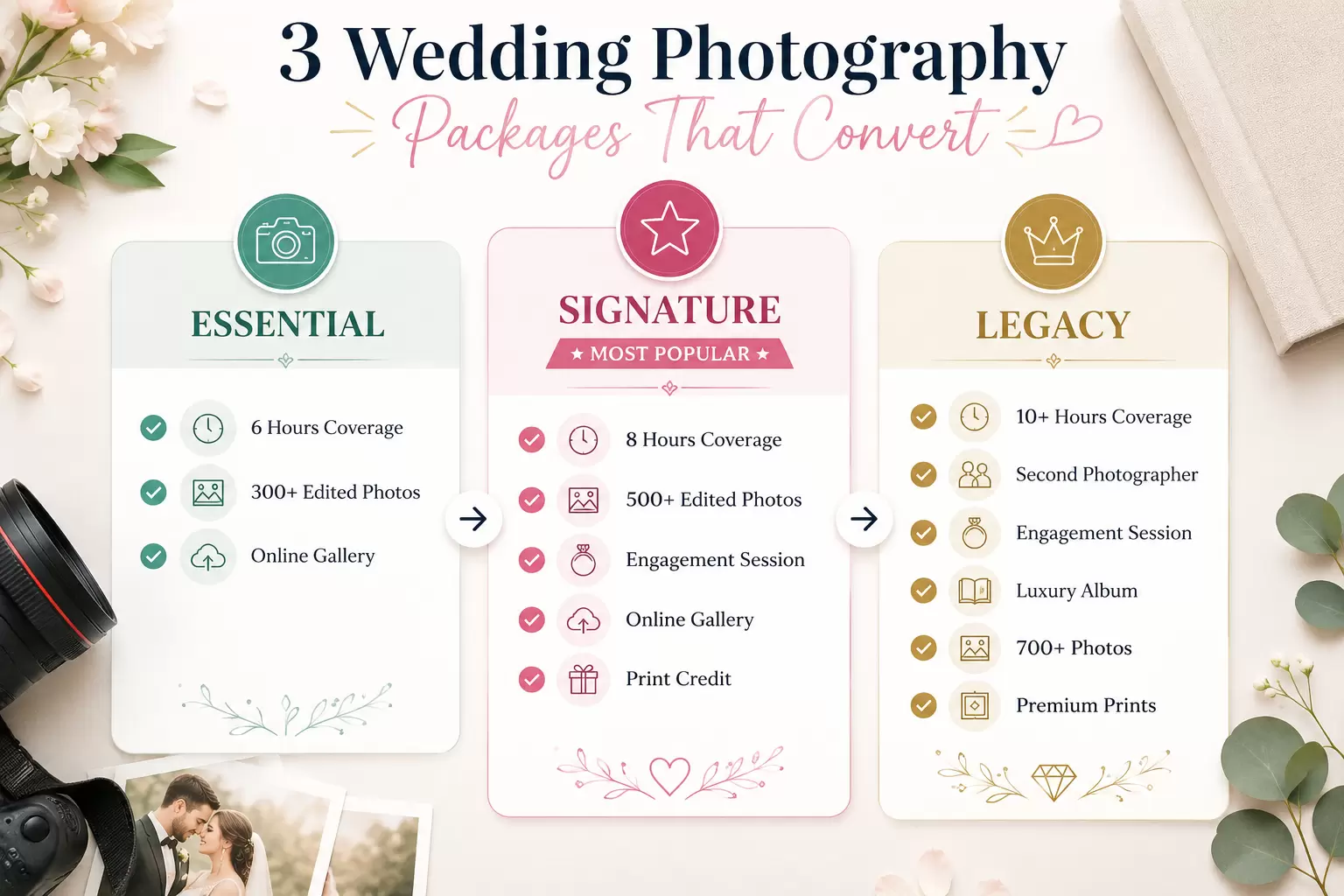
Three tiers is the sweet spot for most photographers. Here's why: when people are presented with three options, they tend to anchor on the middle one. This is basic pricing psychology, and it works consistently.
A structure that works well:
Tier 1 (Entry level): Covers the essentials for couples with a tighter budget or a simpler wedding. Less coverage time, fewer deliverables.
Tier 2 (Signature/Most Popular): Your bread and butter. This is where most of your bookings should land. Price it for profitability and load it with value.
Tier 3 (Premium): Everything included. More coverage hours, engagement session, album, second photographer, all of it. Priced for couples who want the full experience without having to think about add-ons.
Label your middle package as "Most Popular" or "Best Value." That social proof nudge works.
Decide What to Include
Standard inclusions across most wedding photography packages:
- Hours of coverage (be specific: 6 hours, 8 hours, 10 hours)
- Number of fully edited images delivered
- Online gallery with download access
- Turnaround time for delivery
- Whether a second photographer is included
- Engagement session (usually in upper tiers)
- Physical album or prints (usually in premium tier)
Be explicit about what's included and what isn't. Ambiguity leads to misaligned expectations, which leads to difficult client conversations down the road.
Add Optional Upgrades and Add-Ons
Add-ons let couples customize without you having to build infinite package variations. Offer a focused menu of upgrades:
- Engagement session (if not included)
- Second photographer
- Additional hours of coverage
- Rehearsal dinner coverage
- Fine art album upgrade
- Rush delivery option
- Printed photo box or parent albums
Keep the add-on list to eight items or fewer. More than that and it becomes its own overwhelming decision.
Bundle Products for Higher Value
Bundling is one of the most effective ways to increase your average booking value without feeling like you're upselling. When an album is included in a package rather than offered separately afterward, couples are more likely to receive it and more likely to value the package as a whole.
The same logic applies to engagement sessions. Photographers who include them in packages tend to book more of them than those who pitch them as an add-on after the fact.
Wedding Photography Pricing Strategies
Cost-Based vs Value-Based Pricing
Cost-based pricing starts with what you spend (gear, editing time, software, insurance, marketing, travel) and adds a profit margin. It ensures you're not losing money, but it often results in underpricing because photographers undercount their actual time.
Value-based pricing starts with what the outcome is worth to the client and prices accordingly. It requires confidence in your work and clarity on who your ideal client is, but it tends to produce better margins and attracts clients who value photography as an investment rather than a commodity.
In practice, most photographers use a blend: cost-based pricing as a floor (the minimum you can charge and still be profitable) and value-based thinking to determine where above that floor to set your rates.
Researching Your Local Market
Know your market. Wedding photography pricing varies enormously by region. In major cities like New York, Los Angeles, and Chicago, $3,000 to $5,000 for a full-day package is the middle market. In smaller markets, $1,500 to $2,500 might be the upper range.
Research by:
- Browsing competitor websites in your area that show pricing
- Checking The Knot and WeddingWire for advertised rates
- Talking to other photographers in your area (not everyone is territorial about this)
- Looking at what venues in your market consider a "typical" photography budget
Position yourself relative to this market deliberately. Being the cheapest option in your market is a race to the bottom. Being in the mid-to-upper range with strong work to back it up is a sustainable position.
Setting Profitable Price Points
A rough formula to check if your pricing is sustainable:
- Calculate your total annual business expenses (gear, software, insurance, marketing, education, etc.)
- Add your desired annual income
- Divide by the number of weddings you want to shoot per year
- That's your minimum average booking value
Most photographers who go through this exercise discover they're undercharging. If your math says you need $2,800 per wedding and you're charging $1,800, no amount of booking volume will fix the profitability problem.
When to Increase Your Rates
You should consider raising your wedding photography pricing when:
- You're booking out more than 6 months in advance consistently
- You're turning away inquiries regularly
- Your work has improved significantly since you last set your rates
- You've received pricing feedback like "you're so affordable!" from multiple clients (a polite way of saying you're cheap)
- Your editing and client experience has become more refined and time-intensive
Raising rates doesn't mean losing clients. It usually means attracting better-fit clients and working fewer weddings at higher margin.
What Should Every Wedding Photography Package Include?
Hours of Coverage
Be specific. "All day coverage" is vague. "10 hours of coverage" is clear. Specify when coverage starts (typically getting ready through the first dance or cake cutting) and what happens if the wedding runs long.
Most weddings need 8 to 10 hours for full coverage from preparation through reception. Intimate weddings or elopements can work with 4 to 6 hours.
Number of Edited Images
Give a minimum number, not an exact count. "400+ fully edited images" is reasonable for an 8-hour wedding. "800+ images" might be appropriate for a longer event with second photographer coverage.
Clarify what "edited" means: color correction and exposure adjustments at minimum. If you do more extensive retouching for certain images, note that.
Online Gallery
Most photographers deliver images via an online gallery platform (Pixieset, ShootProof, CloudSpot are popular options). Include how long the gallery stays active (typically 1 to 3 years) and whether high-resolution downloads are included.
Engagement Session
An engagement session before the wedding serves multiple purposes: it helps you and the couple get comfortable together, it gives them usable photos for save-the-dates, and it gives you a chance to see how they interact in front of the camera before the wedding day.
Including an engagement session in your middle and premium wedding photography packages adds tangible value and also benefits your work.
Albums and Prints
Physical products are where photographers leave a lot of money on the table. A fine art album is often something couples don't think to prioritize in their planning, but when they receive one, it becomes one of their most treasured possessions.
Including an album (even an entry-level one) in your premium package and offering upgrades creates a natural upsell path.
Second Photographer Options
A second photographer adds meaningful value: better coverage of simultaneous moments (groom getting ready while bride is getting ready), more angles during the ceremony, and relief on post-processing. Include it in your upper tiers or offer it as an add-on.
Streamline Your Wedding Photographer Booking Process
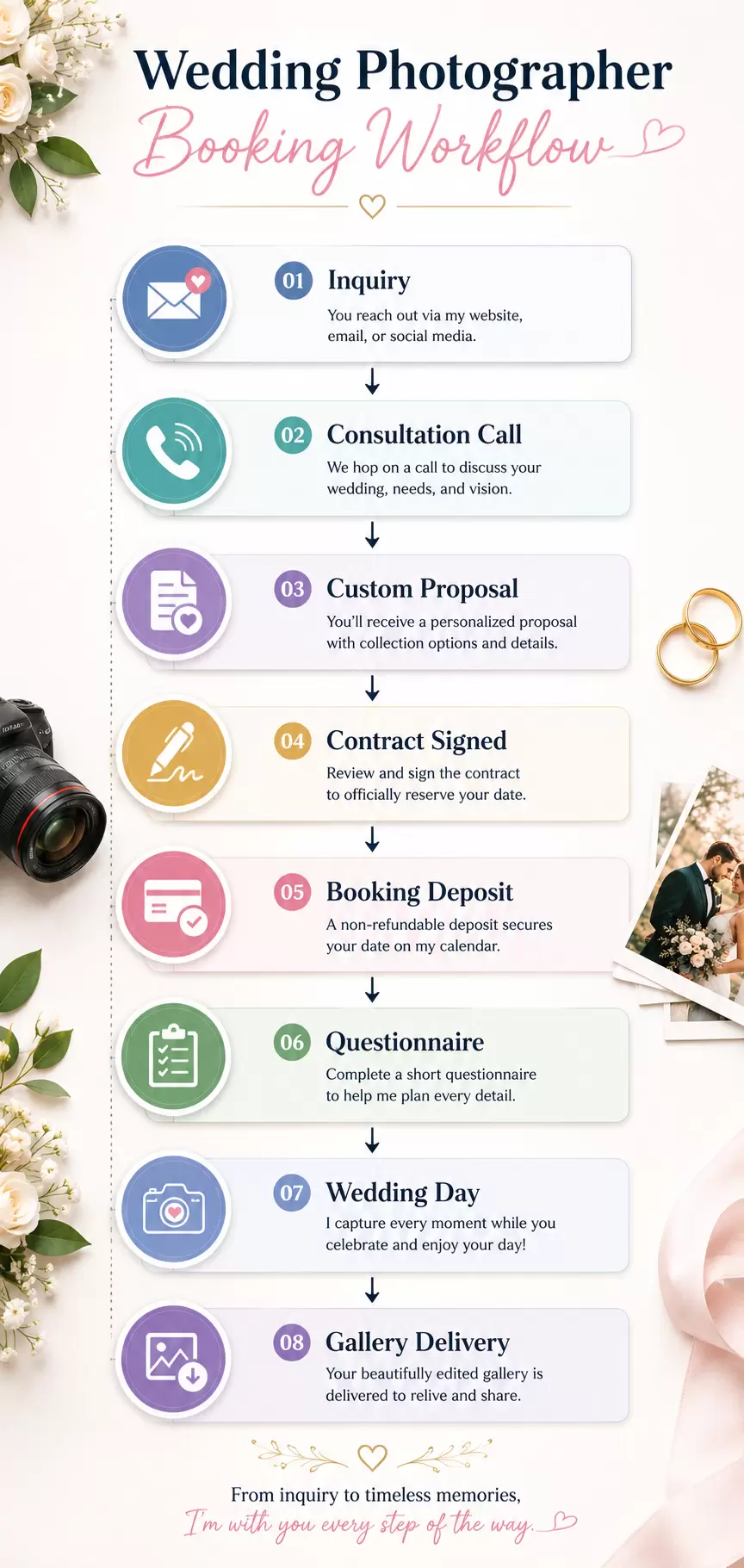
The wedding photographer booking process is where many photographers lose potential clients, not because their work isn't good enough, but because the path from "I'm interested" to "I'm booked" has too many friction points.
Inquiry to Consultation
When someone submits an inquiry through your website, respond within 24 hours. Ideally within a few hours. Response speed matters significantly in the wedding industry because couples are often inquiring with multiple photographers simultaneously.
Your first response should:
- Confirm your availability for their date
- Express genuine interest in their wedding
- Invite them to a consultation call or video meeting
- Give them a clear next step
Don't send your full pricing guide as the very first response before you've had any conversation. Some photographers disagree with this approach, and it depends on your market, but a consultation first lets you connect personally before the conversation becomes purely transactional.
Sending Proposals
After a consultation, send a clear, professional proposal that includes:
- Your recommended package based on the conversation
- What's included (specific, not vague)
- Pricing including deposit amount and payment schedule
- A clear deadline to hold the date (typically 5 to 7 days)
- A link to book or a simple next step
Tools like HoneyBook, Dubsado, and Studio Ninja handle proposal creation and delivery well. They also integrate contracts and invoicing, which keeps the process clean.
Booking Deposits
A non-refundable retainer (commonly called a booking deposit, though the legal terminology varies) is standard in the wedding photography industry. Most photographers charge 25% to 50% of the total package price to secure the date.
Be clear in your proposal and wedding photography contract about what happens to this deposit if the couple cancels.
Automated Client Workflows
Once a client books, an automated workflow saves enormous time and creates a consistent client experience. Using a CRM like HoneyBook or Dubsado, you can automate:
- Booking confirmation emails
- Contract delivery and signature collection
- Invoice scheduling and payment reminders
- Pre-wedding questionnaire delivery
- Timeline planning reminders
- Gallery delivery notifications
This kind of automation makes you look more professional, not less personal. It frees you to focus on the actual creative and relationship work rather than chasing admin tasks.
Confirming Wedding Details
A few weeks before the wedding, reach out to confirm all logistics: ceremony and reception locations, timing, key contacts at the venue, parking, and any changes to the plan. This is also when you'd review the completed wedding photography questionnaire and finalize the shot list.
Protect Your Business with a Wedding Photography Contract
This section matters more than most photographers want to admit. A solid wedding photography contract is what protects you when things go sideways, and occasionally things do go sideways.
Essential Contract Clauses
Every wedding photographer contract should include at minimum:
- Full names and contact information of all parties
- Wedding date, ceremony and reception locations
- Exact services included (package name and details)
- Total price, deposit amount, and payment schedule
- Delivery timeline for images
- How images will be delivered (online gallery, format, resolution)
- Your cancellation and rescheduling policy
- Force majeure clause (what happens if you or the couple can't fulfill the contract due to circumstances outside your control)
- Copyright ownership and licensing terms
- Model release language
Have a lawyer review your contract template at least once. Templates you find online are a starting point, not a finished document.
Payment Terms
Specify:
- Deposit amount and due date
- Any mid-point payment (some photographers charge in installments)
- Final payment due date (typically 1 to 2 weeks before the wedding)
- Accepted payment methods
- Late payment policies
Don't shoot a wedding without receiving full payment beforehand. It's awkward to chase money after the fact and puts you in a poor negotiating position.
Cancellation and Rescheduling Policies
This clause became especially important after 2020. Your contract should address:
- What happens to the deposit if the couple cancels (typically non-refundable)
- Whether and how you'll accommodate rescheduling (most photographers allow one reschedule to an available date)
- What happens if you need to cancel or become unavailable (refund terms, referral to another photographer)
- Specific circumstances that affect policy (venue change, date change vs full cancellation)
Be clear and fair. A cancellation policy that feels predatory will generate bad reviews. One that's too lenient will cost you income.
Copyright and Image Usage
In most countries, the photographer automatically owns the copyright to images they take. Your contract should make this clear while also granting the couple a personal use license to print, share, and display their images.
Decide your policy on:
- Whether couples can post on social media (most photographers encourage this)
- Whether you can use images in your portfolio and marketing (get explicit permission in writing)
- Whether third parties (vendors, publications) can use images and under what terms
Client Responsibilities
Include a clause outlining what you need from the couple to do your job well:
- Designated point of contact on the wedding day
- Timely completion of the wedding questionnaire
- Providing a family photo list before the day
- Understanding that you cannot guarantee specific shots due to lighting or circumstances outside your control
This manages expectations and protects you from complaints about shots that were physically impossible to get.
Use a Wedding Photography Questionnaire to Improve Client Experience
A wedding photography questionnaire sent a few weeks before the wedding is one of the most practical tools in your workflow. It gathers everything you need to shoot the day well and plan the timeline without a dozen back-and-forth emails.
Information to Collect Before the Wedding
Your questionnaire should cover:
Logistics
- Full ceremony and reception addresses
- Getting-ready location and address
- Vendor contacts (coordinator, DJ, florist)
- Parking and access instructions for the venue
People
- Names of the wedding party
- Family photo list (specific groupings you need)
- Anyone with specific needs (mobility limitations, who's not speaking to whom)
Details
- Ceremony order and key moments
- Any special readings, rituals, or traditions
- Decor details they especially want captured
- Rings and detail items location and access
Timeline
- When getting ready starts
- Ceremony start time
- First look (yes or no, and approximate time)
- Reception timeline (first dance, cake cutting, etc.)
Timeline Planning Questions
Getting the timeline right is one of the most valuable things you can do for a couple and for the quality of your images. Ask:
- How much time is available for couple portraits?
- Is a sunset session important to them?
- Are there any hard stops in the timeline (venue curfew, transportation departure)?
- How important is golden hour lighting to them?
Couples who've never planned a wedding before don't know how fast time moves on the day. Use the questionnaire to educate and guide them.
Family Photo Lists
Ask for a specific list of family groupings they want photographed. Something like:
- Bride with parents
- Bride with siblings
- Full bride's family
- Groom with parents
- Groom with siblings
- Both families together
- etc.
Without this list, family portraits become chaotic and run long. With it, you can move through them efficiently and get to the creative portraits with time to spare.
Venue and Vendor Details
Knowing who else is working the wedding is genuinely useful. Other vendors, especially coordinators and DJs, affect your timeline. Knowing their names and roles lets you coordinate without confusion on the day.
Improve Your Wedding Photographer Website Conversion Rate
Getting couples to your website is one challenge. Getting them to actually make contact is another. Your wedding photographer website conversion rate depends on how clearly and confidently your site communicates what you offer.
Display Packages Clearly
Your wedding photography packages should be on your website, not hidden behind an inquiry wall. Couples do their initial research before reaching out, and if they can't find pricing information, many simply won't bother.
You don't have to publish exact prices if your market doesn't support that. But at minimum, publish a starting price and what it includes. "Starting at $2,800 for 8 hours of coverage" gives couples enough to know if they're in the right range.
A dedicated packages or pricing page with clear tier descriptions, inclusions, and a call to action (Book a Consultation, Check Availability) is far more effective than a "Contact me for pricing" page.
Build Trust with Reviews and Testimonials
Social proof is the single most persuasive element on a wedding photography website. A genuine testimonial from a past couple, describing how you made them feel and how the photos turned out, converts browsers into inquiries better than any marketing copy you write about yourself.
Collect reviews consistently. After every wedding, follow up with a brief note thanking the couple and asking them to share their experience on Google or The Knot. Display your best testimonials prominently on your homepage and pricing page.
Showcase Your Portfolio
Your portfolio should do the selling before a couple even reads your packages. Show your best work, not your most recent work. Cull ruthlessly. A gallery of 20 exceptional images outperforms a gallery of 80 average ones.
Organize your portfolio to show range: different lighting conditions, venues, ceremony styles, and cultural traditions. Couples want to see that you can handle their specific wedding type.
For inspiration on how professional portfolio websites are structured, our portfolio page shows how we present client work across different industries and formats.
Add Strong Calls-to-Action
Every page on your website should have a clear next step. Don't make couples hunt for how to contact you.
Effective CTAs for wedding photography websites:
- "Check My Availability"
- "View Packages and Pricing"
- "Book a Free Consultation"
- "Get in Touch"
Place CTAs in your navigation, at the end of every page, and mid-page on longer content pages. Make them visually distinct from surrounding content.
Simplify Your Contact Form
A contact form with ten fields kills conversions. Ask for only what you need to determine if there's a fit:
- Name
- Phone (optional)
- Wedding date
- Approximate guest count
- How they found you
- Brief message
You can get everything else from the wedding photography questionnaire after they book. Don't front-load the inquiry process with form fatigue.
If your website isn't converting visitors into inquiries at the rate you'd expect, our web design and development team builds photography websites specifically optimized for client conversion, not just visual appeal.
Marketing Your Wedding Photography Packages
A great package structure and a strong website only work if couples can find you. Here's how to make sure they do.
Local SEO Tips
Most couples search for wedding photographers in their city or region. Ranking for "[city] wedding photographer" or "wedding photographer near me" is one of the highest-impact things you can do for your inquiry volume.
Local SEO basics:
- Include your city and region in your page titles, headings, and content naturally
- Create location-specific pages if you serve multiple areas
- Get listed in local wedding directories (The Knot, WeddingWire, Zola, Thumbtack)
- Build consistent citations (name, address, phone number) across the web
- Earn backlinks from local vendors, venues, and wedding blogs
Our SEO for wedding photographers service is built specifically around this. We understand the wedding industry's search landscape and what it takes to rank competitively for local photography searches.
For broader local search strategy, our local SEO services cover the full spectrum of what service businesses need to show up in their market.
Google Business Profile Optimization
Your Google Business Profile (GBP) is what appears when couples search for photographers in your area. A complete, active profile can put you in the local map pack, which is prime visibility.
Key elements to optimize:
- Business category: Wedding Photographer (primary), Photographer (secondary)
- Service area: List the cities and regions you serve
- Photos: Upload 20 to 30 high-quality images from recent weddings
- Description: Write a compelling 750-character description that mentions your style, location, and what makes you different
- Posts: Share recent work, availability updates, and offers regularly
- Reviews: Actively collect and respond to every review
Social Media Marketing
Instagram is the primary discovery platform for wedding photography. Couples spend hours on Instagram and Pinterest researching photographers before they ever visit a website.
What works on Instagram for wedding photographers:
- Consistent posting (3 to 5 times per week minimum)
- Reels featuring ceremony highlights, getting ready moments, or behind the scenes
- Genuine captions that tell stories about the couples and weddings
- Local and wedding-specific hashtags
- Tagging venues, planners, florists, and other vendors (they often reshare, which extends your reach)
Pinterest is also worth building for its long-term organic reach. A well-pinned wedding gallery can drive traffic for years.
Our social media management services can take this off your plate if content creation isn't where you want to spend your time.
Referral Programs
Word of mouth is still the highest-converting source of leads for most wedding photographers. A simple referral program formalizes this:
- Offer past clients a small gift or discount on future sessions for referrals that book
- Send a "thinking of you" message to past couples around their anniversary with a referral incentive
Keep it simple. You don't need a complex points system. A genuine thank-you gift when someone refers a booking friend goes a long way.
Vendor Partnerships
Wedding planners, florists, venues, and officiants are all regularly asked for photographer recommendations. Building genuine relationships with these vendors creates a reliable referral stream.
Show up as a professional on every wedding. Be easy to work with. Communicate clearly. When other vendors enjoy working with you, they recommend you without being asked.
Consider reaching out to wedding planners in your area for coffee or a virtual introduction. Many are actively looking for reliable photographers they can confidently recommend to their clients.
Our wedding business marketing services and wedding SEO services help wedding professionals across all categories build the kind of online presence that supports referral and organic growth simultaneously.
Common Pricing and Packaging Mistakes to Avoid
Offering Too Many Options
Decision fatigue is real. When couples face six package tiers plus fifteen add-ons, many simply don't decide at all. Three clear packages with a small add-on menu is almost always the right structure.
Underpricing Your Services
Underpricing doesn't just hurt your income. It affects how couples perceive your work. Very low prices in a market where competitors charge significantly more can actually make couples suspicious about quality. Price for profitability and then back it up with exceptional work.
Using Confusing Package Names
"Package A," "Package B," "Package C" communicates nothing. "Essential," "Signature," and "Legacy" communicate something about the experience. Names that suggest the experience or outcome are more memorable and easier to reference in conversations.
Ignoring Client Psychology
A few psychological principles that apply directly to wedding photography packages:
- Anchoring: Show your highest-priced package first. It makes the middle tier feel more accessible.
- Loss aversion: Describe what couples would miss without a certain inclusion rather than just listing what they get.
- Social proof: "Our most popular package" tells couples they're making a validated choice, not an unknown one.
- Decoy pricing: Sometimes a high-priced tier that few people buy makes the middle tier seem like an obvious value by comparison.
These aren't manipulative tricks. They're just understanding how people make decisions and structuring your offerings accordingly.
Frequently Asked Questions
How much should wedding photography packages cost?
Wedding photography pricing varies significantly by location, experience, and inclusions. Entry-level packages in most markets start around $1,500 to $2,000. Mid-market packages typically run $2,500 to $4,000. Luxury and destination photography can be $5,000 to $10,000 or more. Research your specific local market and price for profitability, not just competitiveness.
What should be included in wedding photography packages?
At minimum: specific hours of coverage, number of edited images, online gallery with download access, and delivery timeline. Upper tier wedding photography packages typically add engagement sessions, second photographer coverage, fine art albums, and additional coverage hours.
What should a wedding photographer contract include?
A solid wedding photography contract should cover services provided, total price and payment schedule, delivery timeline, cancellation and rescheduling policy, copyright and licensing terms, force majeure clause, and client responsibilities. Have a lawyer review your template.
Why is a wedding photography questionnaire important?
A wedding photography questionnaire collects essential information before the wedding day so you're fully prepared: venue logistics, family photo lists, timeline details, and vendor contacts. It prevents last-minute scrambling and produces better results for the couple.
How can I improve my wedding photographer website conversion rate?
Display your wedding photography packages clearly with pricing (or at minimum a starting price), showcase strong testimonials and portfolio work, simplify your contact form, and add clear calls-to-action on every page. If your site looks dated or loads slowly, those technical issues kill conversions before content even gets a chance.
Final Thoughts
Structuring wedding photography packages that actually sell isn't about tricking couples into spending more. It's about communicating your value clearly, removing friction from the decision process, and making it easy for the right couples to say yes.
The photographers who consistently book at healthy rates aren't necessarily the best photographers in their market. They're usually the ones who've figured out how to present their work, price it confidently, and run a smooth booking experience from inquiry to signed contract.
Build three clear package tiers. Price for profitability. Use a proper wedding photography contract. Send a thoughtful wedding photography questionnaire before every wedding. And make sure your website is actually converting the traffic it gets.
If you're a wedding photographer looking to grow your bookings through better search visibility and online presence, Just Digital Gurus works specifically with wedding professionals on exactly this. Our SEO for wedding photographers and wedding business marketing services are built for photographers who want to be found by the right couples at the right time.
We also offer web design and development, local SEO, wedding SEO services, and digital marketing support for wedding businesses across all categories.
Get in touch or book a call to talk about what growing your photography business looks like in practice.

Your comment will appear after approval.