
 Written By :
 ChatGPT
 Perplexity
 Claude
 Gemini
Every officiant remembers their first ceremony. The nerves before the processional, the moment you realize a hundred people are waiting for you to start talking, and that flicker of doubt about whether your wedding ceremony script actually sounds like you or like something copied off a form letter.
If you're standing in front of couples this season, whether you're a licensed celebrant, a friend who got ordained online, or someone building an officiating business from scratch, having a strong script to work from changes everything.
This guide breaks down what belongs in a wedding ceremony script, walks through full examples across a few common styles, and covers what to actually say at each stage of the ceremony. Whether you need a starting point or a rewrite of your go-to structure, you'll find something usable here.
What Goes Into a Solid Wedding Ceremony Script
Before you write a word, it helps to know the shape of the thing you're building. A ceremony script isn't just a speech. It's a sequence of moments, each one doing a specific job, strung together so the whole thing feels intentional instead of stitched on the fly.
The Core Building Blocks
Most ceremonies, regardless of religion or style, hit the same beats:
- Processional: the entrance of the wedding party and the couple
- Opening remarks: the officiant welcomes guests and sets the tone
- Readings or personal stories (optional): a poem, passage, or anecdote from a friend or family member
- Officiant's reflection: a few minutes on love, commitment, or the couple's story
- Declaration of intent: the legal "yes" that starts the marriage
- Vows: traditional or personally written promises
- Ring exchange: the symbolic and often the most photographed moment
- Unity ritual (optional): candles, sand, a shared drink, whatever fits the couple
- Pronouncement: the official declaration that they're married
- Recessional: the exit
Not every wedding ceremony script needs all of these. A courthouse ceremony might skip straight from opening remarks to the declaration of intent. A four-hour Catholic Mass adds several more. Your job as the officiant is figuring out which pieces the couple actually wants, then building a script around those choices instead of a generic template.
How Long Should It Run
Most secular and interfaith ceremonies land between 15 and 30 minutes. Religious ceremonies with a full liturgy can run 45 minutes or longer. If a couple hasn't told you a target length, ask early. It changes how much room you have for readings, personal stories, and how much you can lean into your own remarks without the ceremony dragging.
Wedding Ceremony Script Examples by Style
Here are three full wedding ceremony script examples, each built around a different tone. Treat these as frameworks, not scripts to read word for word. Swap in the couple's actual names, details from their relationship, and language that matches how they actually talk to each other.
Traditional Wedding Officiant Script Example
This version leans classic, with formal language and a religious undertone that can be softened or removed depending on the couple's beliefs.
Friends and family, we're gathered here today to witness and celebrate the union of [Partner A] and [Partner B] in marriage. Marriage is a promise built on patience, honesty, and a willingness to grow together through every season of life. [Partner A] and [Partner B], the love you've built together didn't happen by accident. It was chosen, day after day, and today you make that choice in front of everyone who loves you.
[Partner A], do you take [Partner B] to be your spouse, promising to love, honor, and stand beside them in good times and hard ones, for as long as you both shall live?
"I do."
[Partner B], do you take [Partner A] to be your spouse, promising to love, honor, and stand beside them in good times and hard ones, for as long as you both shall live?
"I do."
These rings represent a circle with no beginning and no end, much like the commitment you're making today. [Partner A], place this ring on [Partner B]'s hand and repeat after me: with this ring, I choose you, today and every day after.
[Partner B], place this ring on [Partner A]'s hand and repeat after me: with this ring, I choose you, today and every day after.
By the authority given to me, I now pronounce you married. You may share your first kiss as spouses.
Modern, Non-Religious Ceremony Script Example
Couples who want something warmer and more conversational, without any religious framing, tend to gravitate toward this style.
Hey everyone, thanks for being here. We're all gathered because [Partner A] and [Partner B] decided the rest of their lives should start together, and honestly, that's a pretty great reason for a party. Marriage isn't about becoming one person. It's about two people who've decided to build something side by side, showing up for each other on the easy days and the messy ones.
[Partner A] and [Partner B], I invite you to share the promises you've written for each other.
[Vows are exchanged.]
[Partner A], do you choose [Partner B] as your partner, today and for whatever comes next?
"I do."
[Partner B], do you choose [Partner A] as your partner, today and for whatever comes next?
"I do."
These rings are a small, wearable reminder of a much bigger promise. Wear them as a sign to the world, and to each other, that you're not doing this alone anymore.
By the power granted to me, I now pronounce you married. Go ahead and kiss your person.
Short and Simple Script Example
For elopements, courthouse ceremonies, or couples who just want the legal essentials without a lot of extra text, keep it tight.
We're here today to join [Partner A] and [Partner B] in marriage. [Partner A], do you take [Partner B] as your spouse? "I do." [Partner B], do you take [Partner A] as your spouse? "I do." With the exchange of these rings and the promises you've made, I now pronounce you married. You may kiss.
What Does a Wedding Officiant Say? A Line-by-Line Breakdown
Knowing the general shape of a script is one thing. Knowing what to actually say, and why, is another. Here's what each part is doing and how to approach it.
Opening Remarks
This is your first real chance to set the room's energy. Welcome guests, thank them for coming, and give a short introduction to why everyone is there. Keep it warm and specific to the couple rather than a stock line you could say at any wedding. If the couple wants their love story woven in, this is usually where it lives.
Declaration of Intent
This is the part people forget matters most. It's short, but in most jurisdictions it's the legally required moment where each partner confirms, out loud, that they're entering the marriage willingly. Everything else in the ceremony can be trimmed or swapped. This part can't.
Vows are what guests remember walking out of the ceremony, but the declaration of intent is what actually makes the marriage legal. Officiants who blur the line between the two risk a ceremony that feels moving but skips the one part that has to be there.
Wedding Officiant Vows and the Ring Exchange
If the couple is using traditional vows, your job is to say them clearly and let each partner repeat after you, line by line, without rushing. If they've written their own, your role shifts to introducing that moment well and getting out of the way. A simple line like "please share the promises you've written for each other" is usually enough.
The ring exchange follows a similar rhythm: a short explanation of what the rings symbolize, then guiding each partner through placing the ring and repeating a brief phrase. Keep the wedding officiant vows here shorter than the main vows so the moment doesn't feel repetitive.
Pronouncement and Closing
This is the payoff line, the one everyone's been waiting for. Keep it confident and clear: "I now pronounce you married" or a close variation, followed by an invitation for the first kiss. Add a short closing line introducing the couple by their new shared status if that fits their preference, then cue the recessional.
If your website or business needs the same kind of clarity your ceremony script has, that's worth a look too. A lot of officiants build a steady stream of bookings just from Google searches like "wedding officiant near me," which comes down to solid SEO as much as good reviews. And a website that's slow, outdated, or hard to find on mobile quietly costs bookings every week. If yours could use a refresh, talk to the team at Just Digital Gurus about building something that actually converts visitors into consultations.
Writing a Wedding Officiant Speech That Sounds Like You
A wedding officiant speech falls flat when it could apply to any couple in the world. A few ways to avoid that:
- Pull in real details. A specific memory, an inside joke, or a small habit the couple has beats a generic line about "true love" every time.
- Match their energy. A couple who jokes around constantly probably doesn't want a somber, formal script, and a couple who wants something reverent won't love a bit that feels like a roast.
- Read it out loud before the ceremony. Sentences that look fine on paper sometimes trip up your tongue in person. Reading it aloud catches that early.
- Send a draft for approval. Most couples appreciate a chance to review the script, tweak wording, or flag anything that doesn't feel right before the big day.
- Time yourself. If the couple wants a 20-minute ceremony and your draft runs 35, something needs to go.
How to Officiate a Wedding: Step-by-Step for First-Time Officiants
If this is your first time behind the podium, knowing how to officiate a wedding is about more than just having good words. It's about preparation.
Before the Big Day
Get properly ordained or registered according to your state's requirements, since rules vary widely and some counties have specific paperwork deadlines. Meet with the couple ahead of time to talk through their vision, confirm names and pronunciations, and find out if there's anything they specifically don't want included. Rehearse your script out loud, ideally at the wedding rehearsal if one is scheduled.
On Ceremony Day
Arrive early enough to coordinate with the planner, photographer, or DJ so everyone knows the cues. Do a quick mic check if one is available. Once the ceremony starts, keep a steady pace, make eye contact with the couple more than with your notes, and don't rush the pauses. Silence during a meaningful moment reads as intentional, not awkward.
The table below breaks down how the three script styles from earlier compare, which can help you pick a starting point based on what a couple is actually asking for.
| Script Style | Typical Length | Tone | Religious Content | Best For |
|---|---|---|---|---|
| Traditional | 20-30 minutes | Formal, classic | Optional, easily included or removed | Couples wanting a timeless feel |
| Modern, Non-Religious | 15-25 minutes | Conversational, warm | None | Couples who want something personal and secular |
| Short and Simple | 5-10 minutes | Direct, minimal | None | Elopements, courthouse ceremonies, small gatherings |
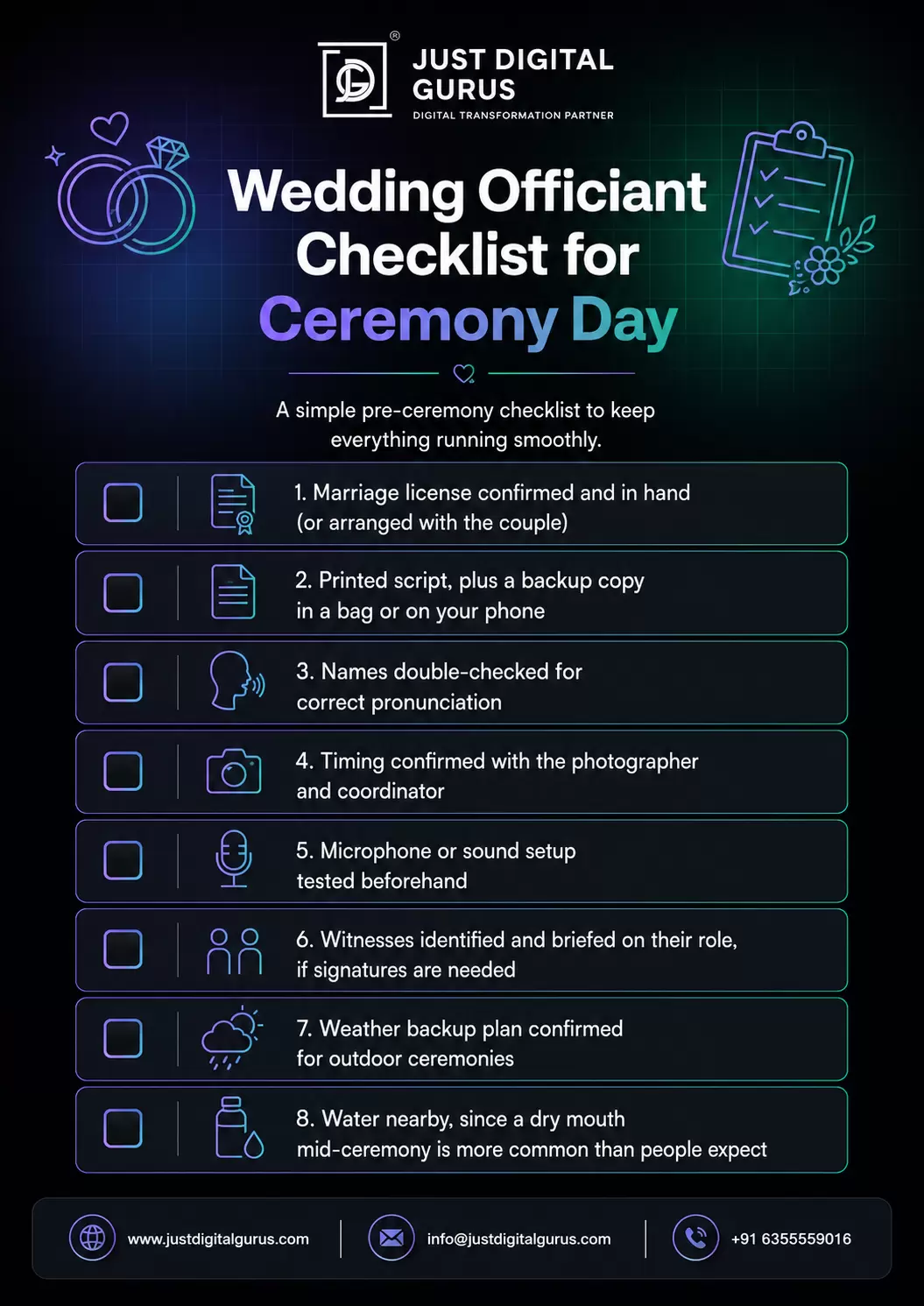
Wedding Officiant Checklist for Ceremony Day
Even a great wedding officiant script can fall apart without solid logistics behind it. Run through this before you step up:
- Marriage license confirmed and in hand (or arranged with the couple)
- Printed script, plus a backup copy in a bag or on your phone
- Names double-checked for correct pronunciation
- Timing confirmed with the photographer and coordinator
- Microphone or sound setup tested beforehand
- Witnesses identified and briefed on their role, if signatures are needed
- Weather backup plan confirmed for outdoor ceremonies
- Water nearby, since a dry mouth mid-ceremony is more common than people expect
Common Wedding Ceremony Script Mistakes to Avoid
A few things trip up even experienced officiants:
Reading in a flat, rushed monotone. Nerves push people to speed up. Slow down more than feels natural. It usually sounds just right to the audience.
Skipping the declaration of intent. It's easy to get swept up in vows and rings and forget this legally necessary moment. Build it into your script every time, no exceptions.
Not confirming pronunciation ahead of time. Mispronouncing a name during the ceremony is one of the most common and most avoidable stumbles.
Ignoring the couple's requested tone. A formal script for a couple who wanted something funny and casual, or the reverse, creates a disconnect guests will notice.
Showing up without a backup copy. Phones die, papers get left in cars, and wind flips pages. Always have a second copy somewhere.
Frequently Asked Questions
What does a wedding officiant say to start the ceremony?
Most officiants open with a welcome to guests, a brief statement about why everyone is gathered, and a short introduction to the couple. The exact wording varies by tone, but the goal is always the same: settle the room and set expectations for what's coming.
How long should a wedding ceremony script be?
Most secular ceremonies run 15 to 30 minutes. Religious ceremonies with a full liturgy can run longer, sometimes 45 minutes or more. Ask the couple for their target length early so you can plan readings and personal remarks accordingly.
Can I write my own wedding officiant vows?
Yes, and many officiants do, especially for non-religious ceremonies. Just make sure the declaration of intent, the legally required exchange, is still included somewhere, since that's the part that technically makes the marriage official.
Do officiants have to say "you may kiss the bride"?
No. That specific phrase is a tradition, not a requirement, and it's increasingly swapped for gender-neutral language like "you may kiss your partner" or "you may kiss each other." Use whatever fits the couple.
What's the legal minimum a wedding ceremony script needs to include?
Requirements vary by state, but at minimum most jurisdictions require a declaration of intent from both partners and a pronouncement of marriage from an authorized officiant. Everything else, from readings to unity rituals, is optional and purely for style.
Conclusion
A great wedding ceremony script does two things at once. It carries the legal weight of the moment, and it makes a room full of people feel something. Whether you're working from a traditional structure, something modern and conversational, or a short and simple version for a small gathering, the goal is the same: sound like yourself, keep the couple at the center, and give the legally required parts the attention they deserve.
If you're building an officiating business alongside your ceremony work, the same principle applies to your online presence.
Couples searching for their officiant are judging you before you ever speak a word, based entirely on your website. Take a look at the full range of services at Just Digital Gurus, or book a call to talk through what a stronger online presence could look like for your officiating business.
Your comment will appear after approval.